Month: September 2020
-
Scrumptious
When it first appeared in English, the word scrumptious meant close-fisted. It owes this original meaning to its derivation from the word scrimp, meaning to be stingy, which in turn derives from a Germanic source meaning to shrivel up. In the mid nineteenth century, this original meaning faded away as scrumptious shifted its application for…
-
Screech
In early twentieth-century Britain, screech referred to an especially harsh whiskey. As one might expect, it was the harshness of screech, or rather the vocalic effect provoked by swallowing it, that gave the liquor its name, but only indirectly: in Scotland, the same whiskey was called screigh, meaning to screech, which was translated directly when…
-

Scone
Although the small round cake of raised dough known as the scone appears to have originated in Scotland, its name is probably Dutch in origin: schoonbrot—compounded from schoon, meaning beautiful or white, and brot, meaning bread—was what the Dutch called a particularly light, fine bread. This name was likely introduced into Scotland and then shortened…
-
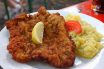
Schnitzel
German tailors, dried apple slices, and veal cutlets have one thing in common: they are all known by names that derive from schneiden, a German verb meaning to cut. From schneiden, German derived its word for tailor: Schneider, literally meaning cutter, a word that also became, in the Middle Ages, a surname for many people…
-
Schnapps
The word schnapps derives from the same source as the word snap: both originate from the Middle Dutch snappen, meaning to snatch at something with the beak (or, if you lack a beak, with the teeth). When English derived snap from snappen in the early sixteenth century, it retained the meaning of the original Middle…
-
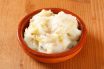
Schmaltz
Although schmaltz originated as a German culinary term, it achieved wide currency in English thanks to American jazz musicians. In German, where it is spelt schmalz, the word refers to animal fat, especially chicken fat rendered so that it may be more easily used in cooking. First borrowed by Yiddish, the word schmalz was brought…
-
Scarf
Scarf the noun has nothing to do with food, but scarf the verb does. Usually found in phrases such as scarf down, the verb means to eat greedily, and first appeared in the United States in 1960. Scarf, however, is simply a variant of an older word, scoff, meaning to eat greedily, which dates back…
-
Savoury
In the Old Testament, eating is used as a metaphor for learning when Adam and Eve taste the fruit of the forbidden tree of knowledge and become aware of alarming new facts—they realize, for example, that they are naked, a condition so distressing that they make themselves clothes. The same association of eating and knowledge…
-

Savory
The minty herb called savory acquired its name not because it makes dishes savoury. The herb’s name, in fact, is not related to the word savoury at all, but rather derives from the Latin satureia, meaning satyr’s herb. This Latin name was bestowed on the herb because satyrs, the mythical beasts who were halfgoat and…
-

Saucisson
The French word saucisse, which entered English as sausage, also gave rise to the word saucisson, which literally means big sausage. Since appearing in English in the late eighteenth century, however, saucisson has developed a perhaps more useful meaning: it now designates a sausage that does not need to be cooked before it is eaten.…