
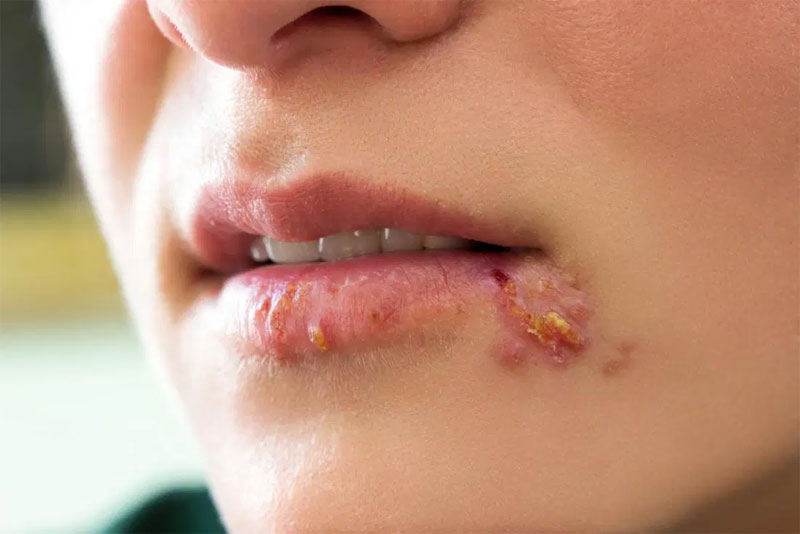
 Herpes can affect both men and women but most of the time there are no symptoms.
A chronic inflammation of the skin or mucous membrane characterized by the development of vesicles on an inflammatory base.
Any inflammatory skin disease caused by a herpesvirus and characterized by the formation of clusters of small vesicles. When used alone, the term may refer to herpes simplex or to herpes zoster.
Inflammation of the skin or mucuous membrane with clusters of deep seated vesicles; a family of viruses that infect humans: herpes simplex causes lip and genital sores; herpes zoster causes shingles.
A small group of capsid-forming DNA viruses, sometimes divided into Type I (forming vesicles and blisters on the mouth, lips-generally above the waist) and Type II (usually sexually transmitted, with symptoms mostly below the waist). Both types form acute initial outbreaks, go dormant, reactivate, and so forth. For most folks, frequent outbreaks are clear signs of stress or immunosuppression. Both types are dangerous for infants.
Skin disease with patches of distinct vesicles.
A skin disorder caused by a virus and characterized by pain and blisters.
A virus infection. There are two types of herpes simplex: a) Herpes simplex type 1 produces commonly known cold sores and fever blisters b) Herpes simplex type.
Inflammation of the skin or mucous membrane, caused by a virus, where small blisters are formed.
Any of a group of viruses that cause painful blisterlike eruptions on the skin.
Inflammation of the skin caused by viruses and characterized by collections of small blisters. There are two nonvenereal types. Herpes simplex (cold sore) can cause an acute conjunctivitis or inflammation of the mouth or vagina, but many people contract the virus without showing any symptoms. The disease may recur. Herpes zoster {shingles) usually starts with pain along the distribution of a nerve (often in the face, chest, or abdomen), followed by the development of vesicles. The disease subsides in about three weeks, though sometimes severe pain may persist for many months in the area of the affected nerve. The virus that causes herpes zoster can also cause chickenpox in children.
Vesicular eruption caused by a virus, especially herpes simplex or herpes zoster.
Sexually transmitted disease caused by a viral infection (herpes simplex virus types I and II). The disease is characterized by the appearance of sores on the mouth, genitals, rectum, or other parts of the body. There is no known cure, but treatments exist to help control symptoms.
The realm of viral entities encompasses a familial lineage encompassing herpes simplex types 1 and 2, alongside herpes zoster, colloquially referred to as varicella zoster. These herpes viruses, being the instigators of a plethora of afflictions, bestow upon their hosts an array of distressing symptoms, predominantly manifesting as vesicles and lesions. The ailments inflicted by these viral agents span a wide spectrum, encompassing conditions such as chickenpox, shingles, genital herpes, as well as cold sores or fever blisters.
Various conditions, typically marked by the outbreak of tiny, often painful, skin blisters, are generally categorized under the term “herpes”. This term is predominantly used to indicate an infection caused by the herpes simplex virus. Two types of this virus, namely HSV1 and HSV2, are usually associated with cold sores and genital herpes, respectively.
An organism that is closely related, known as the varicella-zoster virus, is responsible for two additional conditions characterized by the presence of skin blisters: chickenpox and herpes zoster, also known as shingles.
A skin condition typically triggered by a viral infection, marked by severe discomfort and clusters of blisters on the skin. Herpes encompasses numerous types, but when mentioned alone, it typically refers to herpes simplex.