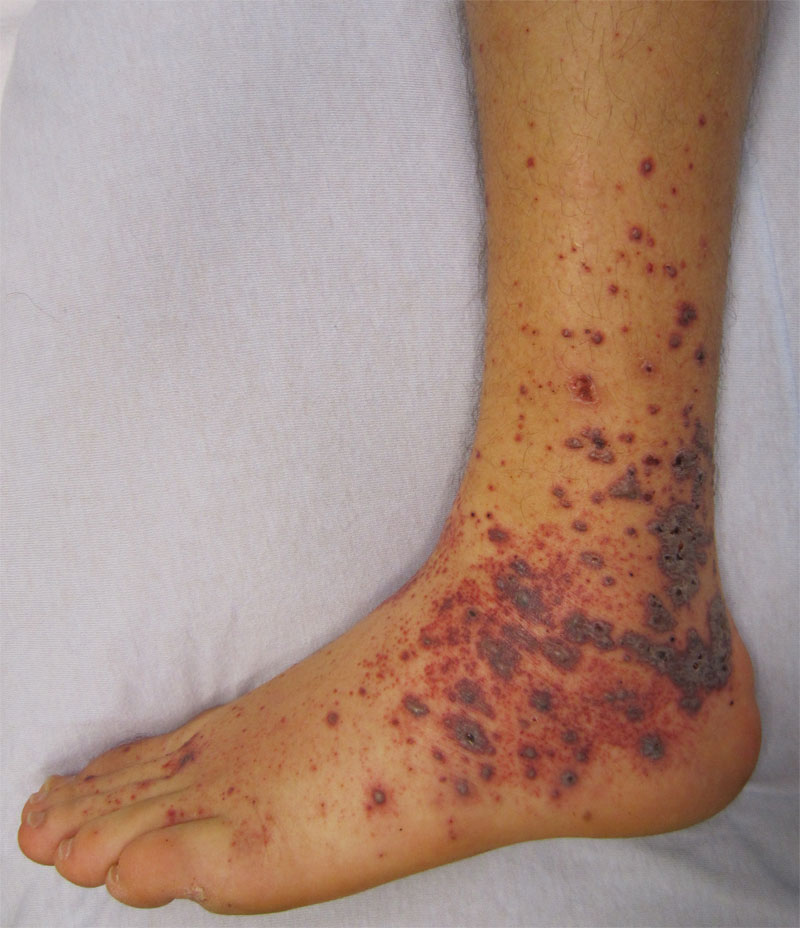
 Hemorrhage into the tissues with resultant large discoloration (greater than 2 mm in diameter) that does not blanch on pressure. Initial discoloration is red/purple, but later it becomes brown‐yellow as it fades away.
Is the appearance of red or purple discolorations on the skin that do not blanch on applying pressure. Also called peliosis.
A red-purple discoloration of the skin caused by multiple minute hemorrhages in the skin or mucous membrane.
A blood disease characterized by a marked tendency to bleed.
A purple colouring on the skin, similar to a bruise, caused by blood disease and not by trauma.
Any of several disorders in which the escape of blood into tissues below the skin causes reddish or purplish spots (petechiae); it may be due to a defect in capillaries caused by such agents as bacteria or drugs (nonthrombocytopenic purpura), or to a deficiency of platelets, due to such factors as drug reactions or infections or toxic disorders (thrombocytopenic purpura). Topically, petechiae are smaller while purpuric lesions are larger and blotchier in nature.
Purple-colored, visible leakage of red blood cells into the subcutaneous tissue or mucous membranes; caused by a variety of mechanisms (trauma, clotting disorders, allergy).
Red, black and blue, or purple hemorrhages due to leakage of blood into the skin. Purpura is common in older people (especially on the arms and legs) because skin grows thinner with age and the loss of fat and connective tissue around blood vessels makes the blood vessels more susceptible to injury. Older people who sunbathe are more likely to develop purpura because their skin has been weakened by sun damage. There are also vascular causes of purpura, such as drug induced inflammation of blood vessel walls. Medications such as aspirin and warfarin make people more susceptible to bruising and purpura.
A skin rash resulting from bleeding into the skin from small blood vessels (capillaries); the individual purple spots of the rash are called petechiae. Purpura may be due either to defects in the capillaries {nonthrombocytopenic purpura) or to a deficiency of blood platelets (thrombocytopenic purpura). Acute idiopathic thrombocytopenic purpura is a disease of children in which antibodies are produced that destroy the patient’s platelets. The child usually recovers without treatment.
A skin rash caused by bleeding into the skin from capillary blood vessels. The discrete purple spots of the rash are called purpuric spots or, if very small, petechiae. The disorder may be caused by capillary defects (non-thrombocytopenic purpura) or be due to a deficiency of platelets in the blood (thrombocytopenic purpura). It can also result from the effects of a fulminant form of meningococcal septicaemia called purpura fulminans.
Any rash in which blood cells leak into the skin or mucous membranes, usually at multiple sites. Purpuric rashes often are associated with disorders of coagulation or thrombosis. Pinpoint purpuric lesions are called petechiae; larger hemorrhages into the skin are called ecchymoses.
A pigmentation alteration characterized by the appearance of purplish or brownish-red patches on the skin, resulting from bleeding originating from damaged capillaries.
Purpura refers to a collection of conditions marked by purple to red-brown patches on the skin, resulting from internal bleeding in the skin or mucous membranes. The term “purpura” also pertains to these discolored patches, which do not fade when pressure is exerted on the skin.
Purpura manifests in various types and origins. Commonly known as senile purpura, it predominantly affects middle-aged to elderly women. Pronounced discolored patches emerge on the thighs or the back of hands and forearms due to thinning of the tissues supporting blood vessels beneath the skin. Another form, Henoch-Schönlein purpura, arises from inflammation of superficial blood vessels. Purpura can also be linked to thrombocytopenia, a bleeding disorder. Furthermore, it might accompany conditions like septicemia (blood poisoning) and be observed in cases of meningitis (inflammation of the brain and spinal cord membranes).
A condition characterized by the occurrence of spontaneous hemorrhages in the skin, mucous membranes, serous membranes, and other areas. These hemorrhages can happen without an apparent cause, from minor injuries, or as a result of a blood disorder or disease. They may vary in size, from tiny dots to large patches, and individuals often notice this condition when they mention a tendency to bruise easily.