
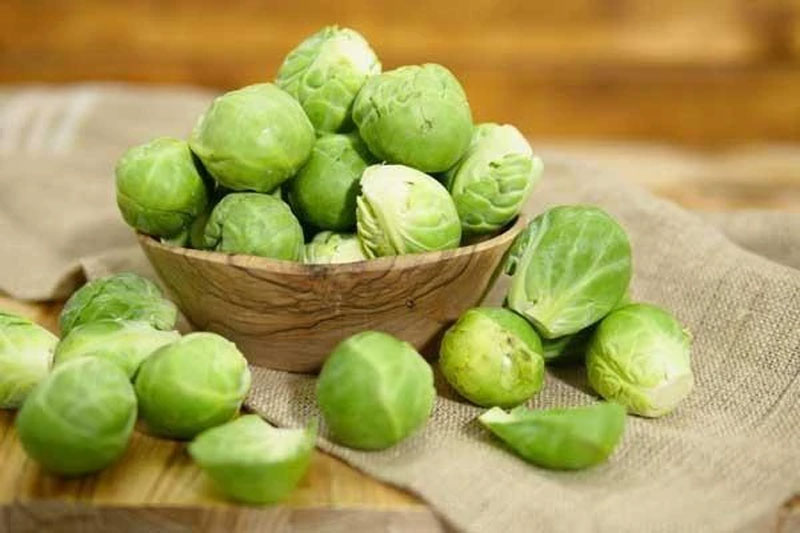
 Brussels sprouts are small cabbages that actually belong to the mustard family. They take their name from Brussels, Belgium; where horticulruralists first developed them in the fourteenth century. The vegetable itself was not imported to England until the mid nineteenth century, but fifty years earlier it had been referred to by name in English gardening books. The city of Brussels derived its name in the sixth century from the Germanic broca sali, meaning marsh building, an apt name considering that the city originated as a fortress built upon a low-lying island. The other half of the Brussels sprout’s name, sprout, derives from a Germanic source that also gave rise to the words spurt (as in, “The ketchup spurted onto my shirt”), sprit (as in bowsprit, the shaft that “sprouts” from the bow of a ship) and spritzer (a drink of wine and soda water whose name was adopted from German in the 1960s).
Brussels sprouts, a cruciferous vegetable, belong to the same family as cabbage. Optimal consumption of this vegetable occurs during their youth, when they are small, circular, and have a hard texture comparable to a walnut. As winter, a season during which other green vegetables are scarce, approaches, the availability of Brussels sprouts increases, making it an advantageous vegetable to consume. Furthermore, this vegetable contains a considerable amount of vitamin C, which provides several health benefits.