
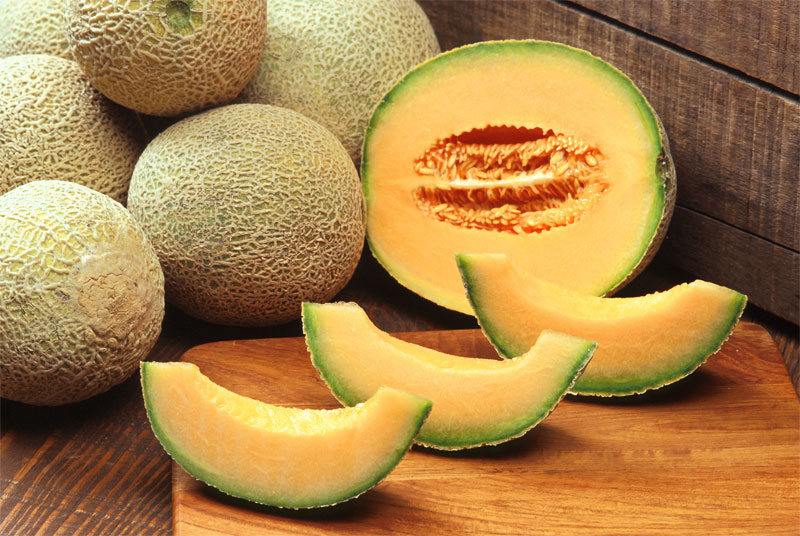
 The two common names for this orange-fleshed melon, cantaloupe and musk melon, derive respectively from the most divine and most earthly of sources. When introduced to Italy from Armenia in the seventeenth century this fruit was cultivated at the Pope’s country villa, a place near Rome called Cantalupo to which His Holiness would occasionally withdraw. Accordingly, when the French started importing this melon from Italy they called it cantaloup, a name that English borrowed in the early eighteenth century. The melon’s other common name, musk melon, appeared in the mid sixteenth century, and originally belonged to another variety of melon with a very musky scent; the word was then transferred by mistake to the much less musky melon that currently has its name. The earthy origin of musk melon lies in musk, which evolved—through French, Latin, Greek, and Persian—from the Sanskrit word muska, meaning scrotum; the ancient people of India, where Sanskrit was spoken, evidently perceived a resemblance between the musk-producing gland of certain animals and the typical scrotum. The history of musk does not end there, however: the Sanskrit word for scrotum—muska—derived in turn from an older word, mus, meaning mouse; once again, the ancient people of India perceived a resemblance, this time between a scrotum and a mouse, and thus they gave that part of the male body a name that literally means little mouse. You therefore have a choice in considering the musk melon a little mouse melon or a scrotum melon. Muscatel (a French wine), moscato (an Italian wine), and muskrat (a Canadian rodent) derive from the same musky source as musk melon.
A spherical muskmelon endowed with a skin that is interwoven or veined, characterized by a greenish-yellow hue. The flesh possesses a delectable texture that ranges from soft to slightly firm, showcasing a delightful orange hue that is pleasantly perfumed and juicy.