Category: B
-
Baculate
(Of pollen) covered in stick-shaped rods.
-
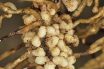
Bacterial nodules
(Of leaves) dark inclusions formed of bacteria (e.g. in Pavetta and some Psychotria (Rubiaceae)); also perhaps in the petals and calyx of some flowers.
-
Back-crossing
Hybrids crossing with one of the parents; the result of such a union is a backcross. In genetics, the crossing of a hybrid with one of its parents or with a genetically equivalent organism.
-
Back bulbs
Old orchid plant modules separated and used for propagation.
-

Baccate
Berry-like.
-

Bacca
(Berry) succulent fruit with seeds immersed in the pulp.
-
Bacteria
Microscopic organisms, usually one-celled. Some kinds of bacteria cause dead animals to decay. Unicellular prokaryotic microorganisms which generally possess rigid cell walls, multiply by cell division, and exhibit three principal forms: round or coccal, rodlike or bacillary, and spiral or spirochetal. Unicellular microorganisms, ranging from 0.5 to 5 pm in size. They may be classified…
-
Blood
This word carries a different meaning in the context of Chinese medicine than it does in standard English, often being capitalized. In TCM, blood is defined as a red liquid circulating inside the blood vessels that is a vital substance of the human body. The functions attributed to blood are nourishing and moistening the body’s…
-
Bi syndrome
Bi literally means “obstruction” in Chinese. Bi syndrome refers to a variety of conditions in which there is a painful obstruction to the normal flow of Qi and Blood. In general, Qi stagnation is less severe, and Blood stagnation is more severe. Bi syndrome can be caused by an external invasion of wind, cold, or…
-
Beng Lou
A group of disorders that would be classified as dysfunctional uterine bleeding in Western medicine. Beng Lou refers to uterine bleeding that does not happen during the normal time in the menstrual cycle. Beng means excessively heavy uterine bleeding, while Lou means continuous spotting that does happen during the normal time in the menstrual cycle.…