Category: H
-
Hapten
A relatively small, lipophilic, nonprotein molecule that is able to elicit an immune response (contact or delayed hypersensitivity) only when bound to a carrier protein. Any chemical, drug, or its metabolite that combines with tissue protein to form a complete antigen; most allergenic drugs are haptens. A small molecule that can elicit an immune response…
-
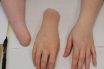
Hand prosthesis
Artificial substitute for a human hand.
-
Handpiece motion tracker
An array of active emitters or passive reflectors that are attached to a surgical instrument to enable their localization within the operative field by an overhead detector.
-
Hanau Quint
Five factors involved in developing a balanced articulation for removable complete dentures: incisal guidance, condylar guidance, cusp height, plane of occlusion, and compensating curve. First described by Rudolph Hanau in 1926 and incorporated in the design of a semi‐adjustable articulator (Hanau H) that provided for horizontal condylar guidance to be set using an intraoral protrusive…
-

Halitosis
Malodorous breath often offensive to others. Halitosis results from a variety of causes, such as bacteria on the tongue, periodontal disease, poor oral hygiene, systemic disorders, and consumption of some food types. Also known as fetor ex ore, fetor oris, and stomatodysodia. (Bad breath) a common condition caused by sulfur-producing bacteria that live within the…
-
Half‐life (drug)
The amount of time for plasma concentration of a drug to be reduced by 50%.
-
Hairy leukoplakia
A corrugated, white plaque of the oral mucosa, primarily on the lateral borders of the tongue, that contains the Epstein–Barr virus. Most patients with confirmed hairy leukoplakia are infected with the human immunodeficiency virus (HIV). Whitish spots that may occur in the mouth of HIV-infected persons.
-
Haemophilus
Genus of gram‐negative, nonmotile, microaerophilic, pleomorphic bacilli and coccobacilli. A genus of acteria which needs specific factors in the blood to grow. Genus within the bacteriological family of the Brucellaceae, consisting of small aerobic non-motile and non-sporing Gram-negative bacilli, most frequently of respiratory tract origin. Growth requires accessory factors contained in blood, and known as…
-
Hader bar
A rigid bar that connects two or more abutments designed for the retention of a restoration(s). The removable restoration contains housings that are machined to clip over the bar.
-
Habit
An act that has become a repeated performance, almost automatic, such as bruxism or tongue thrusting. General appearance of vegetation (e.g. erect or sprawling, herbaceous or woody). General appearance of a plant, especially the vegetative aspects. The complete picture of the way a plant grows; a species may be described as being of “compact,” “weeping”…