Category: I
-
Immunostimulatory
The ability to stimulate the immune response.
-
Isinglass
The next time you are about to throw out all your old sturgeon bladders, resist the temptation. Instead, peel the outer skin from each bladder and wash what is left in cold water. Next, remove the bladder’s inner skin and squish it with a bowling ball until it becomes a nearly-clear ribbon. You can then…
-
Irrorateur
If the stench wafting from a malodorous guest makes it difficult to appreciate the subtle fragrance of your almond chicken, you might address the problem by whipping out your irrorateur and discharging it over the dinner table. This culinary accoutrement, a kind of perfume-filled spray gun, was invented by an eighteenth-century gastronome, Jean-Anthelme Brillat-Savarin. The…
-
Invitation
After spending all of May traipsing from one friend’s wedding to another, you might be unwilling to attend the vernal equinox party being hosted by your sister-in-law’s accountant. Your frantic search for an excuse to decline the invitation—” I’m having my hedgehog spayed”—would not surprise an ancient Roman, whose word for an invitation—invitatio—bears a striking…
-
Infare cake
Today, most brides and grooms cut their wedding cake in full view of their friends and family, and then slip away to cross the threshold of their new home—or hotel room—in private. Long ago in England, however, these two events were one and the same, as wedding guests crumbled infare cake over the head of…
-
Impanation
Impanation is the Christian doctrine that the bread consecrated and eaten during communion actually becomes, or at least unites with, the body of Christ. The term is a compound formed from the Latin prefix in, meaning in, and the Latin panis, meaning bread, and was adopted from Medieval Latin in the middle of the sixteenth…
-
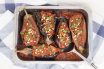
Imam bayildi
According to Turkish legend, this dish of eggplants stuffed with onions and tomatoes is so tasty that when it was served to a Muslim priest, he fainted from gastronomic delight. Thenceforth, the dish was known as imam bayildi, meaning the priest fainted, a dish first referred to in English in 1935. Further back in history,…
-
Isozymes (isoenzymes)
Multiple forms of an enzyme that differ from each other in their substrate (substance acted upon) affinity, in their maximum activity, or in their regulatory properties. Enzymes that have slightly different chemical structures, but produce the same result, as the enzymes they resemble.
-
Isoprene
The five-carbon hydrocarbon molecule: 2-methyl-l,3 butadiene. It is a recurring structural unit of the terpenoid molecules, which are either linear or cyclic. There exists a very large number of terpenes and many are major components of essential plant oils. A five-carbon unit used in the synthesis of sterols. A volatile hydrocarbon produced naturally by plants…
-
Isomerase
An enzyme-catalyzing transformation of a compound into its positional isomer. Any one of a group of enzymes that catalyze the conversion of one isomer of a compound into another. Any enzyme that catalyzes the isomerization of its substrate. For example, phosphoglucose isomerase interconverts glucose and fructose-6-phosphate.