Category: N
-
Nym
If you glance through a fourteenth-century cookbook, you will see many strange words, but one will appear more than almost any other. That word is nym, meaning take, and it was used in Middle English sentences like this—”Nym a pond of ris, seth hem fort it berste”—a sentence that actually means this—”Take a pound of…
-
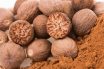
Nutmeg
When the word nutmeg entered English at the end of the fourteenth century, about the time that Chaucer was writing The Canterbury Tales, it was spelt notemugge. The medieval form of this spice’s name had been derived from the French nois muguede, which had in turn developed from, the Late Latin nuce muscata, meaning musky…
-
Nosh
The word nosh and the word snoop originally denoted the same thing: the act of eating something in secret. Both words derive from Germanic sources: the German naschen, meaning to eat surreptitiously, is the source of the Yiddish nosh, which English adopted in the 1960s; the Dutch snoepen, meaning to appropriate and consume dainties in…
-
Noon
In the working world, the established time for lunch is noon, currently fixed at twelve o’clock but formerly the ninth hour of the day, the ninth hour being three o’clock in the afternoon. The convoluted history of noon extends back two thousand years to when the ancient Romans reckoned the hours of the day not…
-
Nipperkin
If any category of words is especially prone to extinction, it is those relating to measures. Words that relate to things, like sky or egg, tend to persist because the things themselves usually continue to exist; likewise, words that relate to ideas, like freedom or evil, persist because people continue to debate them. Measures, however—whether…
-

Nectarine
Nectarines are essentially a kind of peach—in fact, nectarines can develop from peach seeds just as peaches can develop from nectarine seeds. The two fruits are so similar that botanists do not know which one originated first. Despite these botanical affinities, however, the word nectarine is a much more recent addition to English than the…
-
Nutrient-enhance
A phrase that is now a trademark of ICI Seeds Inc. (Garst Seed Co.); it refers to plants that have been modified to possess novel traits which make those plants more economically valuable for nutritional uses (e.g., higher than normal protein content in feedgrains).
-
Nucleosome
Spherical particles composed of a special class of basic proteins in combination with DNA. The particles are approximately 12.5 mm in diameter and are connected to each other by DNA filaments. Under the electron microscope they appear somewhat like a string of pearls. The structural subunit of chromatin, consisting of -200 bp of DNA and…
-
Nucleoside diphosphate sugar
A coenzyme-like carrier of a sugar molecule functioning in the enzymatic synthesis of polysaccharides and sugar derivatives.
-
Nucleophilic group
An electron-rich group with a strong tendency to donate electrons to an electron-deficient nucleus.