Category: P
-
Pseudodichotomy
Where regular sympodial branching takes place but with the apical meristem regularly aborted or forming a temporary structure such as an inflorescence.
-
Pseudocopulation
(Of orchids) a special type of mimicry in which the flowers resemble female insects (e.g. Ophrys) and are pollinated by males of that insect species when these attempt to copulate with the flowers. The act of an insect attempting to mate with a specialised flower that resembles a member of the opposite sex and thereby…
-
Pseudocephalium
(In Cactaceae) dense mass of hair at the stem apex; (In Compositae/Asteraceae) aggregations of capitula into a secondary head of heads [unusual term].
-
Pseudocarpy
False dichotomy, not resulting from division of an apical meristem.
-
Pseudocapsule
Dry dehiscent fruit which, on opening, discloses not seeds but single-seeded nutlets (e.g. in Boswellia (Burseraceae)).
-
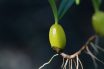
Pseudobulb
(Of a storage organ) resembling, but not homologous to, a bulb; A swollen internode or couple of internodes (e.g. in Orchidaceae). The fleshy, bulb-like stem found on many orchids.
-
Pseudobilabiate florets
Florets in the Compositae/Asteraceae whose corollas possess a single adaxial lobe and an outer 4-lobed limb (e.g. in the subfamily Barnadesioideae).
-
Pseudoaxillary
(Of inflorescences) initiated in a terminal position but placed axillary by the continued development of lateral relay axes or meristems (e.g. as in Hydnophytum (Rubiaceae)).
-
Pseudo-
Seemingly; for example, pseudo-axillary means seemingly (but not really) axillary; A prefix denoting a resemblance to another state or organ.
-
Pseudaril
Resembling an aril but attached to an endocarp (which encloses the seed) not to the seed (e.g. in Commiphora (Burseraceae)).