Category: P
-
Passive
Latent, not active, inert. Resistant to corrosion. Receiving rather than initiating an action. Not active, not initiated by the self (e.g., passive movement, movement of body parts by a therapist or other agent, not by the efforts of the person). Holding back one’s feelings and yielding to others.
-
Passivation
A process by which metals and alloys are made more resistant to corrosion through treatment to produce a thin and stable oxide layer on the external surfaces. The stabilization and protection of a surface from outside influences, e.g., the treatment of an atherosclerotic plaque to keep it from rupturing or of a metal to keep…
-
Passivated surface oxide
Surface treatment of an oxidized implant surface resulting in lower surface energy and increased corrosion resistance. This may be the result of intentional treatment of the surface by the manufacturer or simply exposure to air over time.
-
Pass principle
A principle that promotes a successful regenerative procedure (originally used for guided bone regeneration, but has recently been expanded to include guided tissue regeneration as well).
-
Parulis
A drainage tract seen in attached and/or mucosal gingiva that is associated with an oral abscess of odontogenic origin. Commonly known as a gum boil. A pus-filled swelling under the membrane of a tooth socket, also known as a gumboil.
-
Particulate marrow cancellous bone (PMCB)
Graft material obtained from donor sites, such as the iliac crest, with extensive marrow content. PMCB of an autogenous nature is the most osteogenic graft material; the number of multipotential stems cells is especially high.
-
Particulate graft
Graft used in particulate form, which may be an autograft, allograft, alloplast, or xenograft. Particulate grafts differ concerning osteogenic potential, osteoconductivity, hydrophilicity, pore and particle size, and substitution rate.
-
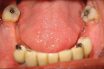
Partially edentulous
State of being without one or more, but not all, of the natural teeth.
-
Partial veneer crown
A nonspecific term that does not distinguish between the partial-coverage crown restoration of the tooth and the partial veneering of an artificial crown.
-
Partial‐thickness flap (syn)
Split‐thickness flap. A flap resulting from the elevation of epithelium and some connective tissue but not the periosteum, which is left on the bone.