Category: R
-
Rachilla, rhachilla
(In Gramineae/Poaceae) axis of spikelet; The ultimate flower-bearing axis of an inflorescence (specialist term used in Palmae) [not recommended].
-
Rachides
Plural of rachis.
-
Racemule
In a compound raceme or umbellate inflorescence, a second-order raceme.
-
Racemose
In the form of a raceme, resembling a raceme. In anatomy, shaped like a cluster of grapes. Referring to glands which look like a bunch of grapes. Resembling a cluster of grapes (e.g., certain glands consisting of a number of small sacs). Resembling a bunch of grapes. The term is applied particularly to a compound…
-
Racemiform
In the form or shape of a raceme.
-

Raceme
A monopodial inflorescence in which the flowers are borne on pedicels along a central axis, with the terminal flowers being the youngest and last to open. There are many different types of racemes; the spike and the spadix are racemes in which the flowers are sessile. A more or less elongate inflorescence with pedicellate flowers…
-
Race
A strain of a species with certain characters fixed genetically; Used more loosely to mean a form with certain characters. A population within a species which exhibits general similarities within itself, but is both discontinuous and distinct from other populations of that species, though not sufficiently so as to achieve the status of a taxon.…
-
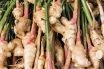
Rhizome
An underground stem that usually grows horizontally and looks like a root. Underground stem, distinguished from root by its nodes, buds or scale-like leaves. A creeping underground stem. A creeping stem, usually below ground, consisting of a series of nodes and internodes with adventitious roots. Creeping, often fleshy underground stem from which new plants may…
-
Ren (meridian)
One of the Eight Extra Meridians. Ren acts as a “general” of all the Yin meridians, and controls conception and nourishment of the fetus for women. An imaginary line encircling a globular body at right angles to its equator and passing through the poles, or half of such a line.
-
Rasa
The Ayurvedic term for taste. The six tastes are sweet (madhura), sour (amla), salty (lavana), bitter (tikta), pungent (katu), and astringent (kashaya). The taste of a substance. The six tastes of sweet, sour, salty, pungent, bitter and astringent are used in Ayurveda to classify the quality of foods and herbs. Also used to mean the…