Category: S
-
Swallowed caustics poisoning
Consumption of strong cleansers containing acidic or alkaline substances that cause tissue damage. Swallowed caustic poisoning, or caustic ingestion, can occur when children drink strong household cleansers containing substances such as lye. Signs of caustic ingestion include burns or swelling of the lips or tongue, drooling, and breathing problems, although many children with caustic burns…
-
Shortening of leg
A discrepancy in leg length, generally caused by a disease or fracture that interferes with normal bone growth during childhood. Possible causes include poliomyelitis or a fracture that crossed the long bone’s growing end in the thighbone or shinbone of one leg during childhood. If the shinbone (tibia) is affected, the shortening of the leg…
-
Snapping hip
A chronic and painful condition caused by the abnormal movement of a tendon involved in the hip joint. This tendon attaches the hip bones and is responsible for the movement of the hip joint, which allows the leg to flex forward. As a result of the irregular motion of the tendon when the hip joint…
-
Seafood food poisoning
Poisoning caused by eating fish or shellfish that have been inadequately preserved. Several types of seafood poisoning have been identified. Ciguatera, for instance, is a type of food poisoning found in tropical waters in which large fish over 6 pounds eaten by vacationers and other recreational fishermen have fed on small fish that in turn…
-
Surgical drain
A device inserted during surgery to draw fluid from an internal body cavity to the surface. A surgical drain is used to prevent fluid from accumulating inside the body during an operation. A surgical drain can ensure that any fluid formed during the procedure will immediately pass to the surface and prevent infection or a…
-
Scientific analysis
Determination of the identity of a substance or of the constituent parts of a compound. Qualitative analysis is the identification of the elements present in a substance; quantitative analysis is the determination of the amount or concentration of each element in a substance.
-
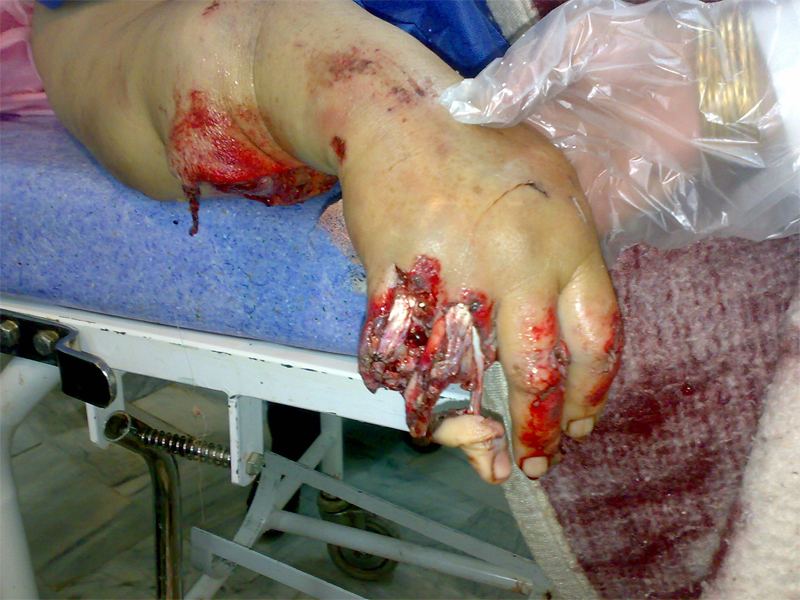
Surgical amputation
Surgical removal of a limb or appendage, such as a finger, hand, arm, toe, or leg. An amputation is necessary when a limb is irretrievably damaged in an accident or irreversibly infected by bacteria or when its blood supply is disrupted by diabetes, severe artery disease, frostbite, or gangrene (death of tissue).
-
Systematic heating
Elevation of the temperature of the whole body.
-
Standard air chamber
A radiation-measuring device used by national and international calibration laboratories to provide exposure calibrations of ion chambers for use in the diagnostic or orthovoltage energy range. Secondary ion chambers are intercompared with a standard chamber to provide a calibration factor for the field instrument, which will make its readings traceable to the standardization lab.
-
Spin
The intrinsic angular momentum of an elementary particle or of a nucleus.