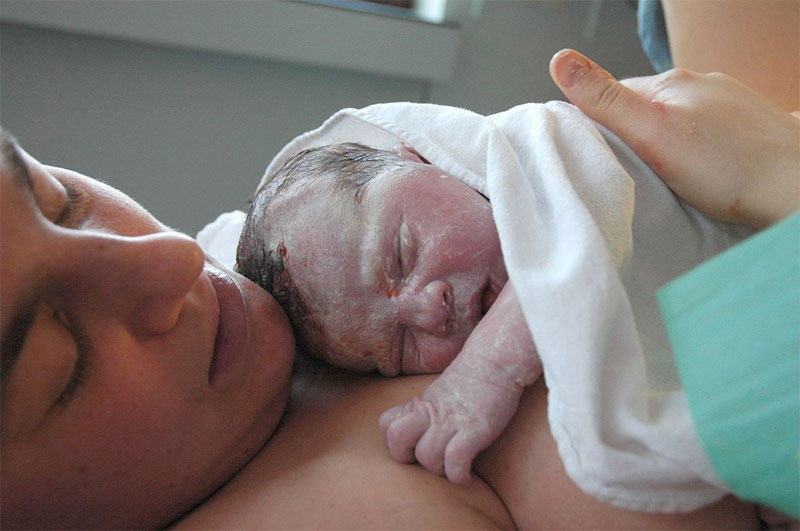
 The act of giving birth.
The whole process of a baby’s emergence from the uterus into independent life, which culminates nine months of pregnancy in the intense activity of labor and delivery. For most of history, a woman was attended at childbirth by a midwife. Only in the last few centuries were men even allowed in the rooms where labor and delivery took place. But with the rise of modern medicine, obstetrician/gynecologists became the main health-care providers for women giving birth, and by the mid-20th century most births, especially in the United States, took place in hospitals, which came to routinely use anesthesia and painkillers (analgesics) and various kinds of medical technology and techniques, such as fetal monitoring, forceps delivery, vacuum extraction, episiotomy, and CESAREAN section. Each of these came as great advances in their day, freeing women from the great pain of childbirth and providing life- and health-saving alternatives in cases of difficult deliveries.
The process of giving birth to a child, involving the three stages of labor. Usually, babies are delivered with the help of a medical caregiver. Some women cannot deliver their babies by vaginal delivery and must have them by cesarean section (C-section), a surgical procedure in a hospital in which the baby is born through an incision in the abdomen.
The event you are referring to is called childbirth or delivery. It is the process in which a baby transitions from the mother’s uterus (womb) to the outside world. This natural process, also known as labor, typically occurs between 38 and 42 weeks of pregnancy, calculated from the mother’s last menstrual period. During childbirth, the mother experiences contractions as the cervix dilates and the baby moves through the birth canal, eventually being born. It is an awe-inspiring and significant event that marks the beginning of a new life.
Childbirth typically poses minimal complications for the majority of women who receive optimal medical care throughout their pregnancy and delivery. The advancement of specialized apparatus and the accessibility of blood transfusions and antibiotic medications have significantly enhanced the safety of childbirth for both the mother and the infant. Nevertheless, in underdeveloped nations, there persists a distressingly high mortality rate among women due to childbirth-related causes.
Pinpointing the exact onset of labor can often be a challenging task. As the final trimester of pregnancy unfolds, the uterus initiates contractions as part of its preparatory measures for childbirth. These contractions, known as Braxton Hicks’ contractions, can sometimes be misconstrued as the initiation of labor. However, when these contractions intensify in pain, occur more frequently, and follow shorter intervals, it is a strong indication that labor has likely commenced.
During the initiation of labor, notable changes take place within the cervix, also known as the uterine neck. It undergoes a process of thinning and softening, followed by gradual dilation in response to contractions. At this stage, a phenomenon referred to as a “show” may occur, characterized by the expulsion of the mucous plug that previously obstructed the cervical canal during pregnancy. This expulsion manifests as a discharge tinged with blood. Additionally, the “breaking of the waters” can transpire, signifying the rupture of the amniotic sac—a protective, fluid-filled membranous bag that envelops the fetus within the uterus. This event can manifest either as a gradual trickle of fluid from the vagina or as a sudden, forceful gush.
The initial phase of childbirth encompasses the time span from the commencement of labor until the woman’s cervix has achieved complete dilation, which occurs when the opening has expanded to approximately 10 cm in diameter. The duration of this stage fluctuates both among individuals and across different birthing experiences.
The second stage of labor commences after the complete dilation of the cervix and extends until the baby is delivered. During this phase, the mother experiences a strong urge to push in synchrony with forceful contractions. As the baby’s head descends into the mother’s vaginal canal, it undergoes a rotation to face the mother’s back. Once the baby’s head is successfully delivered, the remainder of the body follows suit with subsequent contractions. Following the birth, the umbilical cord, which connects the baby to the placenta, is clamped and severed.
During the third stage of labor, the expulsion of the placenta, also known as the afterbirth, occurs. This pivotal moment typically transpires within approximately ten minutes following the birth of the baby.
Pain management options are accessible to alleviate discomfort during regular labor and delivery. These options encompass diverse forms such as opioid analgesic drugs, epidural anesthesia, and pudendal block.