 Highest part of an object, such as with the normally exposed part of a natural tooth covered by enamel, or an artificial restoration replacing part or all of the coronal portion of a tooth or implant abutment for esthetic and functional purposes.
To place on the head, as to place a crown on a tooth, dental implant or tooth substitute. Usage: implies fabrication of a restoration for a tooth on a natural tooth, dental implant and/or dental implant abutment.
In trees, the cluster of branches and leaves borne at the top of the trunk, or the shape formed by the uppermost and outermost leaves;
(In cycads) the apex of the trunk or stem, usually covered with protective bracts [not recommended];
The part of the stem at the surface of the ground.
The region of a plant where the root and shoot join; the branching part of a tree.
The top branches, twigs, and leaves of a tree.
The more or less permanent base of a herbaceous plant from which the leaves and flower stems grow upwards and the roots downwards; the upper part of a tree, consisting of the branches and top section of the trunk; the corona of a narcissus or narcissus-like plant.
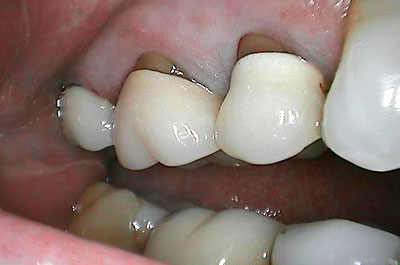
An artificial “cap” to replace the natural crown of a tooth, the enamel-coated part above the gum. Crowns are used when a tooth’s natural crown has been damaged beyond repair but also for cosmetic reasons, as when a tooth turns grayish after root canal therapy. Crowns in the front of the mouth are normally made of porcelain or other materials that can be matched in shade to the surrounding natural teeth; crowns on the grinding teeth—bicuspids and especially molars—are made of an alloy of gold or other metal, or at least have metal on the upper surface, for strength. In recent decades, dentists have developed several alternatives for cosmetic use when the crown of the tooth is intact.
A prosthetic restoration that reproduces the entire surface anatomy of the visible natural crown of a tooth. It may be partial (covering three or more surfaces of a tooth) or complete (covering all surfaces). It is made of gold or other metal, porcelain, or resin.
The part of a plant at or just below soil level where the shoots join the roots.
The more or less permanent base of a perennial plant from which the leaves and flower stems grow upwards and the roots downwards; the upper part of a tree, consisting of the foliage and its supporting branches; the collective fronds of a palm, tree fern or cycad.
The top or highest part of an organ, tooth, or other structure, as the top of the head; the corona.
Area of the head between the apex and back of the parietal ridge.
The upper portion of a tooth, which is safeguarded by enamel, is referred to as the crown. Additionally, a dental restoration known as a protective shell can be placed over a tooth, serving as a crown.
The term for the uppermost region of the cranium. This designation is also applied to the discernible section of a dental structure.