Mindblown: a blog about philosophy.
-
Barbiturate dependence
Being dependent on regularly taking barbiturate tablets.
-
Barbiturate abuse
Repeated addictive use of barbiturates which in the end affects the brain. Barbiturates are depressant drugs that were initially designed to induce sleep and relieve anxiety or tension by slowing down the central nervous system. The sedative affect is much the same as alcohol’s and normally lasts for 3-6 hours at a time (Information on…
-
Barbados leg
A form of elephantiasis, a large swelling of the leg due to a Filaria worm.
-
Banti’s disease
Same as splenic anaemia [Described 1882. After Guido Banti (1852-1925), Florentine pathologist and physician.]
-
Bankart’s operation
An operation to repair a recurrent dislocation of the shoulder [First performed 1923. After Arthur Sydney Blundell Bankart (1879-1951), first orthopaedic surgeon at the Middlesex Hospital, London, UK.]
-
Bank
A place where blood or organs from donors can be stored until needed. In medicine, storage of human materials for later use, usually by other persons (e.g., blood bank, eye bank, sperm bank). A stored supply of body fluids or tissues for use in another individual (e.g., blood bank, eye bank, kidney bank, tissue bank).…
-
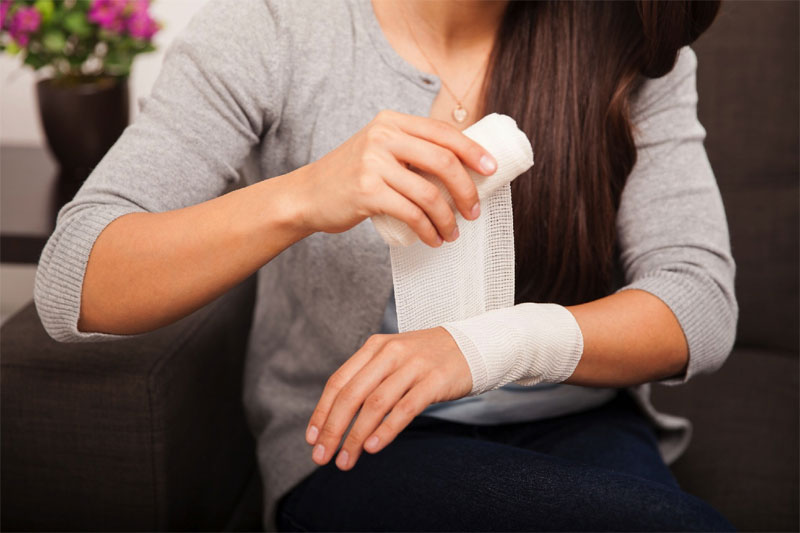
Bandage
A piece of cloth which is wrapped around a wound or an injured limb. Piece of soft material that protects an injured part of the body; wrap around with something so as to cover or enclose. There are numerous types of bandages. Typically the wound is covered first by a dressing, which is held in…
-
Balneotherapy
The treatment of diseases by bathing in hot water or water containing beneficial natural chemicals. Use of baths to treat disease, especially to relieve pain and improve circulation. The treatment of disease by bathing, usually in the mineral-containing waters of hot springs. The once fashionable ‘water cures’, taken at spas, certainly had a more psychological…
-
Ballottement
Method of examining the body by tapping or moving a part, especially during pregnancy. Checking for the correctness of position or the size of a floating part or organ or a fetus by gently flicking or bouncing it with the hand or finger(s) and feeling its response (e.g., an unborn child felt through the birth…
-
Balloon catheter
A tube that can be inserted into a blood vessel or other body part and then inflated, e.g. to widen a narrow artery. A thin, hollow tube with an inflatable balloon at its tip. A balloon catheter is used to compress the deposits, widen the artery, and restore normal blood flow when an artery is…
Got any book recommendations?