Mindblown: a blog about philosophy.
-
Cottabus
On any winter night, in any Canadian city, beer-soaked, toque-clad young men slump on sticky kitchen floors, flipping bottle caps in an attempt to strike a target worthy of their skill: perhaps the top of an empty bottle or the nose of an unconscious peer. This sport is called caps and it parallels, if not…
-
Costmary
For hundreds of years, the British have grown costmary in their gardens and used it as an herb in salads or to give flavour to ale. Originally, the plant was simply called cost, a name that travelled from Sanskrit, to Arabic, to Greek, and then to Latin before entering Old English about a thousand years…
-
Cos
The variety of long-leafed lettuce known since the late seventeenth century as cos—and also known since the early twentieth century as romaine lettuce—takes its name from the island of Kos situated between Greece and Turkey.
-
Corsned
A corsned was once a dreaded morsel of bread used in the Middle Ages to determine the guilt or innocence of a person accused of a crime. The accused was made to swallow an ounce of bread, known as the corsned, that had been exorcised and consecrated by a priest. If, after swallowing, the accused…
-

Cornucopia
A cornucopia is literally a horn of plenty deriving as it does from the Latin cornu, meaning horn, and copia, meaning abundance or a copious amount. Overflowing with fruits and vegetables, the cornucopia is still a common sight at Thanksgiving, although the original goat’s horn, a symbol of the nanny-goat that nursed the god Zeus…
-
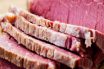
Corned beef
Corned beef contains no corn, but it does contain salt—lots of salt, because that is how the meat is cured. Nonetheless, despite the absence of corn in corned beef, the salty meat and the yellow niblets do derive their names from the same source. In the Germanic language from which English developed, the word kurnam,…
-

Cookie
The obvious source of the word cookie is the wrong one: cookie has no relation to cook, which seems less surprising when you stop to consider that cookies are not cooked but baked. Whereas cook derives from a Latin source, cookie derives from a Germanic one: namely the Dutch koekje—a diminutive of koek, meaning cake—which…
-
Cook
Job names, like teacher or farmer, usually arise almost as soon as their verb forms, teach or farm, come into existence. Other times the verb form may precede the appearance of the job name by centuries, as with weld and welder, because it takes that long for the job to be recognized as a valid…
-
Contradiction
In the eighteenth century, punch was sometimes referred to as contradiction, so called because its various ingredients contradicted one another: the rum, for instance, was opposed to the water, while the sugar was opposed to the lemon. Today we refer to such contradictory concoctions as sweet and sour, a phrase that also dates back to…
-
Companion
From an etymological point of view, a companion is anyone who shares a loaf of bread with you: the word derives from the Latin cum, meaning with or together, and the Latin panis, meaning bread. Companion entered English at the end of the thirteenth century, about the same time that the related form company was…
Got any book recommendations?