Mindblown: a blog about philosophy.
-
Reduced calories
Less than one-third of the calories of the food it substitutes or resembles. A food that must contain one-third less calories than the food it replaces, low calorie.
-
Reduce
To boil liquid until part of the water is evaporated. To make something smaller or lower. To put something such as a dislocated or fractured bone, a displaced organ or part or a hernia back into its proper position so that it can heal. Surgery, return of a dislocated part to its normal position by…
-
Recycle
The return of or pass-around again of materials for another use. To reuse specific materials.
-
Reconstitute
To rehydrate (put moisture back into) dehydrated foods by soaking in a liquid (water).
-

Recipe
A set of instructions including a formula. When the word recipe appeared in English in the fifteenth century, it referred only to directions for making medicines; not for another three hundred years, in the early eighteenth century, did recipe also come to denote directions for preparing a dish of food. Before this modern sense of…
-
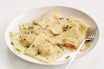
Ravioli
Pasta stuffed with various mixtures and poached in salt water, moistened with beef gravy, and sprinkled with cheese. Tiny turnips and little lambs—that is what you are metaphorically eating when you sit down to a meal of ravioli and agnelotti. The two pastas—ravioli stuffed with cheese and agnelotti stuffed with meat—both derive their names from…
-
Ranking test
The arranging of food items in order of intensity.
-
Random sample
Samples that are taken in such a way that each member of the population or lot have an equal chance of being selected. Subgroup of a large population (the so-called universe) selected by a random process insuring that each member of the universe has an equal chance of being included in the sample. It is…
-
Random numbers
Numbers from a table of random numbers used for sampling purposes.
-
Rancidity
An oxidative deterioration in food fat whereby a typical off-odor and/or off-flavor is produced. Deterioration of fats and oils in foods. It is characterized by an unpleasant odor and taste. Two types of rancidity can be defined as follows; (1) hydrolytic rancidity, and (2) oxidative rancidity.
Got any book recommendations?