Mindblown: a blog about philosophy.
-
Postural assessment
An analysis of the body in which imbalances are located by comparing specific bony landmarks to reference postural deviations.
-
Poststretch
Part of the cool-down, consisting of stretching exercises to return muscles to pre-exercise length.
-
Post-polio syndrome (PPS)
Affects adults who suffered polio as a child and has symptoms similar to polio.
-
Posterior tilt
Movement used to describe movement of the head or pelvis. With the head, it will result in extension of the cervical spine (chin up); with the pelvis, it will be opposite, with the lumbar spine flexing or flattening.
-
Positive risk factor
An undesirable factor that increase one’s risk for cardiovascular disease.
-
Polyunsaturated
Refers to a triglyceride in which two or more carbons have double bonds. A fatty acid having more than one unsaturated bond. Being in an organic compound such as a fatty acid in which there is more than one double bond. In chemistry, relating to long chain carbon compounds, especially fats that have many carbon…
-
Plyometrics
A form of dynamic-action land resistance training; stretch-shortening cycle exercise. Often referred to as jump training. A stretching and shortening exercise technique that combines strength with speed to achieve maximum power in functional movements. This regimen combines eccentric training of muscles with concentric contraction. A form of training where muscles are subjected to rapid alternation…
-
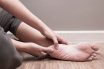
Plantar fasciitis
A chronic condition that affects the bottom or heel of the foot. Inflammation of the fascia in the arch of the foot, with the greatest pain at the calcaneal attachment. An inflammation of the plantar fascia-the long thick band of connective tissue on the undersurface of the foot. Inflammation of a layer of connective tissue,…
-
Plantar
Refers to the bottom surface or the sole of the foot. The sole of the feet. Referring to the sole of the foot. To the undersurface (sole) of the foot. Relating to the underside of the foot.
-
Plane or gliding joint
These joints are formed by the proximity of two relatively flat surfaces. This allows gliding movements to occur. Example: intertarsal joints (in the foot). Type of synovial joint in which the articulations of the bones allow only gliding motion; examples of gliding joints are the ankle and the wrist.
Got any book recommendations?