


Understanding this profound medical condition requires observing both the musculoskeletal system and the body’s largest organ, the skin. Psoriatic arthritis is a chronic, immune-mediated inflammatory joint disease that predominantly occurs in a specific subgroup of individuals who already suffer from psoriasis 1. Characterized by persistent stiffness, deep tissue swelling, and chronic pain, it specifically targets the peripheral joints, the axial skeleton, and the entheses, which are the highly sensitive anatomical sites where ligaments and tendons attach directly to the bone 2. Rather than being a simple case of normal mechanical wear and tear, this complex disease is driven by a confused immune system that mistakenly releases aggressive inflammatory proteins into healthy tissues. This relentless localized inflammation subsequently leads to a destructive cycle of continuous cartilage breakdown, erratic new bone formation, and significant functional impairment 3. Without proper medical intervention, it possesses the distinct potential to cause permanent joint deformities and severely limit a person’s basic physical mobility.
Causes of Psoriatic Arthritis
Unraveling the exact origins of this condition has proven to be a highly complex task for medical researchers, as there is no single, isolated trigger. Instead, the disease emerges from an intricate combination of overlapping biological, genetic, and environmental factors.
1. Genetic Predisposition
Carrying certain inherited genetic markers drastically increases an individual’s vulnerability to developing the disease. Over forty specific genes have been conclusively linked to the condition, with the HLA-B27, HLA-B38, and HLA-B39 genetic markers being strongly associated with various distinct patterns of severe joint and spinal inflammation 3.
2. Immune System Dysfunction
The primary engine driving the internal tissue damage is an overactive innate immune response. Normal T-cells mistakenly differentiate into aggressive helper cells that flood the body’s tissues with inflammatory cytokines, primarily interleukins and tumor necrosis factor-alpha, which directly cause deep tissue swelling and eventual joint degradation 1.
3. Physical Trauma and Environmental Stress
Sustaining physical trauma to a joint or enthesis can actively trigger the localized development of the arthritis. In the fields of dermatology and rheumatology, this specific mechanism is referred to as the deep Koebner phenomenon, where a minor physical injury prompts an aggressive, localized autoimmune flare-up 4.
4. Metabolic and Systemic Links
High rates of clinical obesity, metabolic syndrome, and insulin resistance share incredibly similar inflammatory pathways with this type of arthritis, creating an internal physiological environment where autoimmune responses can easily thrive and escalate rapidly 5.
Symptoms of Psoriatic Arthritis
Recognizing the disease in its early stages relies heavily on identifying a highly varied cluster of physical warning signs.
- Dactylitis: A painful, uniform swelling of an entire finger or toe, which gives the digits a characteristic sausage-like appearance.
- Enthesitis: Extreme tenderness and localized inflammation found exactly where tendons anchor to the bone, most commonly felt at the back of the heel or the sole of the foot.
- Peripheral Joint Swelling: Noticeable asymmetric or symmetric pain, morning stiffness, and physical swelling in the joints of the hands, wrists, knees, or ankles.
- Nail Abnormalities: Distinct physical changes to the fingernails or toenails, such as deep surface pitting, rigid structural ridges, or the visible separation of the nail bed from the finger.
- Spinal and Pelvic Pain: An inflammatory stiffness situated deep in the lower back and pelvis, which typically worsens with rest and improves slightly with movement.
- Dermatological Plaques: The outward appearance of red, scaly, and itchy skin patches characteristic of plaque psoriasis, commonly appearing on the scalp, elbows, and knees.
- Ocular Inflammation: The development of uveitis, a chronic inflammation of the eye that causes persistent redness, aching pain, and sudden blurred vision.
Psoriatic Arthritis Facts
| Category | Details |
| Symptoms 2 |
|
| Causes 1 |
|
| Types of Psoriatic Arthritis 3 |
|
| How does spread 4 |
|
| Age Group 6 |
|
| You might be at a higher risk for exposure of this disease if you: 7 |
|
| How doctors diagnose 8 |
|
| Other facts |
|
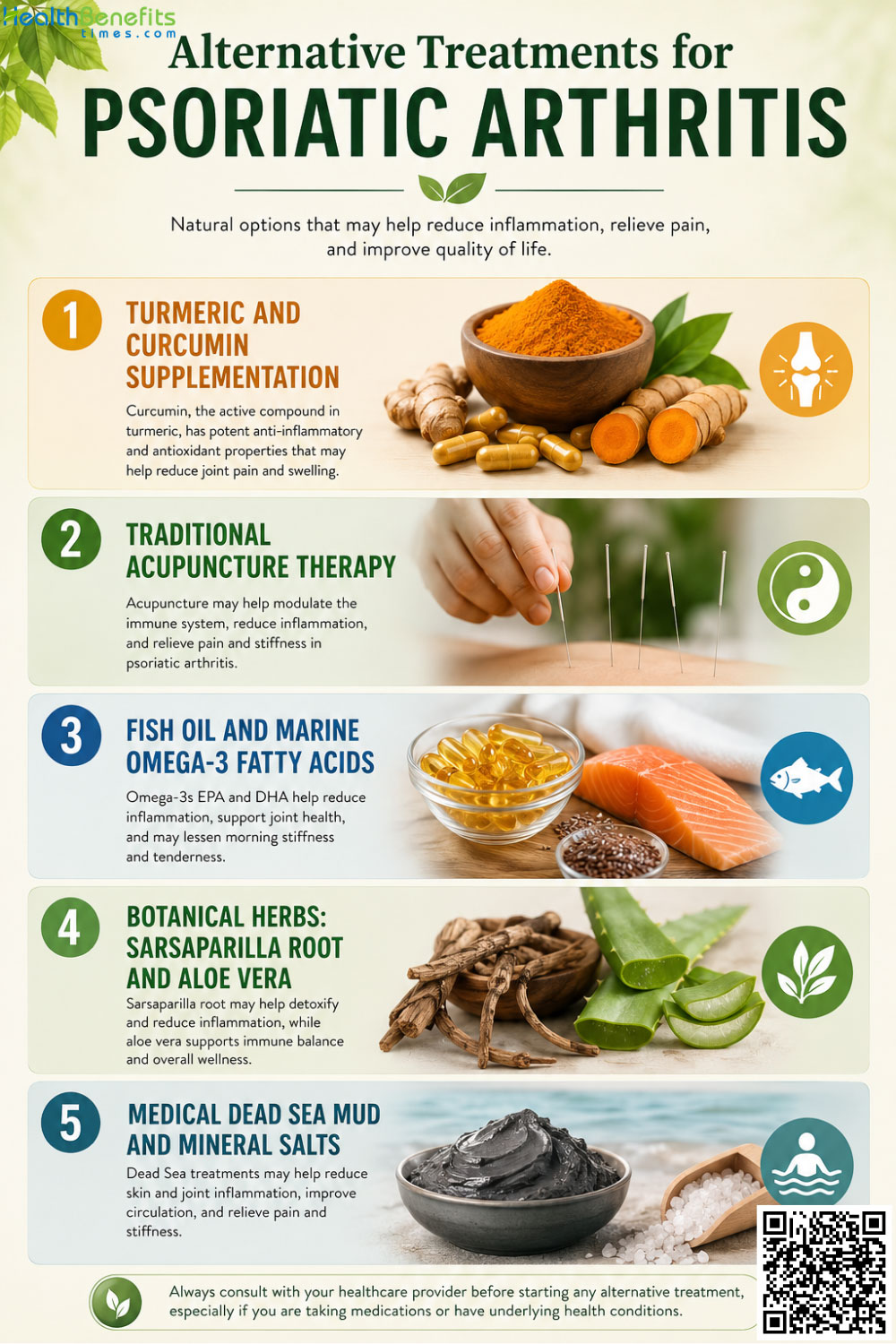
Alternative Treatments for Psoriatic Arthritis
Finding a truly balanced therapeutic approach often requires looking far beyond conventional pharmaceutical interventions. While traditional medicine utilizes biologics or disease-modifying antirheumatic drugs to address the root autoimmune dysfunction, numerous individuals successfully integrate complementary and alternative medicine into their daily routines to actively manage pain and lower localized inflammation 10. Embracing a holistic treatment plan can significantly prioritize overall quality of life, targeting both the physical and emotional burdens of the disease.
1. Turmeric and Curcumin Supplementation
Harnessing the natural power of ancient botanical spices has shown remarkable promise in modern autoimmune care regimens. Turmeric contains a highly active biological ingredient known as curcumin, which is internationally regarded for its profound anti-inflammatory and robust antioxidant properties 11. When ingested, curcumin actively modulates several intracellular signaling pathways, heavily suppressing the body’s overproduction of pro-inflammatory cytokines, which are the primary culprits behind joint cartilage destruction 12. Furthermore, evidence points toward its ability to enhance the expression of critical skin barrier proteins, suggesting it may improve the protective function of psoriatic skin and dramatically reduce transepidermal water loss. Regular supplementation at concentrated dosages has positively influenced clinical outcomes, reducing overall pain, morning stiffness, and chronic fatigue 13.
Note: You can easily consume turmeric by taking it as a concentrated, standardized oral supplement pill, or by generously applying it as a primary ingredient in cooked curries, warm soups, and golden milk beverages to achieve gentle, systemic medicinal benefits.
2. Traditional Acupuncture Therapy
Taking a centuries-old physical approach to chronic pain can yield highly effective, localized relief for swollen extremities. Acupuncture, a fundamental cornerstone of Traditional Chinese Medicine, operates on the core principle of restoring internal physiological balance and ensuring the proper flow of energy throughout the human body 14. Clinical observations continuously suggest that carefully inserting sterile, hair-thin needles into specific acupoints can successfully reduce autoimmune-generated systemic inflammation and dramatically decrease edema in the rigid joints of the hands and feet 15. Importantly, this ancient practice serves as a highly safe, non-pharmacological adjunct therapy that does not interfere with standard medications or trigger existing skin flare-ups 16.
Note: To achieve the best remedial benefits, you should undergo scheduled, repeated sessions administered by a licensed acupuncturist who will target points surrounding your inflamed joints to gently release localized tension and successfully restore your comfortable range of motion.
3. Fish Oil and Marine Omega-3 Fatty Acids
Turning to the ocean for therapeutic relief offers a scientifically backed method to actively cool systemic cardiovascular and joint inflammation. Cold-water fish oils are densely packed with eicosapentaenoic acid and docosahexaenoic acid, which are essential omega-3 polyunsaturated fatty acids 17. These specific dietary fats naturally alter the body’s overall lipid profile and dampen the hyperactive immune pathways that directly cause prolonged joint swelling. Consistent supplementation with high-quality fish oil has been strongly correlated with reduced joint tenderness, an improved lipid profile, and a substantially lower overall risk of associated cardiovascular disease 18.
Note: You can apply this therapy internally by taking daily high-dose omega-3 softgel supplements, or by directly incorporating fatty, cold-water fish like wild-caught salmon and mackerel into your weekly diet to effortlessly support long-term joint lubrication.
4. Botanical Herbs: Sarsaparilla Root and Aloe Vera
Exploring plant-based topicals and systemic herbal roots provides another vital layer of targeted relief for persistent skin and joint irritation. Sarsaparilla root is a traditional botanical that, when taken as a direct oral supplement alongside vitamins like D3, helps maintain joint swelling and enthesitis at a far more tolerable, baseline level 19. Externally, topical herbal applications such as pure aloe vera creams, evening primrose oil, and emu oil are routinely used to directly soothe the burning, erythematous skin plaques inherently associated with psoriatic disease 20. These diverse botanicals help trap essential moisture, fortify the natural skin barrier, and greatly reduce agonizing epidermal itching.
Note: You can swallow botanical roots like sarsaparilla in powdered capsule form for internal inflammation control, while soothing herbs like aloe vera should be applied topically directly onto itchy skin patches to instantly hydrate and calm the compromised barrier.
5. Medical Dead Sea Mud and Mineral Salts
Submerging your aching body in mineral-rich waters remains a time-honored, globally recognized therapy for severe dermatological and arthritic conditions. Treatments utilizing authentic mud and salts harvested directly from the Dead Sea are highly favored by the psoriatic community due to their unique composition 21. These specific minerals possess incredible osmotic properties that deeply cleanse the skin, temporarily reduce the rigid thickness of psoriatic plaques, and draw out localized inflammation from the underlying peripheral joints. Bathing in these therapeutic blends deeply relaxes tight muscles and creates a highly soothing, low-gravity environment for overstressed entheses.
Note: You can dissolve these specialized mineral salts into a warm, shallow bathtub at home and gently soak your entire body for twenty minutes to absorb the remedial benefits, relieve deep skeletal tension, and efficiently soften hardened skin scales.
Is there any exercise or physical activities for Psoriatic Arthritis?
Keeping your body actively moving is an absolute physical necessity, not just an option, when battling a severely joint-stiffening disease. Regular, tailored exercise is heavily recommended by leading rheumatology professionals to actively preserve vital muscle strength, strictly maintain a full range of motion, and successfully combat the extreme fatigue associated with chronic inflammation 22.
1. Aquatic Therapy and Water Aerobics
Stepping into a pool offers a highly forgiving, essentially weightless environment for severely impacted joints. Because water provides excellent natural buoyancy, it effectively removes the harsh, downward burden of gravity from your hips, knees, and inflamed spinal column 23. This unique environment actively allows you to push your muscles and build crucial strength against the gentle hydrostatic resistance of the water without ever risking micro-trauma to your fragile cartilage 24.
Note: To perform aquatic therapy, you should carefully wade into a heated, chest-deep pool and practice slow, deliberate walking, gentle leg lifts, and wide arm circles, ensuring you keep your movements incredibly fluid and entirely pain-free.

2. Yoga and Mindful Stretching
Linking your breath directly with controlled physical movements is a scientifically proven method to manage both physical joint rigidity and the heavy mental burden of a chronic disease. Yoga heavily focuses on gentle, sustained stretching and core strengthening, which naturally improves localized blood flow directly to the bodily areas heavily affected by psoriasis 25. Furthermore, the deep meditative and mindful aspects of yoga help to significantly lower systemic cortisol levels, which are known biochemical triggers for severe autoimmune flares.
Note: To practice yoga safely, you should use a thick, highly supportive mat and focus primarily on modified, low-impact poses—completely avoiding putting intense, direct pressure on your wrists or inflamed finger joints.
3. Tai Chi and Qigong
Embracing ancient martial arts fundamentally focuses on deliberate, sweeping motions rather than jarring, high-impact cardio. Tai chi and qigong are highly effective, incredibly graceful exercises that utilize continuous, circular bodily movements to gently open up tight joints, promote deep balance, and heavily reduce chronic physiological fatigue 26. Because the forms strictly require slow, intentional weight-shifting steps, they are incredible for drastically improving stability in the lower extremities without subjecting the feet to sudden shocks.
Note: You should perform Tai Chi in a quiet room by standing with softly bent knees, following a specialized instructor’s flowing arm patterns, and focusing deeply on shifting your center of gravity slowly from left to right.
4. Targeted Joint Isolation Stretches
Dedicating just a few brief minutes a day to micro-movements can drastically preserve the long-term function of your hands and legs. Since the distal interphalangeal joints located at the absolute ends of the fingers are so frequently attacked and eroded by the disease, isolating them with tiny resistance exercises fundamentally helps prevent permanent claw-like contractures 27.
Note: To do a simple finger extension, gently wrap a soft rubber band around your cupped fingers and thumb, slowly spread your hand open against the tight resistance, and smoothly relax back to the start, repeating this ten times.
Foods to Avoid When You suffer from Psoriatic Arthritis
Watching exactly what goes onto your plate is incredibly critical, as certain dietary choices can inadvertently fuel the inflammatory fire already burning inside your body. Minimizing specific chemical triggers can help you successfully manage your daily symptom severity.
- Excessive Refined Sugar: High quantities of processed sugar heavily drive systemic cellular inflammation and directly contribute to rapid weight gain, which subsequently puts more mechanical stress on weight-bearing joints 28.
- Gluten: Found primarily in wheat, barley, and rye, gluten is a highly reported autoimmune trigger, particularly if you have an underlying sensitivity or a genetic overlap with celiac disease 29.
- Nightshade Vegetables: Tomatoes, white potatoes, eggplants, and bell peppers contain natural chemical compounds that a large percentage of patients anecdotally report cause distinct, sudden worsening of their joint stiffness 30.
- Full-Fat Dairy: While calcium is physically necessary, heavy milk and cheese products contain high amounts of saturated fats that are biochemically known to actively promote internal inflammation 31.
- Red and Heavily Processed Meats: Bacon, sausages, and fatty cuts of beef are incredibly rich in inflammatory compounds; frequently consuming them can drastically worsen autoimmune symptoms and elevate your cardiovascular risk 32.
- Alcohol: Frequent consumption heavily burdens the liver and remains a top-reported dietary trigger for explosive, sudden skin and joint flare-ups 33.
Activities to Avoid When You suffer from Psoriatic Arthritis
Guarding your fragile joints requires you to be highly mindful of the daily mechanical stressors you put them through. Pushing aggressively through the pain is rarely the correct approach.
- Prolonged Standing or Walking: Remaining upright and entirely stationary on hard surfaces for hours at a time places relentless, unyielding pressure on the fragile entheses in your heels.
- High-Impact, Jarring Sports: Physical activities that involve heavy repetitive pounding, such as long-distance running on concrete or intense jumping, can easily trigger fresh joint damage.
- Ignoring Adequate Rest Periods: Skipping vital recovery days directly after a strenuous workout starves your inflamed joints of the essential physiological time they desperately need to rebuild.
- Lifting Heavy Objects Improperly: Straining your vulnerable fingers or lower back to aggressively hoist heavy loads can easily cause deep micro-tears in weakened ligaments.
Myths and Misconceptions
| Myth | Reality |
| It is just a superficial cosmetic skin condition. | Psoriatic arthritis is a highly severe, systemic autoimmune disease that aggressively attacks deep tissues, bone cartilage, and even internal organs like the cardiovascular system. |
| Only older adults get this disease. | While most common in adults, children can absolutely develop it. Juvenile Psoriatic Arthritis accounts for up to 7% of childhood arthritis cases. |
| It is contagious and easily spreads by touch. | The disease is generated entirely internally by genetic and immune system malfunctions. You absolutely cannot catch it or pass it to someone else through physical contact. |
| If my skin clears up, my joints are completely healed. | The visual severity of dermatological skin plaques does not perfectly correlate with internal joint damage. Your joints can continue to erode aggressively even if your skin looks normal |
| Joint damage will eventually heal entirely on its own. | Unlike a simple muscle sprain, the inflammatory erosion in this condition can easily result in permanent, totally irreversible bone destruction if not treated properly. |
Special Considerations
1. Children
Navigating an autoimmune arthritis diagnosis in a developing child requires highly specialized, incredibly careful attention from pediatric specialists. Juvenile Psoriatic Arthritis is a relatively rare but profoundly impactful condition, historically representing a small but significant fraction of all juvenile idiopathic arthritis cases 39. Children afflicted with this condition often present quite differently than adults, sometimes displaying distinctly asymmetric joint swelling, severe dactylitis, and chronic eye inflammation long before any classic psoriasis skin patches ever become visible to parents 40. The condition in youth is highly heterogeneous, requiring aggressive early intervention to completely prevent permanent bone growth stunting or irreversible joint fusion 41.
2. Pregnancy
Actively planning a growing family while simultaneously managing deep systemic inflammation presents a unique set of complex medical challenges that require careful foresight. The overall course of the disease during human pregnancy is often highly unpredictable; some women experience a wonderful natural remission of symptoms, while others face incredibly difficult flare-ups, particularly in the highly vulnerable postpartum period 42. Because certain cornerstone systemic drugs are strictly contraindicated due to their high statistical risk of causing severe fetal malformations, complex treatment plans must be heavily altered well before conception 43. During pregnancy, localized topical treatments and tightly controlled phototherapy are generally preferred as the safest options to protect maternal health 44.
3. Chronic Conditions and the Elderly
Managing this aggressive disease in older populations is inherently complicated by the heavy, overlapping physiological burden of lifelong systemic comorbidities. Elderly patients suffering from the disease are statistically much more prone to eventually developing severe metabolic syndrome, clinical depression, hypertension, and advanced cardiovascular diseases 45. Because older individuals are often already managing a highly complex web of daily pills for these secondary conditions, prescribing doctors must be incredibly vigilant regarding dangerous drug interactions when initiating new systemic therapies 46. Furthermore, distinct physical issues like thinning skin or general unsteadiness can physically limit the safe use of standard treatments like topical steroids or standing light therapy booths 47.
Precaution before use of natural remedies when you have Psoriatic Arthritis
Taking independent charge of your personal health with natural supplements is incredibly empowering, but it requires a remarkably high degree of clinical caution.
- Beware of Hidden Liver Toxicity: Even highly popular natural anti-inflammatories carry severe biological risks if heavily overused. Consuming overly massive daily doses of seemingly benign supplements can actually cause acute, highly dangerous liver damage over time 48.
- Check for Dangerous Drug Interactions: Botanical herbs and high-dose vitamin supplements can actively interfere with the body’s absorption or chemical breakdown of your highly prescribed biologic injections.
- Watch for Extreme Photosensitivity: Certain topical herbal remedies applied directly to the skin can cause extreme hypersensitivity to sunlight, making you dangerously susceptible to severe, blistering sunburns.
- Never Substitute Without Medical Guidance: Alternative therapies are designed primarily to complement, not entirely replace, proven medical interventions. Dropping your prescribed medications in favor of untested botanical supplements can easily allow silent, irreversible bone erosion to continue totally unchecked.
- Source Quality Matters Immensely: Always meticulously ensure that your dietary supplements are purchased from highly reputable, third-party tested manufacturers to entirely avoid ingesting hidden heavy metals or wildly inaccurate dosages.
When to see a Doctor
Vigilantly monitoring your body’s subtle daily signals is your absolute best defense against long-term physical disability. You should immediately reach out to your rheumatologist if you observe any of the following clinical red flags:
- Sudden or Unexplained Joint Swelling: If a previously healthy finger, toe, or knee suddenly balloons rapidly in size, turns bright red, or becomes strangely hot to the touch.
- Changes in Your Vision: If you suddenly experience unexplained eye pain, intense localized redness, or incredibly persistent blurred vision, which could be signs of severe ocular inflammation.
- Debilitating Morning Stiffness: If the physical stiffness in your lower back or peripheral joints lasts for several agonizing hours after waking up and severely impedes your ability to dress yourself.
- Adverse Supplement Reactions: If you independently start a new natural remedy and suddenly experience unusual nausea, severe mental fatigue, or deep abdominal pain.
- Family Planning: If you are actively planning to become pregnant or father a child, as your entire medical and alternative therapy regimen must be thoroughly evaluated for safety 49.
Comments
comments