

Causes of Eyesight Problems
1. Refractive Errors
An irregular eyeball shape, changes in the cornea, or aging of the lens prevent light from focusing directly on the retina. This structural mismatch causes common blurry vision issues such as nearsightedness, farsightedness, and astigmatism 3. Furthermore, as individuals age past 40, the internal lens naturally stiffens, leading to presbyopia, a condition that makes focusing on close objects difficult 4.
2. Cataracts
Over time, the proteins inside the eye’s natural lens can break down and clump together, creating cloudy areas that block light from passing through clearly. This clouding, known as a cataract, progressively blurs vision, reduces color perception, and is a primary consequence of the biological aging process 5.
3. Glaucoma
Fluid buildup inside the eye can dangerously increase internal eye pressure, which eventually compresses and damages the optic nerve. Because the optic nerve is responsible for transmitting all visual data to the brain, this progressive damage leads to permanent blind spots, peripheral vision loss, and eventually total blindness if left untreated 6.
4. Age-Related Macular Degeneration (AMD)
Physical deterioration of the macula the central portion of the retina responsible for sharp, straight-ahead vision causes progressive central vision loss. This degradation destroys the light-sensitive cells needed for detailed tasks like reading and driving, and it is strongly linked to aging, genetic history, and smoking 7.
5. Diabetic Retinopathy
Chronically high blood sugar levels associated with diabetes severely damage the delicate blood vessels that supply oxygen to the retina. These damaged vessels swell, leak fluid, or bleed directly into the eye, which can eventually lead to retinal scarring, retinal detachment, and severe vision impairment 8.
Symptoms of Eyesight Problems
1. Blurry or Hazy Vision
Persistent blurriness when looking at distant objects, difficulty focusing on close-up text, or experiencing an overall cloudy appearance to one’s surroundings typically indicates a refractive error or the early development of cataracts 3.
2. Loss of Peripheral (Side) Vision
The gradual disappearance of vision around the edges of the visual field, often described as developing “tunnel vision,” is a primary warning sign of glaucoma, resulting from progressive pressure damage to the optic nerve 6.
3. Distorted or Lost Central Vision
Perceiving normally straight lines as wavy, bent, or distorted, or noticing a dark, empty spot in the center of the visual field are hallmark symptoms of age-related macular degeneration (AMD), which damages the retinal cells required for sharp, forward-facing sight 7.
4. Sudden Floaters and Flashes
Experiencing an abrupt increase in small dark spots or cobweb-like strings drifting across the visual field, especially when accompanied by brief, bright flashes of light, strongly indicates a retinal tear or detachment that requires immediate medical intervention 9.
5. Severe Glare and Night Blindness
Struggling to see clearly in low-light environments, or noticing pronounced halos and starbursts around bright lights such as streetlamps or car headlights, frequently occurs as cataracts cause the eye’s internal lens to become opaque and scatter incoming light 5.
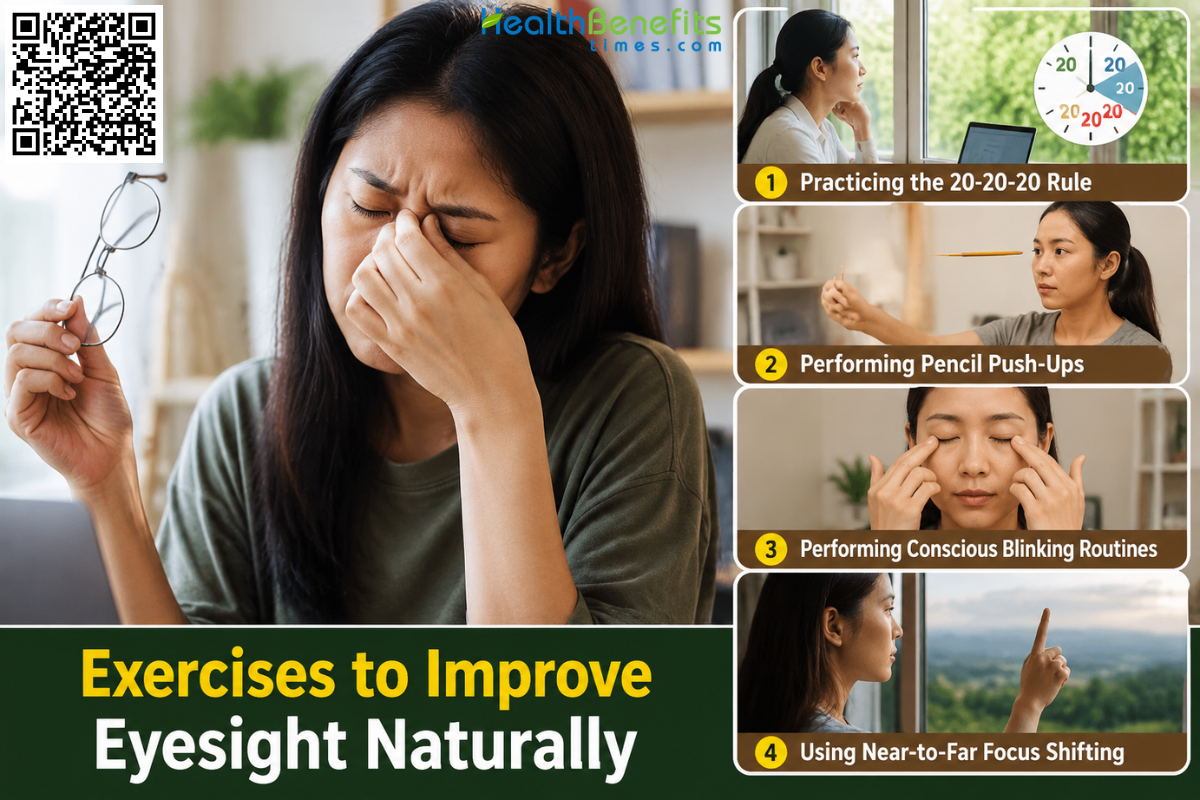
Exercises to Improve Eyesight Naturally
1. Practicing the 20-20-20 Rule
How it may help
Staring continuously at digital screens locks eye muscles into a fixed near-focus position and significantly reduces blinking. The 20-20-20 rule provides regular intervals for these focusing muscles to relax and encourages natural tear production, thereby reducing eye fatigue and temporary blurriness associated with digital strain 10.
What research says
Clinical studies confirm that frequent focusing breaks significantly reduce symptoms of digital eye strain, such as dryness, headaches, and blurred vision. However, medical research clarifies that while this practice relieves temporary muscle fatigue, it does not permanently reverse underlying structural refractive errors like nearsightedness or farsightedness 11.
How to use it safely
Set a timer while using digital devices. Every 20 minutes, shift your gaze away from your screen and look at an object located at least 20 feet away for a minimum of 20 seconds. Use this time to blink fully and frequently to rehydrate your eyes 10.
Potential precautions or side effects
This practice carries no adverse side effects. However, it is solely a strain-relief technique and should not replace prescribed corrective lenses or professional medical evaluations for chronic, progressive vision disorders 10.
2. Performing Pencil Push-Ups
How it may help
Pencil push-ups are a targeted vision therapy exercise designed to treat convergence insufficiency, a condition where the eyes struggle to work together to focus on near objects. By actively tracking a moving target, this exercise strengthens extraocular muscles, improving binocular coordination and reducing reading fatigue 12.
What research says
Clinical trials funded by the National Eye Institute confirm that pencil push-ups can improve near-focusing coordination. However, research concludes that this at-home exercise is significantly less effective at eliminating symptoms of convergence insufficiency than supervised, office-based vision therapy combined with targeted home reinforcement 13.
How to use it safely
Hold a pencil at arm’s length and focus on a printed letter. Slowly move the pencil closer to your nose while keeping the image sharp. Stop when the pencil suddenly appears double, then slowly push it back to the starting position 14.
Potential precautions or side effects
This exercise may cause temporary eye fatigue or mild headaches. Discontinue the practice if severe pain occurs, as this technique does not correct refractive errors like nearsightedness 12.
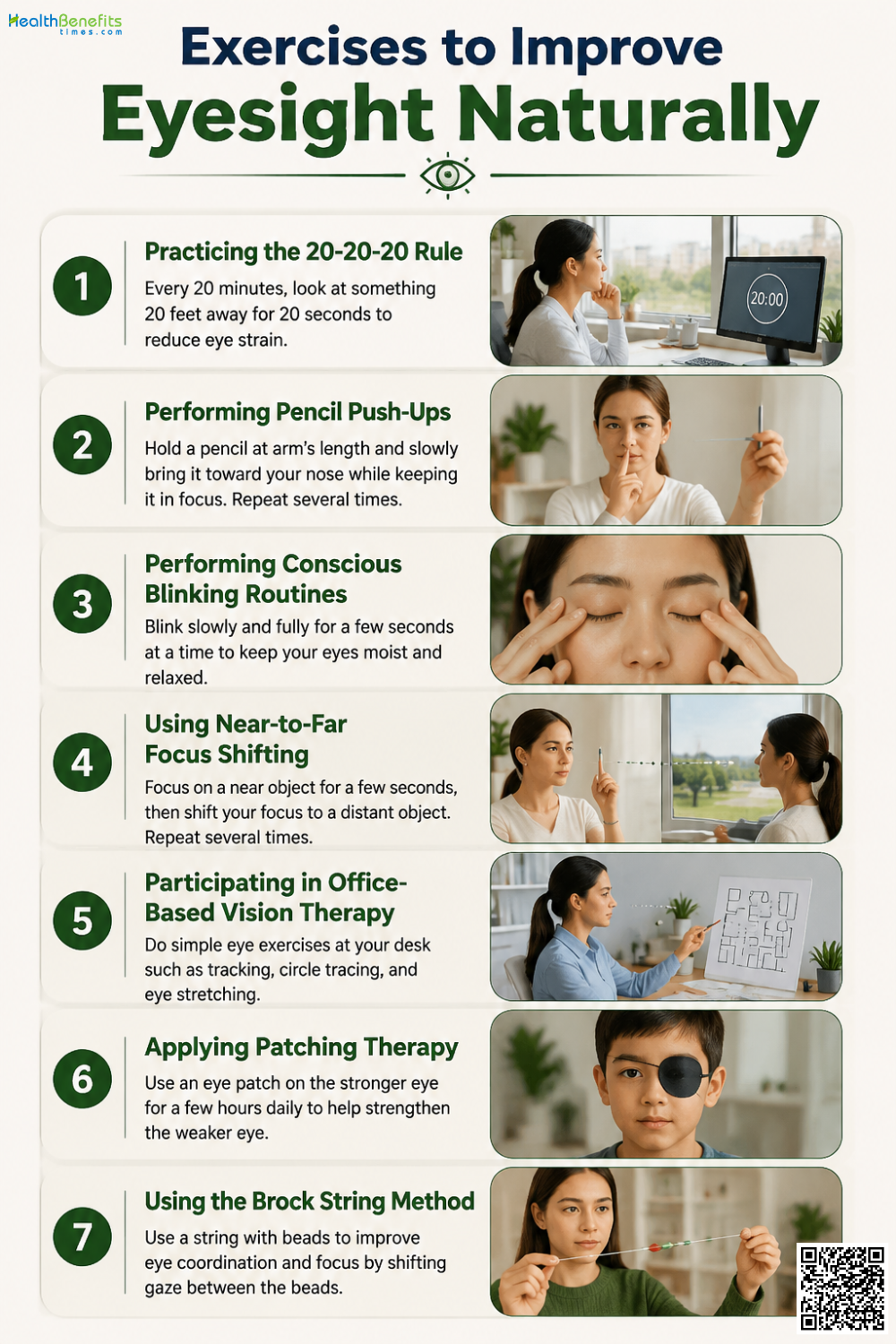
3. Performing Conscious Blinking Routines
How it may help
The cornea requires a smooth, continuous tear film to focus light properly. Staring at screens drastically reduces natural blink rates, leading to rapid tear evaporation and blurred vision. Performing conscious blinking routines actively replenishes this vital moisture layer, preventing dry spots and instantly sharpening temporary visual blurriness 15.
What research says
Clinical studies confirm that prolonged visual tasks cause incomplete and infrequent blinking, directly contributing to dry eye disease and visual instability. Medical research demonstrates that structured, purposeful blinking exercises effectively increase tear film stability and lipid layer thickness, significantly reducing eye discomfort and strain-related blurriness 16.
How to use it safely
Pause your visual task and close your eyes gently for two seconds. Then, squeeze your eyelids lightly together for another two seconds to stimulate the tear glands. Finally, open your eyes and relax. Repeat this cycle five times periodically throughout the day to maintain adequate eye hydration 16.
Potential precautions or side effects
Conscious blinking is entirely safe. However, avoid squeezing your eyelids excessively hard, which can cause muscle strain, and remember it does not cure structural refractive errors like nearsightedness.
4. Using Near-to-Far Focus Shifting
How it may help
Shifting focus between near and distant objects exercises the ciliary muscles, which control the shape of the eye’s internal lens. This active flexing and relaxing prevents accommodative spasms caused by prolonged close-up work, thereby improving binocular coordination and relieving the temporary blurry vision associated with severe eye strain 17.
What research says
Clinical studies indicate that accommodative facility exercises, such as near-to-far focus shifting, significantly reduce digital eye strain and improve overall reading performance. Research confirms these exercises enhance the ciliary muscle’s flexibility and accommodative response, though they do not cure permanent structural refractive errors like nearsightedness 18.
How to use it safely
Hold a pen about ten inches from your face and focus on it clearly for 15 seconds. Next, shift your gaze to an object at least 20 feet away for another 15 seconds. Repeat this cycle five times to stretch and relax your focusing muscles safely 10.
Potential precautions or side effects
This exercise is completely safe but may cause mild, temporary eye fatigue. Discontinue the practice and consult an eye specialist if you experience severe headaches or persistent double vision.
5. Participating in Office-Based Vision Therapy
How it may help
Office-based vision therapy is a customized, supervised program that uses specialized equipment to retrain the brain and eye muscles to work together. This intensive therapy improves binocular coordination, tracking, and focusing, which directly alleviates severe reading fatigue, blurred vision, and double vision associated with convergence insufficiency 19.
What research says
Clinical trials funded by the National Eye Institute demonstrate that supervised, office-based vision therapy combined with at-home reinforcement is the most effective treatment for convergence insufficiency. Research concludes it significantly improves binocular vision and eliminates reading-related symptoms far better than home-based exercises alone 20.
How to use it safely
Schedule a comprehensive evaluation with an eye care professional specializing in binocular vision. Attend weekly in-office sessions and strictly follow the prescribed at-home reinforcement exercises. Do not attempt to substitute professional diagnosis and equipment with unverified online vision training programs 21.
Potential precautions or side effects
Therapy may cause temporary eye fatigue or mild headaches initially. It is not a cure for structural refractive errors like nearsightedness, farsightedness, or astigmatism 22.
6. Applying Patching Therapy
How it may help
Patching therapy, clinically known as occlusion therapy, is the primary treatment for a lazy eye. By covering the stronger eye with an opaque patch, it forces the brain to rely on the weaker one. This active stimulation strengthens neural pathways, naturally improving the eye’s visual acuity 23.
What research says
Clinical studies confirm that occlusion therapy effectively restores vision in children with a lazy eye. Research concludes that patching the stronger eye for just two to six hours daily is as successful at improving visual function as full-time patching, achieving optimal visual results with less daily disruption 24.
How to use it safely
Place a medical-grade adhesive patch directly over the stronger eye for the exact daily duration prescribed by a doctor. While patched, perform active, close-up tasks like reading or drawing to actively stimulate the weaker eye and encourage visual development 23.
Potential precautions or side effects
Patching must be strictly monitored by a medical professional. Over-patching can inadvertently weaken the strong eye, and the adhesive material may cause temporary mild skin irritation 23.
7. Using the Brock String Method
How it may help
The Brock string is a vision therapy tool that trains the eyes to work together effectively. By shifting focus between beads placed at different distances along a string, it strengthens binocular vision, improves depth perception, and treats convergence insufficiency, reducing eye strain and double vision during reading 12.
What research says
Clinical trials confirm that convergence exercises utilizing tools like the Brock string significantly improve binocular coordination. Research concludes that when incorporated into a structured vision therapy program, these methods successfully reduce reading-related visual fatigue and resolve convergence insufficiency symptoms more effectively than placebo treatments 25.
How to use it safely
Secure one end of the string to a stationary object and hold the other end against your nose. Focus directly on the nearest bead until you see a single bead with two strings forming a “V” shape, then slowly shift your focus to the next furthest bead 26.
Potential precautions or side effects
This exercise may cause temporary eye fatigue or mild headaches. It does not correct structural refractive errors like nearsightedness and requires professional guidance for optimal results 12.
Foods to Avoid When You suffer from Eyesight problems
Maintaining ocular health requires strict dietary management, as certain food components actively accelerate the progression of chronic eye diseases such as age-related macular degeneration and diabetic retinopathy. Clinical evidence establishes that dietary patterns characterized by high glycemic loads and substantial intake of saturated fats provoke systemic inflammation and oxidative stress, which directly damage retinal ganglion cells and the surrounding microvasculature 27. Consequently, an optimal diet prioritizes whole, plant-based foods and omega-3 fatty acids while stringently limiting the intake of refined sugars, red meat, and high-sodium processed items 28. If you are managing compromised vision, you must scrutinize your dietary choices daily, replacing pro-inflammatory ingredients with nutrient-dense alternatives to preserve your remaining visual acuity and actively slow disease advancement 29.
1. Added Sugars and High-Sucrose Foods
High sugar intake accelerates diabetic retinopathy by damaging retinal blood vessels. Restricting added sugars mitigates visual impairment and oxidative stress in the retina 27.
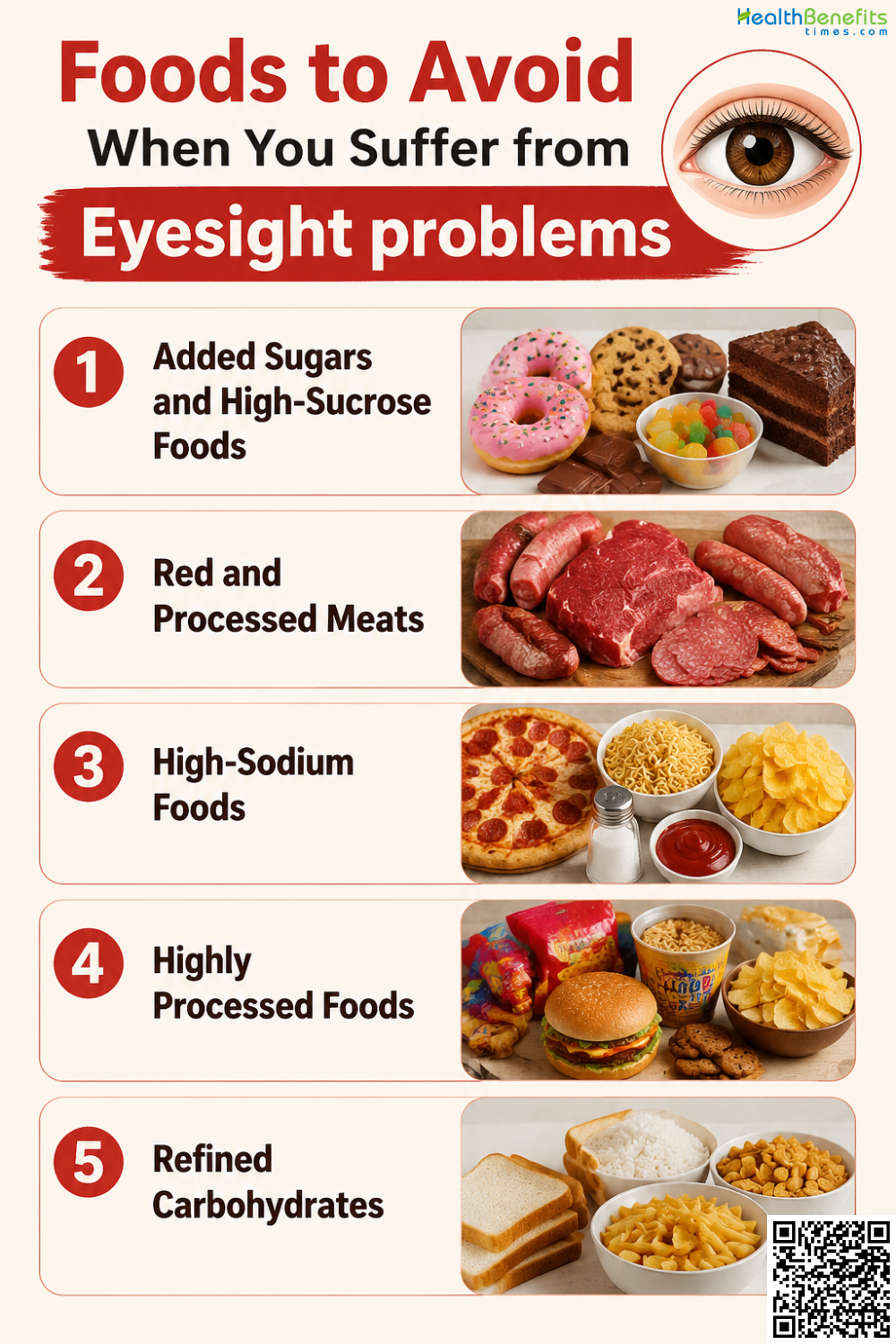
2. Red and Processed Meats
Frequent consumption of red and processed meats increases the risk of age-related macular degeneration. Replacing these meats with fish slows geographic atrophy in the eye 28.
3. High-Sodium Foods
Excessive salt intake exacerbates hypertension, directly worsening hypertensive retinopathy and diabetic vision loss. Avoiding heavily salted products maintains healthy blood flow to delicate ocular structures 29.
4. Highly Processed Foods
Ultra-processed foods contain unhealthy fats that promote systemic inflammation. This inflammatory response accelerates the progression of degenerative eye conditions, including advanced macular degeneration and cataracts 28.
5. Refined Carbohydrates
Foods with a high glycemic index rapidly increase blood glucose levels. This metabolic stress worsens diabetic retinopathy and contributes to widespread macular cellular damage 29.
When to see Doctor when you struggle from Eyesight problems
1. Sudden Vision Loss
Sudden blindness or significant blurring in one or both eyes requires emergency care to treat potential vascular blockages or nerve damage 30.
2. Flashes of Light and Floaters
A sudden onset of flashing lights accompanied by new floating spots indicates a high risk of retinal detachment, necessitating immediate surgical assessment 9.
3. Severe Eye Pain
Intense, unexplained eye pain, particularly when accompanied by redness or nausea, often signals acute glaucoma or severe infection requiring rapid clinical treatment 6.
4. Visual Field Defects
The sudden appearance of a dark curtain or shadow blocking peripheral or central vision suggests structural damage to the retina that demands urgent repair 9.
5. Double Vision
Seeing double, especially when it occurs suddenly, is a primary indicator of underlying neurological issues or severe muscle dysfunction that warrants immediate medical testing 4.
Comments
comments