Category: B
-
Bone loss
Physiologic loss of bone mass. The peak of mineral density is reached between 30 and 40 years of age; women lose about 35% of cortical bone and 50% of trabecular bone, whereas men lose about two-thirds of these amounts. The decline in living bone tissue due to a combination of influences and aging. With age,…
-
Bone induction
Interaction among pluripotential cells and bone morphogenetic proteins (BMPs) that converts these cells to osteoblasts.
-
bone–implant interface
Line of demarcation between the nonliving surface of an endosseous implant and the living bone it contacts. Numerous factors may influence the degree to which bone heals in contact with the implant surface, including surface texture, surface contamination, time since placement, and extent of functional loading, among others.
-
bone–implant contact (BIC)
Direct contact of bone with the surface of an endosseous implant as seen microscopically. The ratio of bone contact to implant surface (percent) is used to evaluate implant surface topographies and materials.
-
Bone healing
Cellular events, recapitulating embryogenesis. After initiation of woven bone formation, deposition of parallelfibered bone ensues. These two primary types of bone repair the defect within weeks; thereafter, the formation of perivascularly arranged lamellar bone takes place with simultaneous resorption of the two primary bone types. This substitution, which gives strength to the bone, may take…
-
Bone harvest
Acquisition of bone from a patient for an autogenous graft, from deceased individuals for an allogeneic graft, or from animals for a xenograft.
-
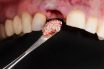
Bone grafting
A surgical procedure performed to establish additional bone volume, using autogenous bone and/or a bone replacement graft, prior to or simultaneously with dental implant placement.
-
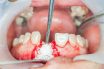
Bone graft
Bone taken from a donor site of the patient (autogenous) or from an outside source (allograft, alloplastic, or xenograft). A bone graft is used in the alveolar ridge to augment a bone deficiency. It can be used with simultaneous or subsequent implant placement. Source of an autogenous bone graft may be intraoral or extraoral in…
-
Bone fracture
Break in bone, usually the result of trauma. It can also be caused by an acquired disease of bone or by abnormal formation associated with bone disease. Fractures are further classified by their character and location: greenstick, spiral, comminuted, transverse, compound, and compression.
-
Bone fill
Clinical restoration of bone tissue in a treated osseous defect. It addresses neither the presence nor absence of histologic evidence of new connective tissue attachment nor formation of a new periodontal ligament in the case of tooth‐supporting bone. Measurement can be accomplished radiographically, clinically (by reentry), or histologically.