Category: P
-
Partial inflorescence
(In Cyperaceae) primary branches of an inflorescence.
-
Parthenogenesis, parthenogenetically
With seeds developing without fertilisation having taken place.
-
Parthenocarpy
With fruit developing without fertilisation of the ovule, with seedless fruit.
-
Parsimony
(In cladistics) the principle that the phylogeny requiring the least number of character changes is most probably correct.
-
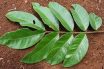
Paripinnate
Evenly pinnate, terminated by a pair of opposite leaflets. Pinnate with an even number of leaflets and without a terminal leaflet.
-
Parietal
Placentation in which the ovules are attached to the inner surface of the outer wall of a (usually) one-celled syncarpous ovary. Attached to the walls. The cells on the wall of a cavity such as the stomach; pertaining to or located near the parietal bone (as the parietal lobe) of the skull. Referring to the…
-
Parenchyma
(In anatomy) soft tissue consisting of cells with thin walls. The pulp of plants. An unspecialized, simple cell or tissue. Tissues which contain the working cells of an organ. Functional part of an organ, apart from supporting or connective tissue. Parts of an organ essential to its function rather than its physical structure. The essential…
-
Paratype
(In nomenclature) a specimen mentioned in the protologue other than holotype, isotype or syntypes, i.e. the remnant specimens without official status but mentioned in the protologue.
-
Paratact
(Irregularly) helical aestivation where the innermost segment is immediately adjacent to the outermost segment (Weberling, 1992).
-
Parastichy
The spiral imaginary line connecting organs along a stem or axis [unusual term].