Category: P
-
Parasitic
Living on, and deriving nourishment from, another organism (the host). The relationship of one organism, the parasite, living in or on another living organism, the host, and obtaining nourishment from the association, usually to the detriment of the host. Connected to and deriving nutrients from another plant or fungus. Referring to parasites.
-
Paraphysis (plural paraphyses)
(In pteridophytes) sterile hairs or filaments among the sporangia within a sorus. Hairs that are formed among sporangia in a sorus of a fern.
-
Paraphyllidium (plural paraphyllidia)
A degenerate leaflet at the base of the pinna or rachis, immediately contiguous to its pulvinus (e.g. in Mimosa).
-
Paraphyletic group
(In phylogenetics) a group of organisms that contains the most recent common ancestor shared with the group under study but not all of its descendants.
-
Parapatric
(Of distribution) with ranges that do not overlap but are adjacent.
-
Parallelodromous
(Of venation) with two or more large veins originating at the leaf base and running parallel to each other throughout most of the leaf length, converging near the apex.
-
Parallel evolution
The evolution of a similar feature in two or more groups, not necessarily guided by similar life-styles or habitats.
-
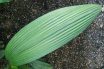
Parallel
(Of veins) all running in the same direction at fairly close intervals. Several to many veins of about the same size (the midrib sometimes more conspicuous) and parallel to one another, as in many monocots. Side by side, approximately the same distance apart for the entire length; often used in reference to veins or edges…
-
Paracladia
Subsidiary branches that follow the pattern of main branches; Units of repeated branching patterns.
-
Parabolic
(Of leaf ) ovate-oblong or ovate, obtuse and contracting below the apex [rarely used term].