Category: S
-

Sockeye
There are only about a thousand words in English—a mere 0.2% of the total vocabulary—that derive from the indigenous languages of the U.S. and Canada. This small number of words might have been greater had it not been for Tisquantum, a member of the Pawtuxet tribe that once thrived at what is now Plymouth. Tisquantum’s…
-
Snarf
Anyone who has learned English as a second tongue knows how maddening this language is. It’s inexplicable, for example, that when we find a piece of chocolate, we can gobble it up or snarf it down. Why the one verb tends to be associated with “up-ness” and the other with “down-ness” is a mystery; it’s…
-
Snack
Back in the fourteenth century, you did not refer to the teeth marks you left in your brother’s leg as a bite but rather as a snack: the word bite, in fact, did not come to be used as a noun until the fifteenth century. Snack, on the other hand, meant animal bite when it…
-
Smorbrod
This Norwegian name for an open-sandwich might be translated as smearbread since the Norwegian smor, meaning butter, derives from the same source as the English smear. The word is first recorded in English in 1933.
-
Smoor
Launching, sowcing, searcing, and smooring are probably not actions you knowingly performed as you prepared for your last dinner party, but they’re all culinary terms mentioned in A New Booke ofCookerie, published in London in 1615. Launch meant to slice, and is identical with the nautical launch: when a ship is launched, it slices into…
-
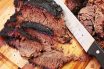
Smoked meat
The word smoke dates back in English to the eleventh century, but it was not until the beginning of the seventeenth century that it came to refer to the process of preserving meat by hanging it in a smoke-filled room. Before the seventeenth century, this ancient culinary technique was called reeking, and the final product…
-
Smetana
The sour cream often served with borscht is called smetana, a word that derives from the Russian smetat, meaning to sweep together. The name alludes to cream’s tendency, as it sours, to coagulate into lumps and ripples, almost as if the curds had been swept or raked onto the surface. A distant relative of smetana…
-
Smell-feast
A smell-feast is a what a freeloader was called centuries ago. Someone who snuck into the wedding party or funeral of a stranger in order to nibble the cold cuts, all the while pretending to congratulate the groom or console the widow, was a smell-feast. In an early eighteenth-century play called The Invader of His…
-
Slurp
For some reason, perhaps not too hard to guess, English has far more words to describe noisy gluttonous eating than dainty well-mannered eating. Of these dozen or so gluttonous words, slurp, first recorded in the mid seventeenth century, is the best known and the least offensive; you can safely chide your spouse for slurping his…
-
Slumgullion
First recorded in the late nineteenth century, slumgullion refers generally to the innards of a gutted fish and more specifically to the watery crud, mixed with oil and blood, that drains from whale blubber as it is rendered. In what now appears, with the benefit of hindsight, to be a dubious marketing strategy, slumgullion was…