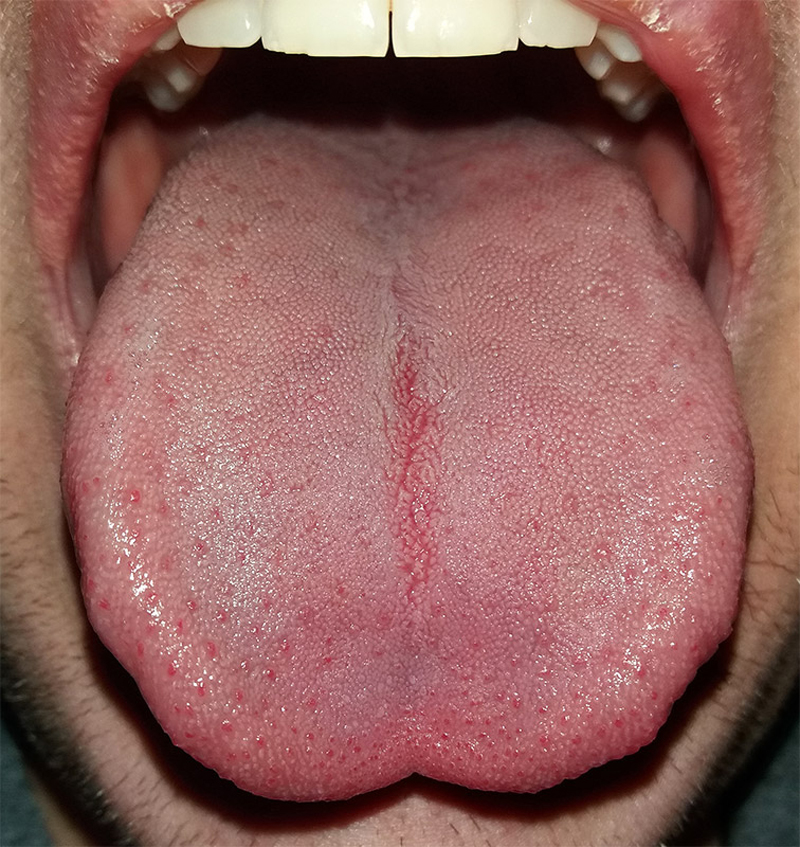
 The long muscular organ inside the mouth which can move and is used for tasting, swallowing and speaking. The top surface is covered with papillae, some of which contain taste buds.
Mucous-membrane-covered, muscular organ attached to the floor of the mouth by the frenulum linguae. The surface is covered with papillae and taste buds. The tongue manipulates food during chewing and swallowing; functions in the production of speech and different sounds; and is the main organ of taste; also called glossa; lingua.
Muscular organ of the mouth involved with taste and management of oral secretions.
The muscular, flexible organ on the floor of the mouth that functions in taste, chewing, swallowing, and speaking. The tongue is formed by internal bands of striated muscle. External muscle attached to the bones of the mouth hold it in place. Taste buds located on the surface of the tongue detect sweet, salty, bitter, and acidic flavors and stimulate the salivary glands beneath the tongue to produce saliva.
A muscular organ attached to the floor of the mouth. It consists of a body and a root, which is attached by muscles to the hyoid bone below, the styloid process behind, and the palate above. It is covered by mucous membrane, which is continuous with that of the mouth and pharynx. On the undersurface of the tongue a fold of mucous membrane, the frenulum linguae, connects the midline of the tongue to the floor of the mouth. The surface of the tongue is covered with minute projections (papillae), which give it a furred appearance. Taste buds are arranged in grooves around the papillae, particularly the fungiform and circumvallate papillae. The tongue has three main functions. It helps in manipulating food during mastication and swallowing; it is the main organ of taste; and it plays an important role in the production of articulate speech.
The tongue consists of a free part known as the tip, a body, and a hinder fixed part or root. The under-surface lies upon the floor of the mouth, whilst the upper surface is curved from side to side, and still more from before backwards so as to adapt it to the roof of the mouth. At its root, the tongue is in contact with, and firmly united to, the upper edge of the larynx; so that in some persons who can depress the tongue readily the tip of the epiglottis may be seen projecting upwards at its hinder part.
A freely movable muscular organ that lies partly in the floor of the mouth and partly in the pharynx. It is the organ of taste and contributes also to chewing, swallowing, and speech.
The culinary world offers a diverse array of cooking methods for the tongues of sheep, beef, calves, and pigs, allowing them to be enjoyed in both hot and cold presentations. Tongues that have undergone the pickling, smoking, or brining process require only half the typical cooking duration and are commonly procured from specialized butchers. However, we present below a guide for those interested in pickling tongues in the comfort of their own homes. When prepared as a hot dish, tongue is traditionally accompanied by delectable sauces like Cumberland, mushroom, or tomato. On the other hand, when served cold, tongues can be adorned with a glossy layer of aspic and served alongside a refreshing salad.
A supple, muscular structure situated in the bottom part of the mouth.
The tongue is comprised of a cluster of muscles concealed by a mucous membrane. These muscles connect to the mandible (lower jaw) and the hyoid bone positioned above the larynx (voicebox).
Small clusters known as papillae protrude from the upper surface of the tongue, lending it a coarse texture. The taste buds are located on these papillae found along the sides and base of the tongue. Nerve fibers from four cranial nerves capture taste and other sensory signals, transmitting impulses to the brain. The tongue holds a crucial role in activities like chewing (mastication), swallowing, and speech.
Down’s syndrome, cretinism, and acromegaly are conditions associated with having an enlarged tongue. Glossitis can lead to temporary tongue enlargement due to inflammation and swelling.
Surface fissures on the tongue are a frequent occurrence and typically pose no significant issues. Nevertheless, there are instances where these crevices can be deep enough to ensnare food particles, resulting in discomfort. Abnormal tongue texture, characterized by smoothness, along with redness and soreness (referred to as glossitis), is indicative of specific forms of anemia. If the tongue becomes excessively dry or accumulates an unusual layer of coating, it might signal dehydration or be indicative of conditions like Sjögren’s syndrome. In infants, such conditions could include candidiasis.
Occasionally, and for reasons not well understood, the papillae on the tongue can elongate and take on a black or brown hue, resulting in a condition referred to as black tongue. While this disorder is generally harmless, it does tend to be visually unappealing and persistent. The discoloration can be effectively addressed by gently brushing the tongue twice a day using a soft toothbrush soaked in antiseptic mouthwash.
The tongue can serve as a location where mouth ulcers and leukoplakia (dense white or gray patches) may develop, with the latter sometimes progressing to cancer. Should an ulcer manifest on the tongue and fail to resolve within approximately three weeks, it’s crucial to promptly consult a doctor.
The tongue is a flexible, muscular organ situated at the bottom of the mouth, playing a key role in tasting, chewing, swallowing, and speaking. It is coated with a mucous membrane, which is studded with numerous taste buds on the papillae. When the tongue is stuck out, as during a throat examination, several large papillae can be seen, which may appear unusual to those not familiar with the anatomy, causing some to mistakenly believe they have an abnormal growth; however, these structures are normal and harmless parts of the tongue’s rear section. The tongue’s range of motion is restricted by a strip of tissue known as the frenum linguae, which connects the underside of the tongue to the mouth floor. In certain people, this frenum linguae is unusually short, restricting tongue movement, a condition referred to as being ‘tongue-tied’.