


Waking up and realizing you cannot easily grip your favorite coffee mug can be a highly frustrating experience. Hand pain is a broad term used to describe any kind of aching, sharp stinging, stiffness, or numbness that occurs in the complex structures of your wrists, palms, or fingers. The human hand is an incredible tool made up of small bones, slippery joints, stretchy tendons, and delicate nerves that work in perfect harmony to help us interact with the world. When any of these tiny parts become inflamed, worn down, or squished, it sends loud warning signals to your brain in the form of pain. This is an incredibly widespread issue, as an estimated 58.5 million adults in the United States currently live with some form of arthritis, a leading driver of joint discomfort 1. As we travel through life, our joints endure a lot of wear, which explains why the chance of being diagnosed with arthritis jumps dramatically from just 3.6% in younger adults all the way to 53.9% in people aged 75 and older 2. Hand symptoms alone affect roughly 14% of the population, leading to lowered grip strength and a reduced quality of life for many individuals 3.
Causes of Hand pain
Trying to figure out exactly why a hand hurts requires looking at the different moving parts under the skin. There are several specific health conditions that create trouble in the wrists and fingers, each with its own unique mechanism.
1. Carpal Tunnel Syndrome (CTS)
This nerve problem occurs when the primary nerve supplying feeling to the hand gets squeezed tightly inside a narrow, crowded tube in the wrist, causing pressure to build up to painful levels 4.
2. Osteoarthritis
Often referred to as “wear-and-tear” arthritis, this condition slowly grinds away the smooth, protective cartilage that normally cushions the ends of the bones, forcing the bare bones to rub roughly against each other 43.
3. Rheumatoid Arthritis
Sometimes, a person’s own immune system gets deeply confused and mistakenly launches an attack on the healthy lining of the body’s joints, which creates intense swelling, warmth, and profound stiffness 44.
4. Trigger Finger
This painful catching feeling, known medically as stenosing tenosynovitis, happens when a tendon in the palm gets inflamed and swollen, making it incredibly difficult for the finger to bend and straighten smoothly without locking 7.
5. De Quervain’s Tenosynovitis
Picking up heavy objects or repeatedly lifting a newborn baby can severely irritate the specific tendons located on the thumb side of the wrist, leading to a localized, sharp swelling 8.
6. Diabetic Hand Syndrome
Having high blood sugar levels for a very long time can sometimes cause the skin and connective tissues in the hand to become incredibly thick and waxy, making it physically hard to straighten the fingers 9.
7. Peripheral Neuropathy
When the delicate nerves themselves become damaged due to underlying sickness or genetic problems, it severely disrupts the normal messages sent to the brain, causing a total loss of feeling, weakness, or strange shooting pains 10.
Symptoms of Hand pain
Paying close attention to how the discomfort feels at different times of the day can provide huge clues about what might be going wrong inside. People experience a wide variety of warning signs depending on which specific part of the hand is unhappy.
- A strange tingling or numbness that feels exactly like “pins and needles,” which usually targets the thumb and the middle three fingers 11.
- Waking up abruptly in the middle of the night because the entire hand feels like it has completely fallen asleep and needs to be shaken awake.
- A dull, deep, and constant ache that starts in the wrist and slowly travels up the forearm toward the elbow.
- Fingers that suddenly get stuck or locked in a bent position, sometimes making an audible popping or clicking sound when they finally snap straight 12.
- Noticeable redness, uncomfortable heat, and visible swelling around the knuckles or the fleshy base of the thumb.
- Feeling incredibly stiff first thing in the morning, which makes it nearly impossible to make a tight fist until the hands warm up.
- Losing everyday grip strength, making it surprisingly tough to open a simple jar of peanut butter or safely hold onto a slippery glass of water 13.
- Difficulty doing tiny, delicate tasks, like buttoning a shirt collar or tying shoelaces, because the fingers feel incredibly clumsy and uncoordinated.
Hand pain Facts table
Gathering all the essential facts in one organized place makes it much easier to understand how hand pain behaves and how doctors approach it. Here is a quick look at the most important details regarding hand and joint discomfort.
| Category | Details |
| Symptoms
14. |
|
| Causes |
|
| Types of Hand pain
7. |
|
| How does spread |
|
| Age Group |
|
| You might be at a higher risk for exposure of this disease if you:
17. |
|
| How doctors diagnose 18. |
|
| Other facts
|
About 2 to 3 out of every 100 people will have to deal with a trigger finger during their lifetime.
Women are generally more likely to report having hand symptoms and diagnosed arthritis than men. |
Hand pain: Causes, home remedies and Exercises
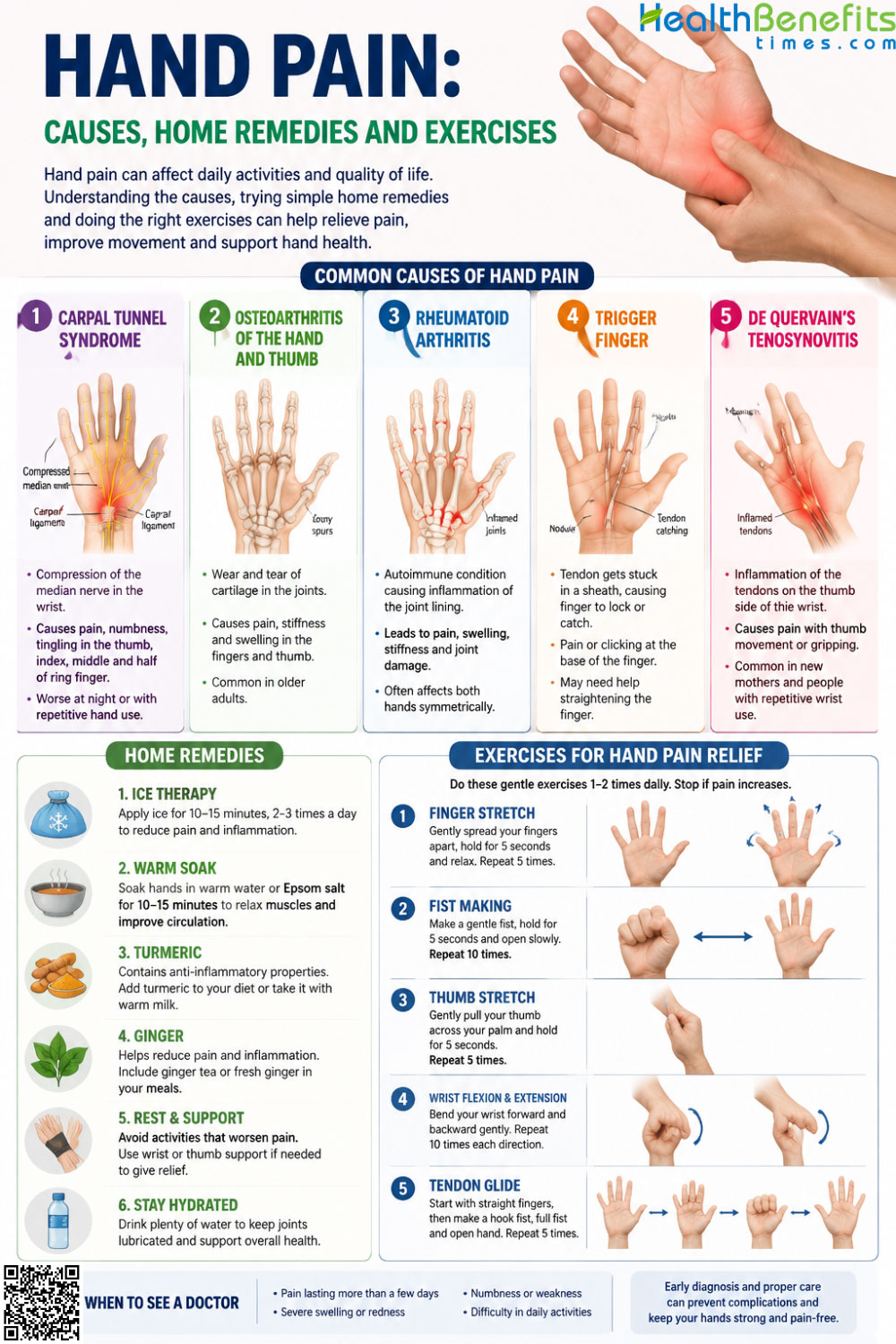
1. Carpal Tunnel Syndrome
Deep inside the wrist, there is a tiny, highly crowded tunnel made of hard bones and a strong band of tissue. This small passageway protects the median nerve, which acts like a vital communication cable sending feeling to the thumb and most of the fingers. When the soft tissues inside this tunnel get swollen from overuse, they crush the median nerve, creating the condition known as carpal tunnel syndrome 4. This intense nerve pinching creates a highly annoying tingling, numbness, and sometimes a sharp pain that travels up the arm and disturbs sleep.
When you want to treat this pressure at home, your absolute first goal is to keep your wrist as straight as possible. You should consciously avoid bending your wrist deeply while sleeping, typing on a computer, or reading a book. You can easily try contrast bathing in your kitchen; this means soaking your hands in a bowl of warm water for a minute, and then immediately switching to a bowl of cold water for a minute. This back-and-forth temperature change acts like a pump to help flush out the extra fluid that is squishing the nerve 20.
To get your hand moving better and reduce the pinched feeling, you should try doing gentle nerve and tendon gliding exercises. Start by holding your hand up in the air like you are telling someone to stop. Next, bend just the top knuckles so your fingers look like a hook. After that, fold your fingers flat against your upper palm. Finally, curl them all the way down to make a tight fist. Do this slowly about five times in a row, repeating the cycle a few times a day to keep the tendons gliding freely.
Note: Wearing a rigid wrist splint is commonly used as a physical remedy applied straight to the arm to securely hold the wrist in a safe, neutral position while you sleep to prevent further nerve crushing.
2. Osteoarthritis of the Hand and Thumb
Years of grabbing, twisting, and heavy lifting can eventually wear out the slippery, protective cartilage that beautifully cushions the bones in the hand. When this essential padding completely disappears, the bare bones begin to rub directly against each other during every movement, leading to a painful degenerative condition called osteoarthritis 44. The base of the thumb is one of the most common spots for this wear-and-tear to happen, making it very painful to pinch small items or grip things tightly.
If you are trying to ease this deep ache in your own living room, gentle warmth is going to be incredibly helpful to you. You should try wrapping a warm, damp towel around your sore hand for ten minutes to relax the stiff muscles and soothe the grinding joints. You also need to actively change how you grab everyday things. Instead of pinching a heavy cooking pan with your fingers, you should use both hands and lift from the bottom so you do not put unnecessary stress on your thumb joints.
You can keep your arthritic joints from completely freezing up by doing easy finger walks. Rest your hand flat on a table with your palm facing down toward the wood. Lift your index finger up and slowly move it toward your thumb, then put it down gently. Do this with each finger, walking them one by one across the table. You can also slowly touch the tip of your thumb to the tip of each finger to make an “O” shape, holding the pose for a few seconds.
Note: Nonsteroidal anti-inflammatory medicines are frequently swallowed as a medicinal benefit to temporarily block the natural chemicals in the body that create severe joint swelling and pain.
3. Rheumatoid Arthritis
Sometimes, the body’s natural defense system gets incredibly confused and starts acting like healthy body parts are dangerous invaders. In rheumatoid arthritis, the immune system directly attacks the soft, delicate lining inside the joints, causing them to fill rapidly with fluid and become very inflamed 43. This typically happens in both hands at the exact same time and leaves the fingers feeling incredibly stiff, especially during the first few hours after waking up in the morning.
When you are dealing with an active flare-up and your hands are noticeably hot and swollen, you should give them a complete rest. You can wrap a bag of frozen peas in a soft dish cloth and hold it over the hot joints for a few minutes to numb the stinging pain. However, when the joints are just stiff and no longer hot to the touch, you can run warm water over them in the sink to help loosen the stiffness before you start your day.
Exercising with this kind of severe arthritis means you must be very gentle and never push through sharp pain. You should try doing slow, relaxing wrist circles. Keep your elbow entirely still and gently draw a circle in the air with your hand, going one way and then reversing to the other. You can also place your hands flat on a table and spread your fingers as wide apart as you comfortably can, holding the wide stretch before bringing them back together 21.
Note: Specialized autoimmune drugs are commonly prescribed by doctors and swallowed or injected for medicinal benefits to successfully stop the immune system from destroying the healthy joints.
4. Trigger Finger
The strong muscles in your forearm connect to your fingers using long, string-like tendons that slide through small, lubricated tunnels called sheaths. If you do a massive amount of repetitive gripping, these sheaths can get highly irritated and swell up, leaving much less room for the tendon to move. This creates a highly frustrating condition called trigger finger, where the finger gets stuck in a bent position and then suddenly snaps or pops straight with a jolt 7.
Taking a long break from whatever activity is causing the intense irritation is the best thing you can do for yourself. If you have been doing a lot of heavy gardening, painting, or typing, you absolutely need to let your hand rest. You can massage the fleshy base of the sore finger gently to help increase blood flow, or apply a small cool pack if the palm feels tender and inflamed.
You want to keep the finger moving gently without forcing it to painfully snap. Use your good hand to gently hold the sore finger and slowly help it bend and straighten without using the finger’s own muscles. You can also place your hand flat on a table, keep your palm down, and gently lift just the sore finger up into the air for a few seconds before resting it back down softly.
Note: Corticosteroids are commonly used and applied as an injected medicinal remedy directly into the tendon sheath to quickly shrink the swollen tissue and allow the finger to move freely again.
5. De Quervain’s Tenosynovitis
Right near the base of the thumb, there are specific tendons that help you point your thumb up and pull it outward. When these specific tendons get rubbed the wrong way from repeating the exact same twisting motions like wringing out wet clothes or constantly lifting a heavy baby from a crib they become highly inflamed. This is known in the medical world as De Quervain’s tenosynovitis, and it causes a very sharp pain on the thumb side of the wrist 22.
To start the healing process at home, you must try your best to avoid twisting your wrist and pinching with your thumb at the same time. You should use ice wrapped in a towel on the side of your wrist to calm down the stinging, burning pain. When you must lift things, you should try to keep your wrist in a perfectly straight line with your arm, rather than letting it bend downward awkwardly.
For a helpful and safe exercise, rest your arm on a table with your hand hanging off the edge, making sure your thumb is pointing up toward the ceiling. You should gently move your wrist up and down like you are happily shaking hands with someone 23. Another wonderful stretch involves holding your hand out flat, tucking your thumb inside your palm, wrapping your fingers over it, and very gently bending your wrist downward until you feel a light stretch.
Note: Thumb spica splints are often worn as a physical remedy applied to the hand to freeze the thumb in place so the severely irritated tendons can finally rest and heal properly.
Foods and Activities to Avoid When You suffer from Hand pain
Thinking deeply about what you eat and how you move can make a massive difference in how your hands feel from day to day. Some daily habits sneakily make swelling and joint aches much worse over time.
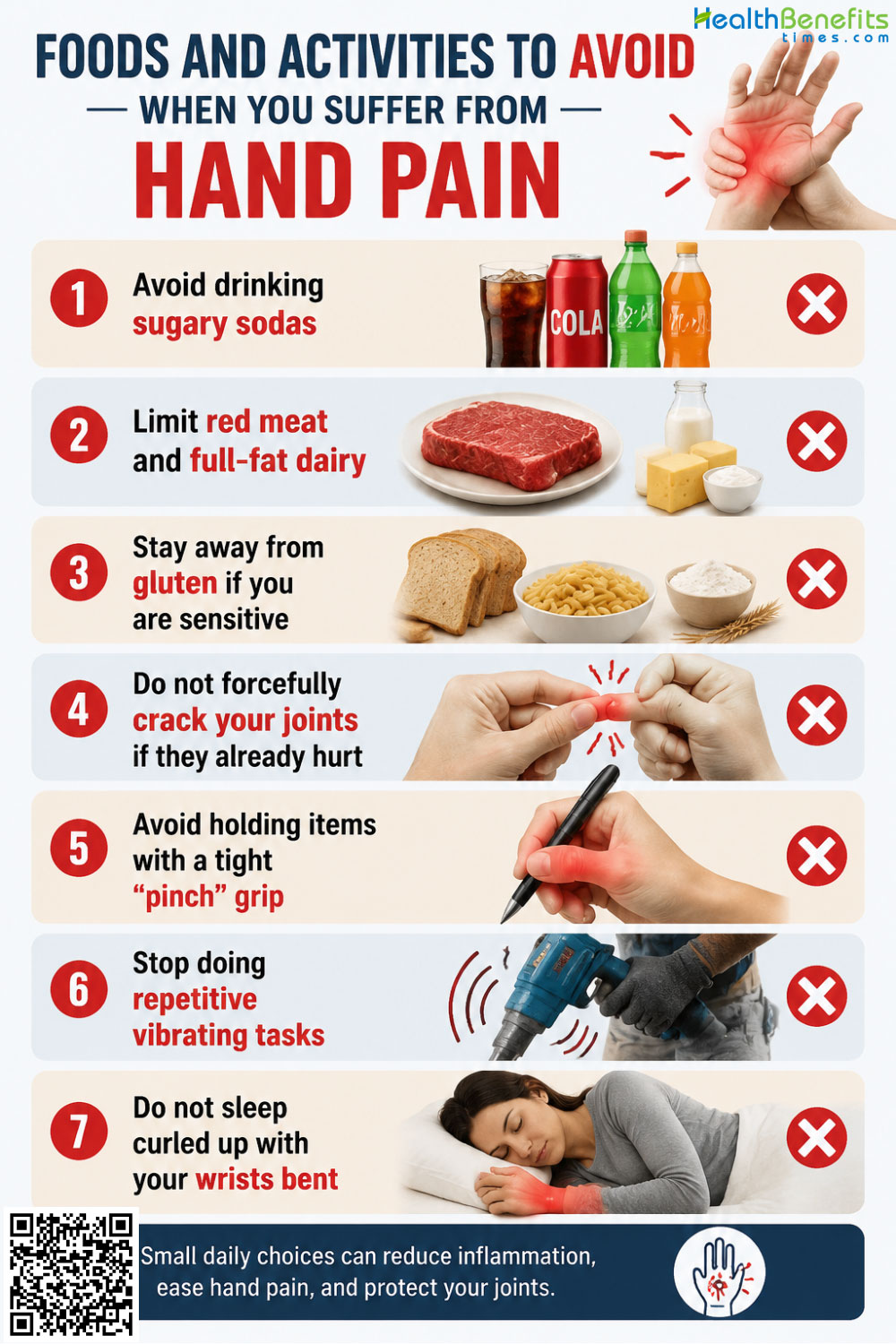
1. Avoid drinking sugary sodas
Gulping down sweet drinks packed with lots of added sugar is known to significantly increase inflammation inside the body, and people with joint pain often report that sugary treats make their arthritis symptoms visibly worse 24.
2. Limit red meat and full-fat dairy
Eating a large amount of heavy red meat or drinking whole cow’s milk brings saturated fats into your digestive system, which can heavily trigger inflammatory markers and make your joints feel hotter and stiffer 25.
3. Stay away from gluten if you are sensitive
For certain people with sensitive systems, the proteins found in wheat and gluten can accidentally set off the immune system, leading to extra joint swelling that you definitely want to avoid 25.
4. Do not forcefully crack your joints if they already hurt
While normal knuckle cracking is usually completely harmless, twisting or aggressively pulling swollen, arthritic joints can seriously aggravate your pain or even injure the nearby delicate tissues 26.
5. Avoid holding items with a tight “pinch” grip
You should never carry a heavy dinner plate or a thick hardcover book by tightly pinching the edge with your thumb and fingers, as this puts a tremendous, damaging load right on the fragile thumb joint.
6. Stop doing repetitive vibrating tasks
Using heavy power tools like sanders or drills that shake your hands violently for hours on end can permanently damage the small blood vessels and nerves, making conditions like carpal tunnel much worse.
7. Do not sleep curled up with your wrists bent
Tucking your hands tightly under your chin or bending your wrists completely downward while you are deep in sleep puts a huge amount of pressure on your nerves, causing you to wake up with numb, tingling fingers.
Myths and Misconceptions
Hearing advice from well-meaning friends is incredibly common, but a lot of the things people strongly believe about joint issues are actually completely wrong. Let’s look at the scientific facts to clear things up.
| Myth | Reality |
| Cracking your knuckles will definitely give you arthritis.
27. |
This is a very old and popular fairy tale. The cracking sound is simply harmless nitrogen gas bubbles bursting in the joint fluid. Studies comparing people who cracked their knuckles for 50 years to those who did not found absolutely no link to getting arthritis |
| If your hand hurts, you should stop moving it completely. | While resting a very hot, swollen joint is generally good, freezing your hand for weeks is a terrible idea. Not moving causes the muscles to rapidly shrink and the joints to become permanently stiff. Gentle, slow movement is actually necessary for healing. |
| Hand pain is just a normal part of getting older that you have to accept. | It is true that joint wear is more common as we age, but severe, life-changing pain is not normal. Many issues, like pinched nerves or stuck tendons, can be easily fixed or managed so you can live comfortably. |
| Eating a healthy diet will not do anything for your aching hands. | What goes into your stomach directly impacts your joints. Eating an anti-inflammatory diet full of fresh vegetables, berries, and omega-3 fish oils can actively calm down the chemical pathways that cause swelling in your hands. |
| Joint popping noises are always a sign of bad arthritis. | If your joint loudly pops without any pain whatsoever, it is usually just a tendon safely sliding over a bone or a normal fluid bubble popping. However, if the noise sounds like grinding sand and causes pain, that is when it might be arthritis. |
Special Considerations
1. Children
Seeing a child complain about stiff or aching hands can be very worrying because kids are usually so highly energetic and flexible. Sometimes, children unexpectedly develop a condition called Juvenile Idiopathic Arthritis (JIA), which is the absolute most common type of chronic childhood joint inflammation 30. When the tiny joints in a child’s hands and wrists become actively swollen, it can severely affect their normal daily life. Many school children with this issue report that holding a pencil and handwriting becomes incredibly painful and difficult 31. Even when doctors say the overall disease activity is currently low, a surprisingly large number of these kids still visibly struggle with moderate physical limitations while trying to participate in normal school activities 32. Catching this early is highly vital so that the child can get the right pediatric care to grow up strong and healthy.
2. Pregnancy
Growing a new life brings countless physical changes to a mother’s body, and surprisingly, dealing with numb fingers is one of them. During pregnancy, hormonal changes and massive fluid retention naturally cause tissues all over the body to puff up and swell 17. In the crowded wrist area, this extra fluid aggressively squishes the median nerve, leading to pregnancy-related carpal tunnel syndrome. Medical research shows that around 60% of pregnant women will experience this annoying tingling and pain, usually starting in the heavy third trimester 33. Thankfully, for the vast majority of new mothers, this uncomfortable hand pain naturally fades away a few weeks after the baby is born as the body’s fluid levels completely return to normal 34.
3. Chronic conditions
Living daily with a long-term health issue like diabetes means keeping a very close eye on how the hands and feet are feeling. High blood sugar levels over many years can actually change the physical makeup of the skin and internal tendons. This can directly lead to a highly restrictive complication known as diabetic hand syndrome, where the skin becomes thick and waxy, and the joints become permanently locked in a bent position because the connective tissues get far too stiff 35. People with diabetes are also much more likely to develop trigger finger and carpal tunnel syndrome compared to people without the metabolic disease 36. Furthermore, in tropical climates, minor, everyday scratches on a diabetic patient’s hand can incredibly quickly turn into severe infections, making quick medical care absolutely necessary to save the hand 37.
4. Elderly
As the years naturally pass, the joints in the hands visually show the history of all the hard work they have done. Osteoarthritis is incredibly common in older adults, with the risk skyrocketing as people happily pass the age of 75 2. For the elderly population, having sore, stiff hands is much more than just a daily bother; it can actually be a major life safety risk. If the hands become too weak to tightly grip a handrail on the stairs or open a heavy glass door, the chance of having a highly dangerous fall dramatically increases. Keeping the hands moving with gentle, daily stretching exercises is highly recommended to help older adults maintain their independence and seamlessly continue taking care of themselves safely at home.
Precaution before use of natural remedies when you have Hand pain
Trying out natural plant treatments sounds like a perfectly safe and healthy idea, but even plants and basic home tools can cause unexpected trouble if you are not very careful. You absolutely need to keep these important safety tips in mind.
1. Watch out for high-dose turmeric
Turmeric is a very popular yellow spice widely used to fight swelling, but special pill formulas designed to be super-strong have been strongly linked to serious liver damage in some people. If you take these pills and start feeling very tired, nauseous, or notice your urine turning dark, you must stop immediately and call your doctor 38.
2. Do not use herbal pills during pregnancy without asking
If you are happily expecting a baby, taking large amounts of turmeric or other highly concentrated herbal joint supplements is generally considered totally unsafe because scientists do not fully know how it affects the growing baby 38.
3. Check for medicine mix-ups
Natural herbs like willow bark or thunder god vine might sound beautifully gentle, but they can actually change the way your normal prescription medicines work, causing highly dangerous side effects 39. You must always tell your healthcare provider what natural items you are swallowing.
4. Do not wear a splint all day and night
Wrapping your sore wrist in a stiff brace feels nice and supportive, but if you wear it 24 hours a day for weeks, the muscles in your hand will begin to rapidly shrink and get incredibly weak from not being used.
5. Be careful with ice if your nerves are damaged
If you have diabetes or severe nerve damage that makes your skin numb, you might accidentally leave an ice pack on your hand for way too long. Because you cannot feel the freezing cold, you could accidentally give yourself severe frostbite.
6. Never put heat on a bright, hot joint
If your knuckles are experiencing an active arthritis flare-up and are glowing red and feeling physically hot, laying a heating pad on them will strongly pump more blood into the area and make the swelling much worse.
When to see Doctor
Most of the time, a little bit of quiet rest and a warm soak will get your hands feeling right again. However, some specific warning signs mean your hand needs professional medical attention right away to prevent permanent damage.
1. You suddenly lose all your grip strength
If you find yourself frequently dropping light objects like a plastic cup, or if you absolutely cannot even pinch your keys to unlock the front door, a major nerve might be getting crushed and needs help fast 40.
2. Your hand looks severely infected
If you get a tiny scratch and suddenly your whole hand becomes bright red, intensely hot, heavily swollen, and you start running a high fever, you must go to a doctor immediately to stop the fast-moving infection 41.
3. Your joints are rapidly changing shape
If you look at your fingers and notice they are starting to look permanently crooked, twisted, or heavily deformed, a doctor can give you special medicine to completely stop the joints from getting destroyed any further.
4. Nothing you do at home is helping
If you have been resting, wearing a splint, and doing your gentle stretches for several long weeks but the burning pain or numbness is exactly the same or getting much worse, it is time to get a professional opinion.
5. You hear a loud pop during an injury
If you unfortunately fall off a bicycle or bend your finger backward and hear a sickening snap or grinding sound followed by intense pain, you might have broken a bone or torn a ligament, which thoroughly requires an X-ray to diagnose correctly 42.
Comments
comments