


Causes of Tennis Elbow
1. Repetitive Wrist and Arm Motions
The primary cause of this condition is the continuous, repetitive use of the forearm muscles. Frequent bending, gripping, or twisting motions exhaust the muscles, ultimately causing microscopic tears in the tendon that attaches to the outer elbow bone 1.
2. Occupational and Manual Labor Strains
The majority of individuals who develop this injury do not play tennis, but rather perform jobs requiring forceful, repetitive hand movements. Professions involving heavy manual labor, such as plumbing, painting, carpentry, and repetitive assembly line work, significantly increase the daily mechanical stress placed on the elbow tendons 2.
3. Sports Technique and Equipment
In racquet sports, repeatedly hitting backhand strokes with improper physical technique directs excessive shock straight into the elbow tendon. Additionally, using a tennis racquet with a grip that is too small or strings that are overly tight substantially increases the harmful vibration and force absorbed by the forearm 3.
4. Age-Related Tissue Degeneration
As the body ages, tendons naturally lose some of their elasticity and become more susceptible to injury and breakdown. Clinical data demonstrates that tennis elbow most frequently develops in adults between the ages of 30 and 50, reflecting the accumulation of long-term wear and tear on the tendon fibers 1.
5. Sudden, Unaccustomed Physical Activity
Engaging in a new or unusually demanding physical task that the arm is not conditioned for can trigger the condition. Activities such as intensely pruning a garden, aggressively turning a screwdriver, or painting an entire room over a single weekend can abruptly overload the extensor tendon and initiate the injury 2.
Symptoms of Tennis Elbow
- Localized Outer Elbow Pain: The most prominent clinical sign is a persistent ache or sharp tenderness located directly on the bony bump on the outer side of the elbow. This localized pain indicates active tissue distress and micro-tearing at the exact point where the forearm tendon anchors to the bone 1.
- Radiating Forearm Discomfort: The pain frequently travels downward from the outer elbow, spreading along the back of the forearm toward the wrist. This radiating sensation typically intensifies when the affected arm is actively used to lift objects or stabilize the wrist 2.
- Weakened Grip Strength: Individuals routinely experience a noticeable loss of functional grip strength in the affected hand. The underlying structural damage to the extensor tendon significantly impairs the forearm muscles’ ability to forcefully grasp, pinch, or hold objects securely 1.
- Pain Triggered by Routine Gripping: The physical discomfort sharply spikes when performing simple, everyday tasks that require extending the wrist or gripping an object. Routine actions such as turning a rigid doorknob, shaking hands, opening a sealed jar, or simply holding a full coffee cup reliably reproduce the sharp elbow pain 1.
- Morning Stiffness: The affected elbow joint often feels distinctly stiff and achy upon waking in the morning. This initial immobility and discomfort gradually improve as the arm is moved and normal blood flow increases to the damaged tendon throughout the day 4.
Home Remedies for Tennis Elbow
1. Rest and Modify Daily Activities
How it may help
Taking a break from repetitive forearm motions immediately stops the mechanical overloading that causes microscopic tears in the elbow tendon. By eliminating the direct source of physical stress, resting allows the damaged tissue to initiate natural cellular repair processes, which effectively reduces localized pain and promotes healing 1.
What research says
Clinical orthopedics establishes that relative rest remains the primary, most effective initial intervention for lateral epicondylitis. Medical literature confirms that avoiding painful, repetitive wrist extensions for several weeks significantly decreases tendon inflammation, successfully preventing acute microscopic tissue tears from progressing into chronic tendon degeneration 4.
How to use it safely
You should temporarily stop activities causing sharp elbow pain, like heavy lifting. Instead of complete immobilization, you must practice active rest by modifying movements. Lift everyday objects with your palms facing upward to successfully shift the physical load away from the damaged outer tendon 2.
Potential precautions or side effects
You must avoid completely immobilizing the arm for extended periods. Total inactivity rapidly causes severe joint stiffness and muscle weakness, which significantly complicates the tendon recovery process 1.
2. Apply Ice Packs to the Outer Elbow
How it may help
Cryotherapy directly constricts local blood vessels around the damaged extensor tendon. This rapid vascular constriction successfully reduces acute tissue swelling and numbs irritated nerve endings in the outer elbow. Consequently, applying cold therapy provides immediate, localized relief from the sharp, throbbing pain caused by fresh tendon micro-tears 1.
What research says
Clinical sports medicine guidelines establish that ice application effectively manages acute pain during the initial phase of lateral epicondylitis. Medical studies confirm that localized cooling temporarily decreases tissue metabolism and nerve conduction velocity, providing a proven, non-pharmacological method to significantly reduce immediate tendon discomfort 4.
How to use it safely
You should wrap a cold pack in a thin towel to protect your skin from freezing. Apply this wrapped ice pack directly to the painful outer elbow for fifteen to twenty minutes. You must repeat this cooling process three to four times daily during acute pain flare-ups 1.
Potential precautions or side effects
You must never apply ice directly to bare skin, as this rapidly causes severe frostbite. Avoid leaving cold packs on the elbow longer than twenty minutes to prevent cellular damage 1.
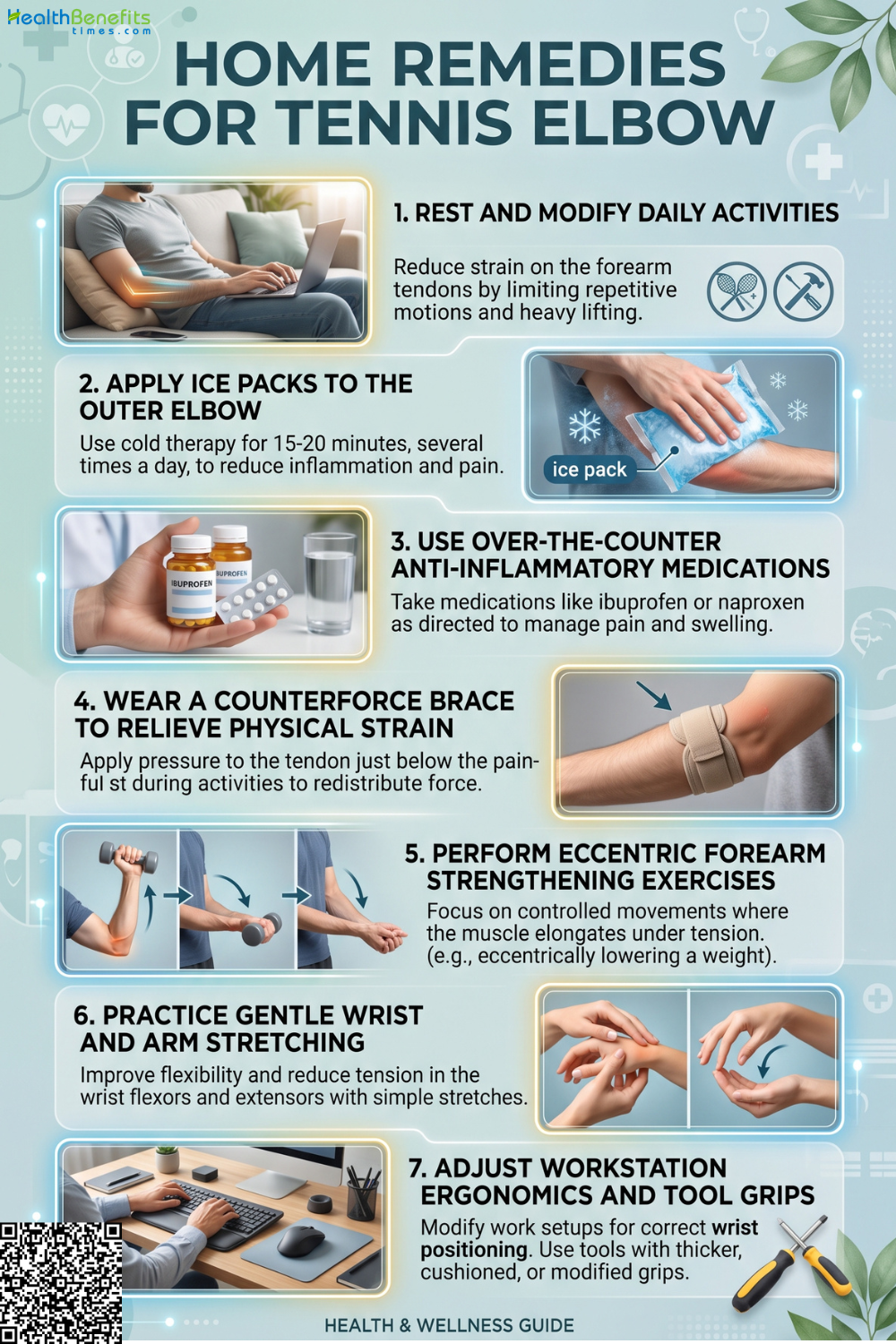
3. Use Over-the-Counter Anti-Inflammatory Medications
How it may help
Nonsteroidal anti-inflammatory drugs, such as ibuprofen or naproxen, directly block specific bodily chemicals that trigger pain and swelling. By inhibiting this chemical response, these oral medications quickly reduce sharp discomfort and mild tissue irritation around the damaged elbow tendon, making basic daily arm movements much more tolerable 1.
What research says
Clinical research demonstrates that anti-inflammatory medications successfully provide significant short-term pain relief during the early, acute phase of tennis elbow. However, medical evidence concludes these drugs do not actively repair the underlying tendon tears or improve the long-term healing outcome of the injured tissue 4.
How to use it safely
You should take these over-the-counter medications exactly as directed on the package label, always consuming them with food and a full glass of water. You must limit continuous use to short periods, generally no more than one to two weeks 1.
Potential precautions or side effects
You must avoid prolonged use, as it frequently causes severe stomach ulcers, dangerous internal bleeding, and kidney stress. Always consult a doctor before mixing these pills with other prescriptions 4.
4. Wear a Counterforce Brace to Relieve Physical Strain
How it may help
A counterforce brace applies targeted compression to the upper forearm muscle. This physical pressure creates a new anchoring point, absorbing mechanical force before it reaches the elbow. By shifting the stress away from the damaged extensor tendon, the brace immediately reduces sharp pain during daily arm activities 1.
What research says
Clinical studies confirm that counterforce bracing significantly improves grip strength and reduces pain in patients with lateral epicondylitis. Medical research demonstrates these orthotic devices successfully decrease muscle tension at the tendon’s bone attachment, providing an effective mechanical intervention for short-term symptom relief and functional improvement 4.
How to use it safely
You should position the brace approximately one to two inches below the painful elbow bump. You must wrap the strap snugly around the thickest part of the forearm and wear it only during physical tasks that require repetitive gripping, heavy lifting, or forceful wrist twisting 2.
Potential precautions or side effects
You must avoid securing the brace too tightly. Excessive compression directly restricts vascular blood circulation and pinches peripheral nerves, which rapidly causes dangerous swelling and localized hand numbness 1.
5. Perform Eccentric Forearm Strengthening Exercises
How it may help
Eccentric strengthening involves slowly lengthening the forearm muscle under tension. This specific mechanical loading actively stimulates collagen production and realigns disorganized tissue fibers within the damaged tendon. Rebuilding this cellular structure directly restores tendon strength and significantly reduces chronic elbow pain over time 4.
What research says
Clinical orthopedics establishes eccentric exercise as a highly effective long-term treatment for lateral epicondylitis. Medical research demonstrates that consistently performing these controlled, lengthening contractions structurally repairs tendon degeneration better than traditional resting, successfully improving grip strength and resolving chronic pain in most patients 4.
How to use it safely
You should hold a light weight, extending your wrist upward using your uninjured hand. You must then slowly lower the weight using only the injured forearm. Perform these controlled lowering movements daily, gradually increasing the weight as your tendon heals 2.
Potential precautions or side effects
You must stop immediately if you experience sharp, sudden elbow pain. Lifting excessively heavy weights prematurely directly causes further tendon tearing and severely delays your overall healing process 1.
6. Practice Gentle Wrist and arm Stretching
How it may help
Gentle stretching actively lengthens the forearm extensor muscles and improves local tissue flexibility. This physical elongation directly reduces chronic muscle tension pulling on the damaged elbow tendon. Relieving this structural tightness improves essential blood circulation and decreases joint stiffness, which significantly eases localized elbow pain during daily movements 1.
What research says
Clinical rehabilitation guidelines establish that incorporating daily wrist and forearm stretches significantly improves range of motion for lateral epicondylitis. Medical studies confirm that combining gentle stretching with muscle strengthening protocols successfully accelerates tendon healing and rapidly reduces pain intensity compared to strict elbow immobilization 4.
How to use it safely
You should extend your arm fully and gently bend your wrist downward using your opposite hand until you feel a mild stretch. You must hold this position for twenty to thirty seconds without bouncing, repeating this controlled movement two to three times daily 2.
Potential precautions or side effects
You must avoid pushing the stretch into sharp pain. Overstretching forcibly pulls the compromised tissue, directly causing severe micro-tears that significantly worsen your elbow injury and delay healing 1.
7. Adjust Workstation Ergonomics and Tool Grips
How it may help
Adjusting workstation ergonomics directly prevents awkward wrist angles and reduces excessive gripping force. Enlarging tool handles and repositioning keyboards successfully lowers the continuous mechanical load on forearm muscles. Eliminating this repetitive daily strain stops ongoing microscopic tissue damage, allowing the compromised elbow tendon to heal without further structural irritation 1.
What research says
Occupational medicine research establishes that poor physical ergonomics significantly increase the risk of lateral epicondylitis. Clinical studies demonstrate that modifying workspaces and increasing tool grip diameters successfully decreases the biomechanical force transmitted to the extensor tendon, providing a highly effective, non-surgical intervention for long-term recovery and continuous injury prevention 3.
How to use it safely
You should adjust your daily desk height to ensure your wrists remain completely straight and neutral while typing. You must wrap manual hand tools with foam padding to increase their physical grip diameter, which directly reduces the severe pinching force required to hold them securely 5.
Potential precautions or side effects
You must avoid making tool grips excessively large. Gripping overly thick handles stretches the hand awkwardly, rapidly inducing severe muscle cramping and creating entirely new secondary wrist injuries 3.
Foods to Avoid When You Suffer from Tennis Elbow
1. Highly Processed Sugars
High glucose intake actively increases cellular stress and severely degenerates tendon cells, directly delaying the natural tissue repair required for complete elbow recovery 6.
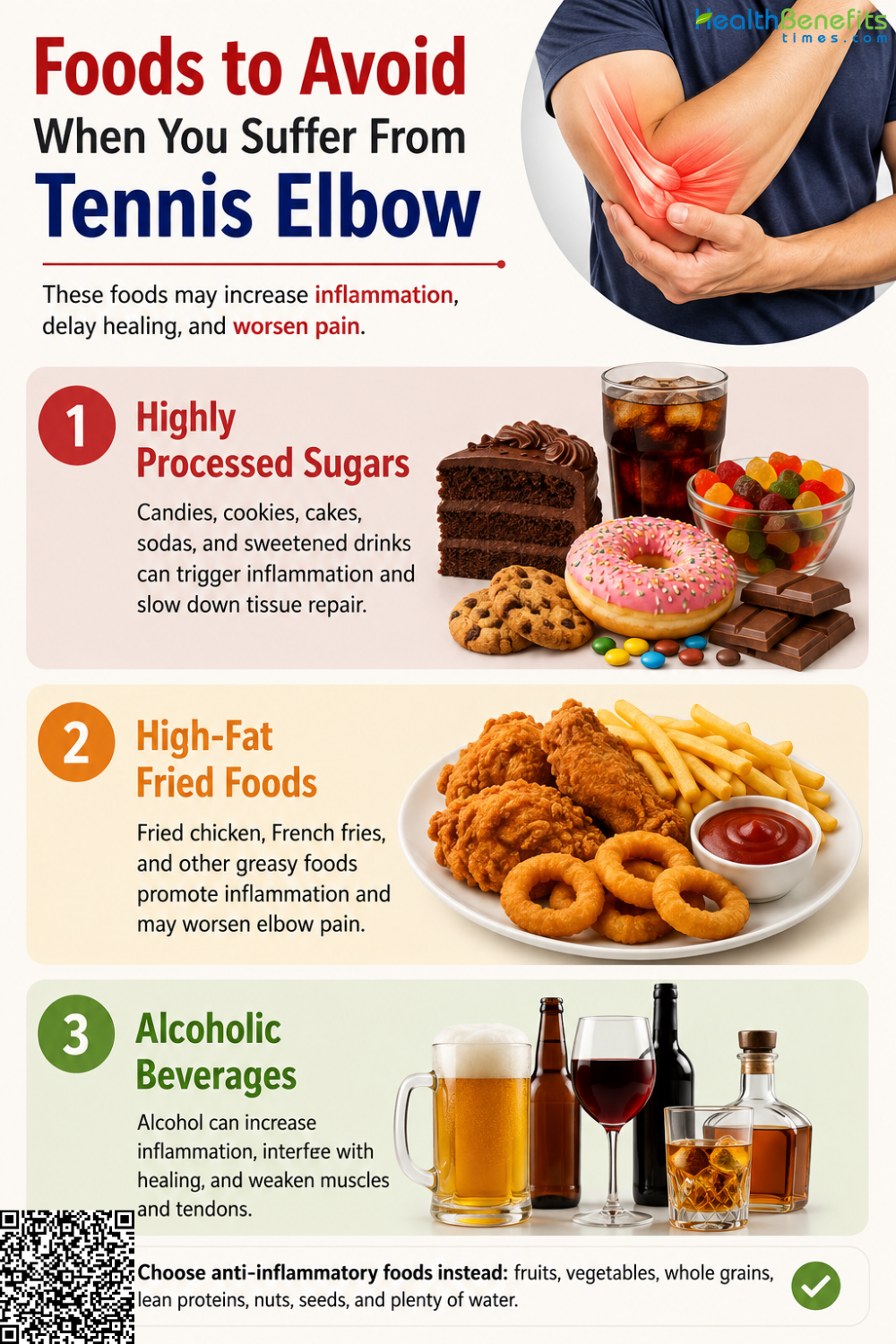
2. High-Fat Fried Foods
Consuming a high-fat diet significantly increases systemic inflammation and degrades tendon tissue quality, directly raising the risk of severe tendinopathy and slowing necessary collagen repair 7.
3. Alcoholic Beverages
Alcohol consumption severely impairs the body’s immune response and heavily limits collagen production, directly preventing damaged extensor tendons from properly healing microscopic tissue tears 8.
When to See a Doctor When You Struggle from Tennis Elbow
- Lack of Improvement: Seek a medical evaluation if localized elbow pain fails to improve after several weeks of continuous rest, ice application, and over-the-counter anti-inflammatory medications 1.
- Severe Functional Loss: Consult a physician if elbow pain becomes severe enough to prevent routine daily activities, such as firmly gripping small objects or turning a doorknob 2.
- Restricted Joint Mobility: Seek immediate clinical attention if you experience severe joint stiffness that physically restricts your range of motion and prevents you from fully bending or straightening the arm 1.
- Signs of Infection or Nerve Damage: Request an urgent medical assessment if the elbow develops visible redness, localized heat, or spreading numbness, which strongly indicates a potential joint infection or severe nerve entrapment 1.
Comments
comments