

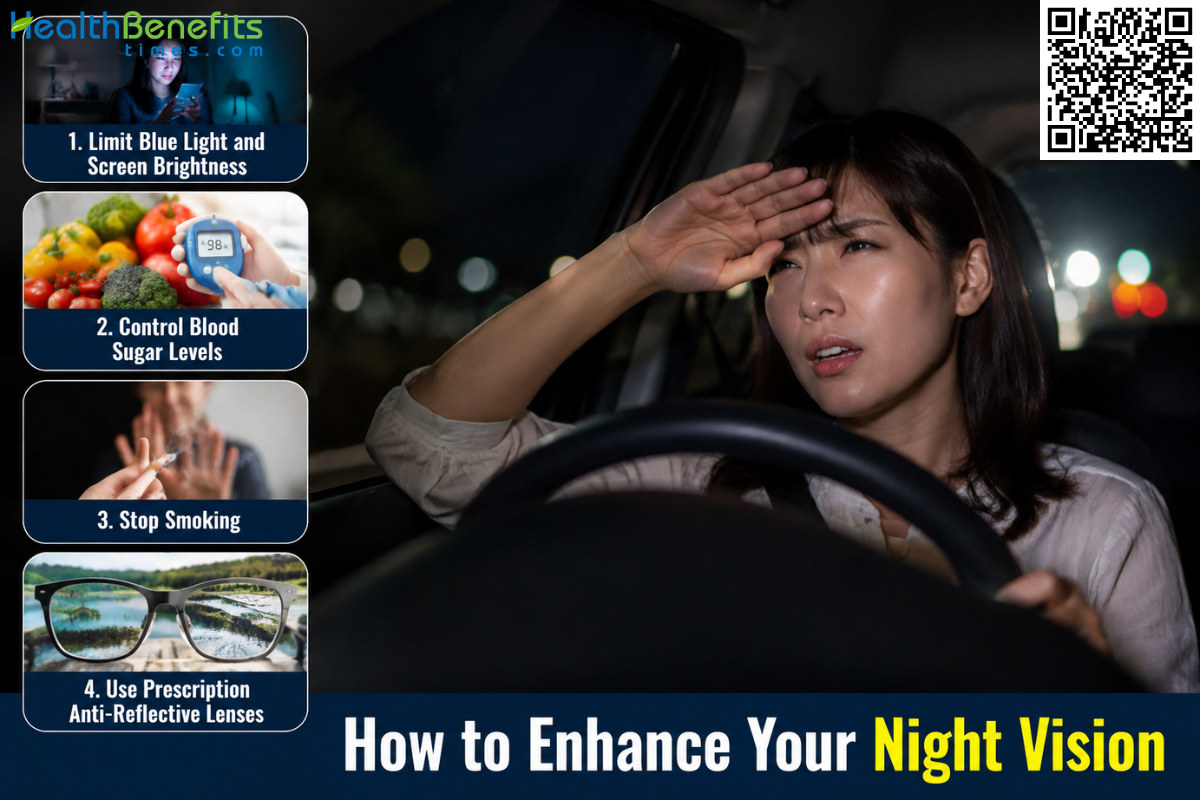
How to Enhance Your Night Vision
1. Ensure Adequate Vitamin A Intake
How it may help
Vitamin A is essential for producing rhodopsin, a specialized light-sensitive protein found in the retina’s rod cells. This protein allows the eyes to detect minimal light in dark environments. Maintaining adequate Vitamin A levels directly supports the eye’s ability to adapt to darkness and process low-light visual signals 6.
What research says
Clinical studies confirm that Vitamin A deficiency directly causes night blindness. Research demonstrates that administering Vitamin A supplementation successfully reverses this condition and restores normal low-light vision in deficient individuals, though it does not improve night vision beyond normal limits in people with already adequate nutrient levels 7.
How to use it safely
You should prioritize obtaining Vitamin A through foods like sweet potatoes and leafy greens. If using supplements, healthy adults should aim for the recommended daily amount of 900 micrograms for men and 700 micrograms for women 8. Always consult your doctor before starting a new supplement.
Potential precautions or side effects
Consuming excess preformed Vitamin A from supplements can cause severe toxicity, leading to liver damage, headaches, joint pain, and serious birth defects during pregnancy 8.
2. Consume Lutein and Zeaxanthin
How it may help
Lutein and zeaxanthin are antioxidants that accumulate in the retina to form the macular pigment. They filter harmful blue light and reduce oxidative damage. By maintaining a dense macular pigment, these nutrients enhance contrast sensitivity and reduce the blinding effect of bright lights at night 9.
What research says
Clinical trials conclude that daily supplementation with lutein and zeaxanthin significantly increases macular pigment density. This structural increase effectively shortens glare recovery time—the time required for vision to normalize after exposure to bright headlights—and improves overall contrast sensitivity in low-light conditions 9.
How to use it safely
You can naturally increase your intake by eating dark leafy greens like spinach and kale. If you choose supplements, a standard, clinically evaluated daily dose is 10 milligrams of lutein and 2 milligrams of zeaxanthin 10. Always consult your physician first.
Potential precautions or side effects
These supplements are considered safe for general use. However, taking excessively high doses over prolonged periods can cause carotenodermia, a harmless and reversible yellowing of the skin 11.
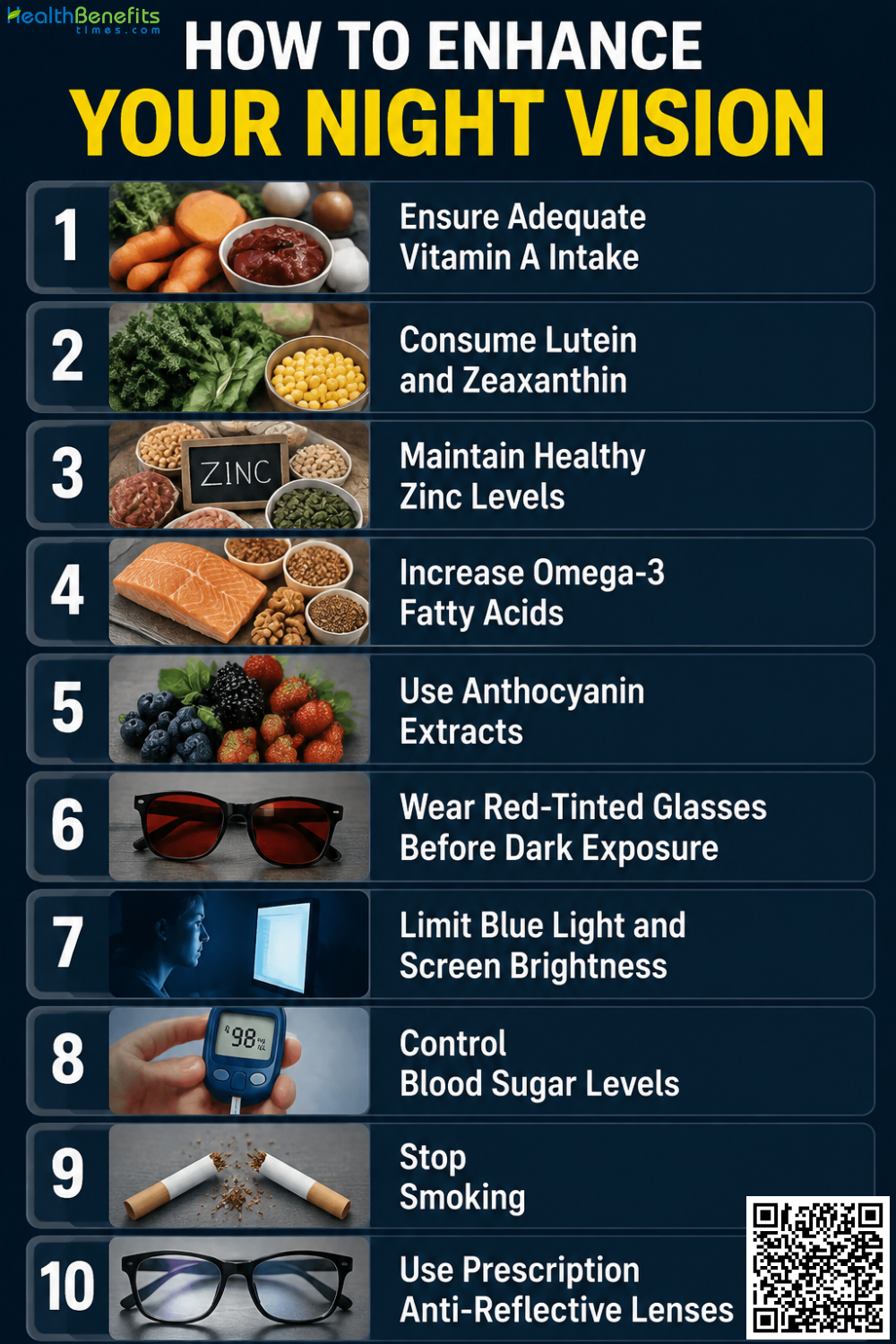
3. Maintain Healthy Zinc Levels
How it may help
Zinc is an essential mineral found in high concentrations in the retina. It plays a critical role in transporting vitamin A from the liver to the eye. Once there, vitamin A helps produce rhodopsin, the primary light-sensitive protein necessary for the eyes to function in low-light environments 12.
What research says
Clinical research demonstrates that severe zinc deficiency can directly cause night blindness, even when vitamin A intake is adequate. Studies conclude that administering zinc supplementation to deficient individuals effectively restores normal dark adaptation and resolves low-light vision impairments 13.
How to use it safely
You can maintain healthy levels by eating zinc-rich foods like meat, poultry, and beans. If taking supplements, keep your total daily intake below the upper limit of 40 milligrams to prevent toxicity 14. Always consult your doctor before starting any supplement routine.
Potential precautions or side effects
High doses of zinc can cause nausea, stomach cramps, and vomiting. Long-term excessive use may lead to a severe copper deficiency, causing neurological issues and weakened immunity 14.
4. Increase Omega-3 Fatty Acids
How it may help
Omega-3 fatty acids, particularly docosahexaenoic acid (DHA), form a major structural component of the retina. They maintain the cellular membrane fluidity of rod photoreceptors required to detect dim light. DHA actively supports the efficient regeneration of rhodopsin, the primary light-sensitive protein needed to adapt to darkness 15.
What research says
Clinical and experimental studies confirm that a deficiency in retinal DHA significantly impairs scotopic, or night, vision. Research concludes that maintaining optimal omega-3 levels preserves photoreceptor structure, prevents early rod cell degeneration, and sustains normal visual sensitivity in dark environments as people age 15.
How to use it safely
You can safely increase your intake by eating fatty fish, like salmon, twice a week. If using dietary supplements, health guidelines recommend consuming no more than 3 grams of combined EPA and DHA daily 16. Always consult your healthcare provider first.
Potential precautions or side effects
Mild side effects include bad breath, nausea, and indigestion. High doses may reduce blood clotting, meaning you should exercise caution if taking blood-thinning medications 16.
5. Use Anthocyanin Extracts
How it may help
Anthocyanins are powerful plant pigments found in dark berries that possess strong antioxidant properties. They work by protecting retinal cells against light-induced oxidative stress and accelerating the regeneration rate of rhodopsin, the key light-sensitive protein used by rod cells to see in low-light environments 17.
What research says
Clinical studies show mixed results regarding anthocyanins for night vision. While certain trials demonstrate that bilberry and blackcurrant anthocyanins improve dark adaptation and reduce visual fatigue, comprehensive systematic reviews conclude that there is insufficient high-quality evidence to confirm that supplement extract enhances normal low-light visual acuity 17.
How to use it safely
You can safely obtain anthocyanins by consuming dark fruits like bilberries, blueberries, and blackcurrants. If opting for standardized extract supplements, doses commonly evaluated in clinical trials range between 160 to 320 milligrams daily 17. Consult your physician before starting a supplement.
Potential precautions or side effects
Anthocyanin extracts are well-tolerated, but high doses may cause mild digestive issues or interact with antiplatelet and anticoagulant medications 17.
6. Wear Red-Tinted Glasses Before Dark Exposure
How it may help
Red-tinted glasses allow the eyes to adapt to darkness while you remain in a lit environment. Because the rod cells responsible for night vision are largely insensitive to long-wavelength red light, these lenses block disruptive wavelengths, allowing rhodopsin to regenerate without requiring complete darkness 18.
What research says
Sensory and physiological research confirms that red-filtered goggles effectively isolate daylight-sensitive cone cells while preventing rod stimulation. Studies validate that this permits rods to fully regenerate under ambient light, allowing individuals to bypass the typical 30-minute dark adaptation phase when finally entering an unlit environment 18.
How to use it safely
You should put on red-tinted glasses 20 to 30 minutes before transitioning into a dark setting. Remove them once you enter the darkness. Never wear these lenses while driving or performing tasks where accurate color recognition is necessary for safety 18.
Potential precautions or side effects
Red lenses severely distort normal color perception and contrast. This visual alteration can make it exceptionally difficult to identify red objects, warning signs, or color-coded safety signals 19.
7. Limit Blue Light and Screen Brightness
How it may help
Electronic screens emit high levels of bright, short-wavelength blue light. This intense light rapidly bleaches rhodopsin, the primary protein in rod cells required for night vision. Limiting screen brightness and filtering blue light prevents this severe bleaching, allowing your eyes to retain their sensitivity and adapt to darkness quickly 20.
What research says
Clinical evaluations demonstrate that viewing bright smartphone screens significantly weakens the visual responses of rod cells. Research confirms that bright, blue-enriched light forces the eyes out of a dark-adapted state, greatly prolonging the time required for rhodopsin to regenerate and for normal night vision to recover in darkness 20.
How to use it safely
You should enable blue-light filtering modes on all digital devices at least 30 to 60 minutes before entering a dark environment. Additionally, manually lower your screen brightness to the minimum readable level to reduce the light exposure that disrupts your retinal rod cells 20.
Potential precautions or side effects
While this practice is entirely safe, severely reducing screen brightness can cause temporary eye strain if you try to read small text in a brightly lit environment 20.
8. Control Blood Sugar Levels
How it may help
Chronically high blood sugar damages the fragile microvascular network that supplies oxygen and nutrients to the retina. This vascular damage restricts blood flow to rod cells, preventing them from properly regenerating the proteins required for low-light vision. Maintaining stable glucose levels protects these ocular vessels and preserves retinal function 21.
What research says
Clinical studies establish that patients with poor glycemic control experience significantly delayed dark adaptation and impaired scotopic sensitivity long before severe visual loss occurs. Research confirms that strict blood sugar management effectively prevents or delays the onset of diabetic retinopathy, safeguarding the structural integrity of night-vision photoreceptors 22.
How to use it safely
You should work with a healthcare provider to establish a personalized target range for your blood glucose. Achieve this by maintaining a balanced diet, exercising regularly, and adhering to prescribed medications or insulin therapies to keep your hemoglobin A1C levels within healthy limits 23.
Potential precautions or side effects
Aggressively managing blood sugar can occasionally lead to hypoglycemia, or dangerously low blood glucose. Symptoms include dizziness, confusion, sweating, and fainting if levels drop too rapidly 24.
9. Stop Smoking
How it may help
Cigarette smoke introduces numerous toxic chemicals into the bloodstream, causing oxidative stress and narrowing blood vessels throughout the body. This vascular constriction reduces the delivery of essential oxygen and nutrients to the retina, hindering the normal metabolic function and regenerative capacity of night-vision photoreceptor cells 25.
What research says
Clinical studies establish that smoking significantly increases the risk of retinal damage and accelerates the deterioration of visual function in low-light conditions. Research concludes that smoking cessation stops ongoing vascular injury and preserves remaining retinal health, helping stabilize and protect long-term scotopic visual sensitivity 26.
How to use it safely
You should quit smoking completely by utilizing evidence-based cessation strategies, such as behavioral counseling, support programs, or approved nicotine replacement therapies. Consult your healthcare provider to design a personalized and safe quitting plan tailored to your health needs 27.
Potential precautions or side effects
Stopping smoking can temporarily cause nicotine withdrawal symptoms, including irritability, anxiety, headaches, and increased cravings, which typically peak within the first week 28.
10. Use Prescription Anti-Reflective Lenses
How it may help
Anti-reflective coatings applied to prescription eyeglasses eliminate light reflections from the front and back surfaces of the lenses. By allowing more ambient light to pass directly into the eye, these lenses reduce blinding glare, minimize light scattering, and prevent halos from oncoming headlights in dark environments 29.
What research says
Clinical evaluations confirm that anti-reflective lenses significantly increase light transmittance compared to standard uncoated lenses. Research concludes that this reduction in lens surface reflections measurably improves contrast sensitivity, minimizes visual fatigue, and enhances overall visual acuity during nighttime driving and in low-light conditions 29.
How to use it safely
You should consult an optometrist to obtain the correct prescription tailored with a high-quality anti-reflective coating. Always clean your lenses using a microfiber cloth and appropriate optical spray, as dry wiping can scratch the delicate coating and ruin its clarity 30.
Potential precautions or side effects
Anti-reflective lenses cannot cure biological night blindness. Furthermore, if the delicate coating becomes severely scratched, smudged, or degraded, it will actively scatter light and significantly worsen nighttime glare 30.
Comments
comments