

Causes of Sun Tan
- Ultraviolet A (UVA) Radiation Exposure: UVA rays penetrate deep into the skin’s dermis, triggering the immediate darkening of existing melanin pigment. This process, known as immediate pigment darkening, results in a tan that appears quickly but provides virtually no protection against further radiation-induced cellular damage 1.
- Melanocyte Stimulation by Ultraviolet B (UVB) Radiation: UVB rays primarily affect the outer skin layers and stimulate melanocytes to increase the production of new melanin. This delayed tanning process takes several days to become visible as the skin ramps up pigment synthesis as a protective response to radiation-induced stress 2.
- DNA Damage and Cellular Stress Response: Exposure to high-energy UV radiation causes direct injury to the DNA within skin cells. In response to this genetic stress, the body accelerates melanin production to act as a physical shield, attempting to prevent further damage to the cell’s nucleus 2.
- Artificial UV Sources: The use of tanning beds, sunlamps, or UV booths exposes the skin to concentrated levels of UVA and UVB radiation. This artificial exposure mimics the effects of direct sunlight, forcing the skin into the same defensive darkening response that occurs during outdoor sun exposure 2.
Symptoms of Sun Tan
- Darkening of Skin Pigmentation: The most prominent indicator of a tan is a visible shift in skin tone toward a darker, browner, or bronzed hue. This change is caused by an increase in melanin production as the body attempts to shield deeper layers of tissue from further ultraviolet radiation 2.
- Uniformity of Coloration: Unlike localized sun spots, a sun tan typically presents as a relatively uniform darkening across the areas of skin that were directly exposed to the light source, rather than manifesting as distinct or discrete spots 2.
- Absence of Immediate Surface Texture Change: In the initial stages, a tan does not typically alter the texture or surface smoothness of the skin. The skin remains intact, without the roughness or peeling that characterizes more severe, acute radiation damage such as a sunburn 1.
- Gradual Fading Over Time: A tan is not a permanent state; as the outer layers of the skin naturally shed and renew themselves through the normal biological cycle of cell replacement, the excess pigment will gradually fade, provided that additional UV exposure is avoided 2.
- Subclinical Indicators of Radiation Injury: Although the skin appears darker, it may also present with increased dryness or a subtle feeling of tightness due to the depletion of natural skin oils and moisture resulting from UV-induced oxidative stress 1.
How to Remove Sun Tan Naturally
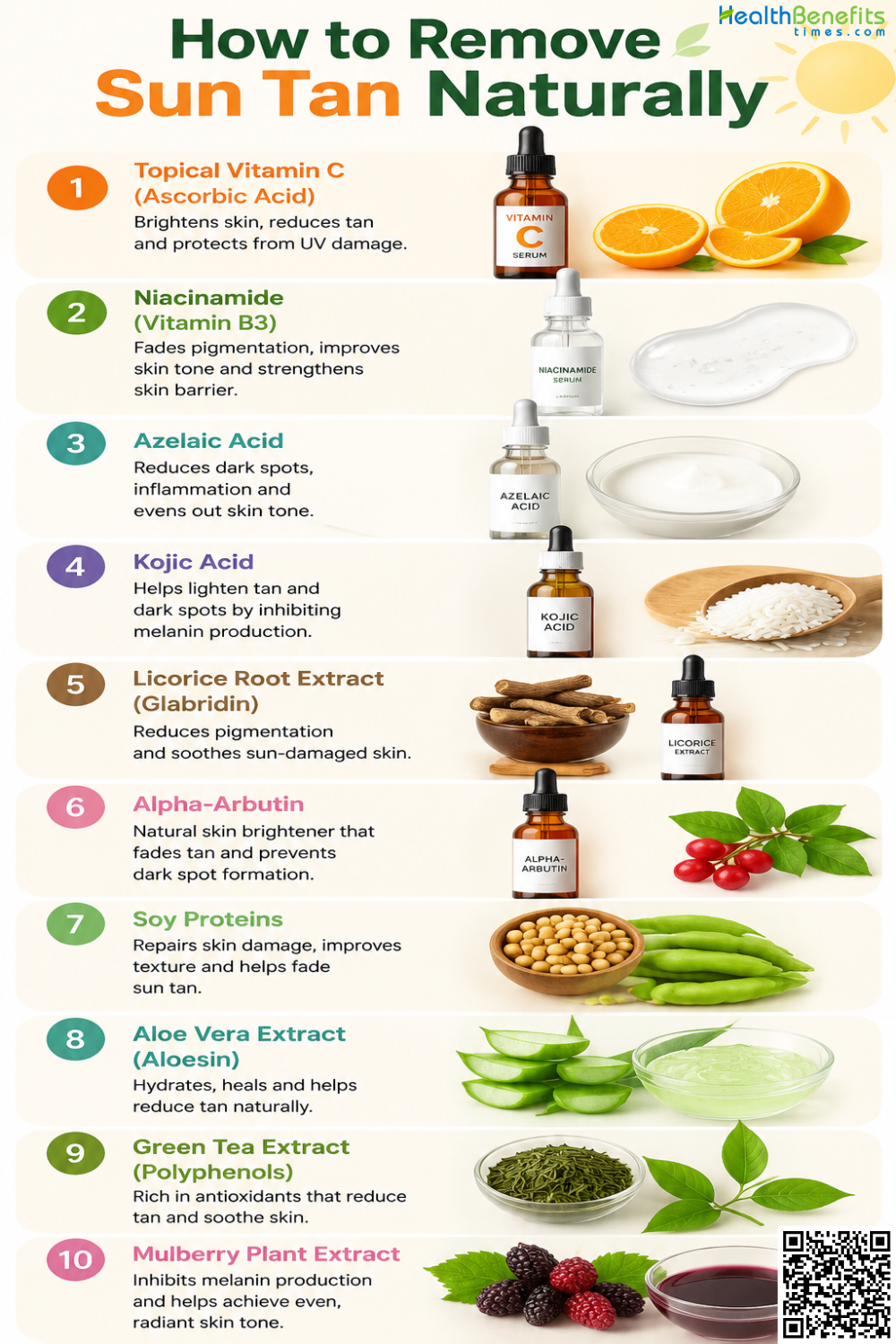
1. Topical Vitamin C (Ascorbic Acid)
How it may help
Topical vitamin C is a potent antioxidant that neutralizes free radicals generated by ultraviolet radiation, which helps prevent further pigment darkening 3. It also inhibits tyrosinase, the enzyme essential for melanin production, effectively reducing excess pigment and promoting the natural fading of a sun tan to restore an even skin tone 4.
What research says
Clinical studies confirm that topical vitamin C is an effective, safe compound for reversing ultraviolet-induced hyperpigmentation 5. Research shows it consistently decreases melanin content and improves skin brightness, making it a valuable evidence-based approach for accelerating the natural recovery process after sun exposure 5.
How to use it safely
For optimal results, apply a serum with a 10% to 20% vitamin C concentration to clean, dry skin once daily 3. Always follow with broad-spectrum sunscreen during the day, as vitamin C does not block ultraviolet rays and requires sun protection to maintain its effectiveness against tanning.
Potential precautions or side effects
Highly acidic vitamin C formulations can occasionally cause mild skin irritation, redness, or dryness 6. The product also degrades rapidly when exposed to air and light.
2. Niacinamide (Vitamin B3)
How it may help
Niacinamide works by preventing the transfer of pigment from the cells that produce it to the outer skin cells where the tan becomes visible 7. By effectively blocking this transport process, it helps fade existing tan and restores a more even skin tone without stopping the natural production of melanin 8.
What research says
Clinical evidence indicates that topical niacinamide is a stable and effective agent for reducing hyperpigmentation caused by sun exposure 7. Research shows that continuous use over several weeks leads to a significant lightening of tanned skin, providing a reliable and safe method for restoring natural complexion without causing cellular harm 8.
How to use it safely
For best results, apply a serum or moisturizer containing 2% to 5% niacinamide to clean skin once or twice daily 7. It is well-tolerated by most skin types and should always be paired with broad-spectrum sunscreen to prevent further UV-induced tanning.
Potential precautions or side effects
Niacinamide is gentle, though high concentrations can sometimes trigger mild redness, itching, or a temporary warm sensation in individuals with very sensitive skin 8.
3. Azelaic Acid
How it may help
Azelaic acid, a natural dicarboxylic acid found in grains, reduces a sun tan by inhibiting tyrosinase, the enzyme that produces melanin 9. It specifically targets overactive pigment-producing cells to safely reduce excess darkening, helping the skin return to its natural color while acting as a gentle exfoliant to brighten the complexion 7.
What research says
Dermatological research confirms that azelaic acid is a highly effective and safe treatment for managing hyperpigmentation, including post-sun darkening 10. Studies show it successfully decreases melanin content and improves skin tone evenness by stabilizing pigment production, providing reliable cosmetic improvements without causing significant toxicity or cellular damage to healthy skin 7.
How to use it safely
Apply a thin layer of a 15% to 20% azelaic acid cream or gel to clean, dry skin once or twice daily 10. Because it can increase sun sensitivity, you must consistently use broad-spectrum sunscreen during the day to protect your skin and maintain progress.
Potential precautions or side effects
Topical azelaic acid is generally well-tolerated, although some individuals may experience temporary mild stinging, redness, itching, or localized dryness when first starting the treatment 10.
4. Kojic Acid
How it may help
Kojic acid, a natural byproduct derived from fungi, works by inhibiting tyrosinase, the enzyme responsible for melanin production 11. By effectively blocking this enzyme, it prevents the formation of new pigment and helps existing sun-induced darkening gradually fade, which assists in restoring a more even and balanced skin tone 12.
What research says
Clinical research identifies kojic acid as a powerful depigmenting agent capable of reducing hyperpigmentation caused by ultraviolet radiation 13. Dermatological studies confirm that it consistently decreases melanin synthesis, making it a highly effective, evidence-based tool for lightening tanned skin while also providing beneficial antioxidant properties against further environmental damage 11.
How to use it safely
For optimal results, use topical creams or serums containing a 1% to 4% concentration of kojic acid. Apply the product directly to the tanned areas on clean skin. Because this ingredient can make your skin more sensitive to the sun, you must always use broad-spectrum sunscreen during the day.
Potential precautions or side effects
Kojic acid can occasionally cause local skin irritation, redness, or contact dermatitis in sensitive individuals 12. Additionally, the compound is light-sensitive and requires proper, dark storage.
5. Licorice Root Extract (Glabridin)
How it may help
Licorice root extract, specifically its active component glabridin, helps lighten a sun tan by inhibiting tyrosinase, the enzyme that drives melanin production 11. Additionally, it acts as a potent antioxidant, neutralizing the oxidative stress caused by ultraviolet radiation, which prevents further pigment darkening and promotes the fading of existing tan 14.
What research says
Dermatological studies confirm that glabridin is a highly effective, natural agent for reversing ultraviolet-induced hyperpigmentation 11. Research shows it consistently reduces melanin synthesis without causing cellular toxicity, providing a reliable and safe, evidence-based method for restoring a natural complexion after excessive sun exposure 15.
How to use it safely
Select topical serums containing licorice root extract with 0.5% to 1% glabridin. Apply the product once or twice daily to the tanned skin on clean, dry surfaces. You must consistently pair this treatment with broad-spectrum sunscreen during daylight hours to achieve and maintain visible fading results.
Potential precautions or side effects
Licorice root extract is generally safe and well-tolerated. Rarely, sensitive individuals may experience mild skin redness or irritation, so perform a patch test before regular application.
6. Alpha-Arbutin
How it may help
Alpha-arbutin, derived from the bearberry plant, reduces a sun tan by directly inhibiting tyrosinase, the enzyme responsible for melanin production 11. By continuously blocking this enzyme, it prevents the formation of new pigment while allowing existing dark areas to gradually fade, effectively restoring a more even skin tone over time 8.
What research says
Dermatological research confirms that alpha-arbutin is a highly stable and effective depigmenting agent for treating ultraviolet-induced hyperpigmentation 11. Clinical studies demonstrate that it significantly decreases melanin synthesis and lightens tanned skin, offering a much safer profile with lower cellular toxicity than traditional synthetic lightening treatments like hydroquinone 8.
How to use it safely
Select topical serums containing a 1% to 2% concentration of alpha-arbutin for optimal safety and performance 11. Apply it directly to the tanned skin up to twice daily on clean surfaces. Always use broad-spectrum sunscreen during the day to protect your skin from additional ultraviolet damage.
Potential precautions or side effects
Alpha-arbutin is generally well-tolerated, although some individuals may experience mild redness, localized dryness, or contact dermatitis. Discontinue use if persistent skin irritation develops.
7. Soy Proteins
How it may help
Soy proteins contain bioactive components, including the soybean trypsin inhibitor, which disrupt the pathway used to transfer dark pigment packages into outer skin cells. By blocking this specific transport mechanism, soy prevents the accumulation of excess pigment in the surface layers, which helps fade a tan and promotes a more uniform skin tone.
What research says
Clinical studies confirm that topical soy-based moisturizers significantly improve skin clarity and reduce the appearance of sun-induced hyperpigmentation. Research demonstrates that consistent use over three months leads to measurable improvements in brightness and skin texture, making it an effective, evidence-based approach for recovering from sun exposure and achieving an even complexion.
How to use it safely
For the best results, select a high-quality cream or serum formulated with unpasteurized soy extracts to ensure the proteins remain active. Apply the product to clean skin twice daily. To prevent further darkening, you must always pair the treatment with regular application of broad-spectrum sunscreen.
Potential precautions or side effects
Topical soy is generally stable and safe for most skin types. However, individuals with a known soy allergy should avoid these products, as they may cause mild redness or irritation.
8. Aloe Vera Extract (Aloesin)
How it may help
Aloesin, an active compound from the aloe vera plant, helps naturally remove a sun tan by directly blocking tyrosinase, the enzyme that the body needs to produce melanin. By slowing down this process, it stops excess pigment from forming and allows the darkened skin to gradually fade back to its normal tone.
What research says
Dermatological studies confirm that aloesin effectively suppresses skin darkening caused by ultraviolet radiation, showing a clear reduction in melanin levels. Research concludes that it acts as a highly effective, natural skin-lightening agent, especially when applied consistently or combined with other botanical compounds to reverse sun-induced pigmentation.
How to use it safely
Apply a targeted gel or serum containing concentrated aloesin directly to the tanned skin on clean, dry areas up to four times daily. For the best results, you must consistently wear broad-spectrum sunscreen to prevent the sun from triggering new pigment production during treatment.
Potential precautions or side effects
Topical aloesin is highly safe and generally well-tolerated by most skin types. However, if you have a known aloe allergy, perform a patch test first to avoid mild allergic reactions.
9. Green Tea Extract (Polyphenols)
How it may help
Green tea extract is rich in polyphenols that neutralize free radicals, which are harmful molecules generated by ultraviolet light that trigger skin darkening. By lowering this oxidative stress, green tea extract helps stop the body from overproducing melanin and assists in the gradual fading of existing sun tan, promoting a clearer, more balanced complexion 8.
What research says
Clinical research demonstrates that topical application of green tea polyphenols provides significant protective and restorative benefits against photoaging. Studies confirm that these compounds effectively mitigate the long-term impact of ultraviolet radiation on skin pigmentation, supporting a reduction in existing tan and enhancing skin health by neutralizing the molecular drivers of radiation-induced discoloration 5.
How to use it safely
Apply a serum or cream containing green tea extract to clean skin once or twice daily. Because this ingredient primarily works by neutralizing oxidative stress rather than blocking rays, you must always apply broad-spectrum sunscreen over the area to ensure your skin is shielded from further ultraviolet-induced tanning.
Potential precautions or side effects
Green tea extract is extremely safe for all skin types. Very rarely, individuals may experience mild skin redness or minor irritation, which typically resolves by reducing application frequency.
10. Mulberry Plant Extract
How it may help
Mulberry plant extract, derived from Morus alba, serves as a powerful inhibitor of tyrosinase, the enzyme that triggers melanin production in response to ultraviolet rays 8. By regulating this enzymatic activity, the extract effectively slows down excess pigment formation, which helps fade a stubborn sun tan and encourages a more uniform, balanced skin tone over time 16.
What research says
Clinical evidence recognizes mulberry extract as a potent, natural alternative to synthetic lightening agents for managing sun-induced hyperpigmentation. Studies demonstrate that its active components successfully reduce melanin content without causing cytotoxicity to healthy skin cells, establishing it as a reliable, evidence-based option for gradually improving the appearance of tanned skin areas 8.
How to use it safely
Apply a topical serum or cream containing mulberry extract to clean, dry skin on the affected areas once or twice daily. To achieve visible improvements, consistent long-term application is required. Always pair this treatment with broad-spectrum sunscreen during the day to protect your skin against further sun-induced tanning.
Potential precautions or side effects
Mulberry extract is generally well-tolerated. Rare side effects may include mild skin redness, dryness, or irritation in individuals with highly sensitive skin, necessitating a preliminary patch test.
Foods to Avoid When You Suffer from Sun Tan
1. Refined Carbohydrates and Sugars
High intake of sugary foods triggers glycation, a process that damages collagen and increases skin sensitivity to ultraviolet radiation, potentially intensifying existing tan and sun damage 17.
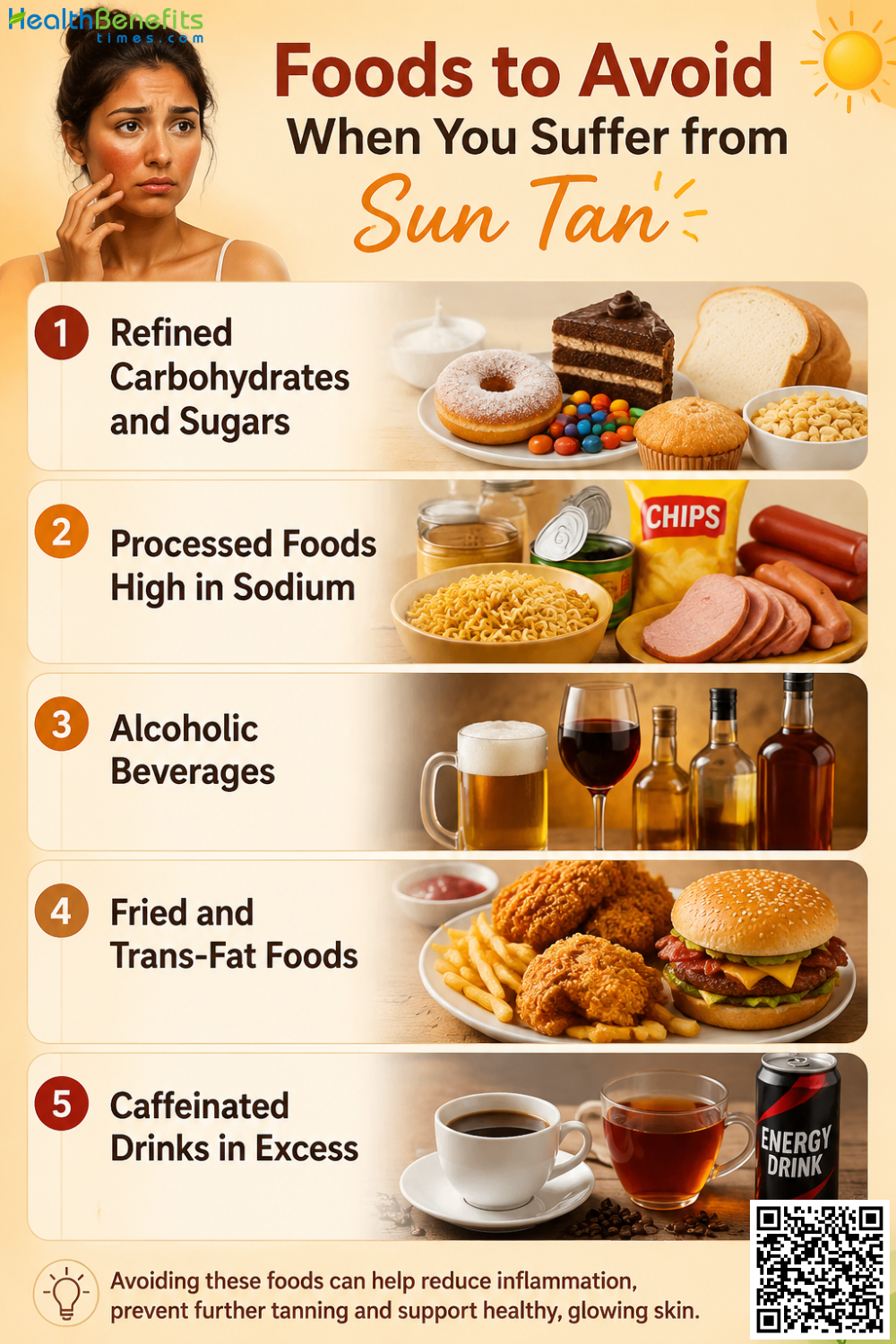
2. Processed Foods High in Sodium
Excessive salt consumption can lead to systemic water retention and inflammation, which impairs the skin’s barrier function and its ability to recover from radiation-induced cellular stress 18.
3. Alcoholic Beverages
Alcohol acts as a diuretic that dehydrates the skin. Dehydrated skin is less efficient at repairing itself and shedding pigmented cells, which may prolong the appearance of a tan 18.
4. Fried and Trans-Fat Foods
These foods promote chronic systemic inflammation. Since a tan is a form of skin injury, ongoing inflammation can hinder healthy skin turnover and stall the natural fading of pigment 18.
5. Caffeinated Drinks in Excess
Consuming too much caffeine may disrupt sleep patterns. Since deep, restorative sleep is essential for skin cell regeneration and repair, poor sleep cycles can impede the skin’s recovery process 18.
When to See a Doctor Regarding a Sun Tan
- Development of Severe Blisters: Consult a healthcare provider if sun-exposed areas develop widespread, painful, or fluid-filled blisters, as this indicates a severe second-degree burn requiring medical management 19.
- Signs of Infection: Seek medical attention if the affected skin shows increasing redness, swelling, pus, or if streaks of red radiate from the area, signaling a potential secondary infection 19.
- Systemic Symptoms: Contact a professional if you experience fever, chills, dizziness, severe headache, or confusion following sun exposure, as these may be signs of heat exhaustion or systemic illness 19.
- Persistent Skin Changes: See a doctor if skin patches do not fade over time, or if new spots, bumps, or growths appear in the tanned areas, as these require evaluation for skin cancer 20.
- Unusual Pain or Sensitivity: Schedule an appointment if the tanned skin remains intensely painful or sensitive to touch long after the initial exposure, as this may indicate deeper tissue damage 19.
Comments
comments