

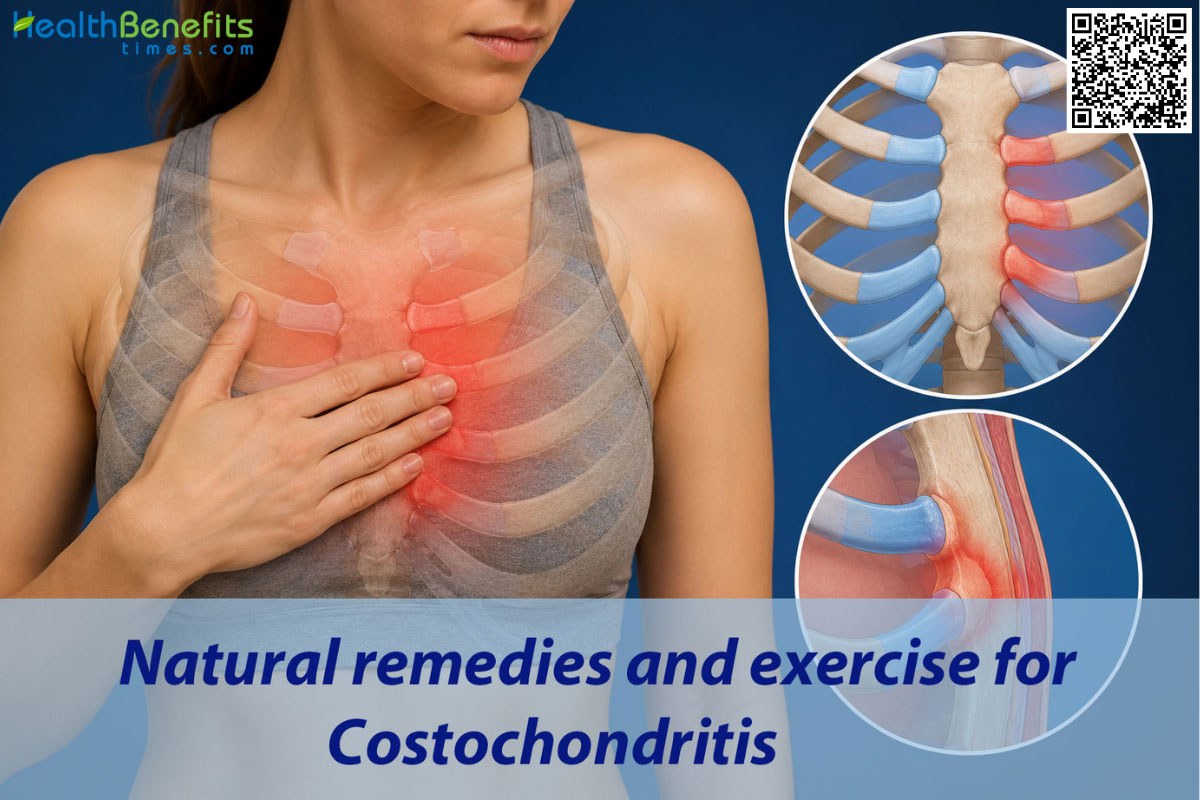
Feeling a sudden, sharp pain in the center of the chest can be one of the most frightening experiences in life, often causing instant worry about a heart attack. However, there is a very common and completely harmless reason for this alarming discomfort known as costochondritis. This medical condition simply means that there is irritation and swelling in the flexible cartilage that connects the ribs to the breastbone 1. The human rib cage is cleverly designed using a mix of hard bone and softer cartilage, and the tiny joints where these two materials meet can sometimes become highly inflamed and sore. Although it feels incredibly intense and mimics a serious cardiac emergency, this is entirely a musculoskeletal issue that poses no threat to internal organs. Doctors see this all the time in their clinics; in fact, out of all young people visiting hospitals for chest pain, approximately thirteen percent are diagnosed with this exact condition 2. The best news is that it generally fades away on its own over a few weeks or months, leaving no lasting damage behind.
Causes of Costochondritis
Figuring out exactly why this frustrating chest pain starts can sometimes be a puzzle for medical professionals. However, doctors have identified several common triggers that frequently lead to this temporary swelling of the rib joints.
- Unknown Origins: Many times, the swelling appears out of nowhere without any clear or obvious cause at all, which doctors formally refer to as an idiopathic condition 3.
- Physical Strain: Doing too much heavy lifting around the house, pushing too hard during a gym workout, or repeating the same forceful upper body movements can place far too much mechanical stress on the delicate chest wall 4.
- Severe Coughing Fits: Coming down with a nasty winter cold or a chest infection that causes severe, hacking coughs can aggressively stretch the ribs, leaving the cartilage battered and inflamed 1.
- Direct Chest Injuries: Taking a sudden hit to the chest, such as bumping into a steering wheel during a minor car accident or taking a fall during sports, can directly bruise the cartilage 5.
- Viral Infections: Certain respiratory viruses or lingering bacterial bugs can sometimes travel into the chest joints, leading to unexpected inflammation 6.
- Everyday Wear and Tear: Just taking normal breaths makes the rib cage expand and contract thousands of times a day, which can eventually lead to natural wear and tear within these hard-working joints 7.
- Other Joint Conditions: People who already live with certain types of arthritis might find that their chest cartilage is naturally more sensitive and prone to swelling 8.
Symptoms of Costochondritis
Knowing exactly what to look out for can help ease a person’s anxiety very quickly. The physical feelings associated with this condition are actually quite distinct and change depending on how the body is moving or resting.
- A sharp, stabbing, or deep aching pain that sits right at the front of the chest wall 9.
- Noticeable tenderness that can be easily felt if someone gently presses their fingers on the area where the ribs meet the breastbone 10.
- Discomfort that gets much worse when taking a very deep breath, sneezing loudly, or having a good laugh 11.
- Pain that usually targets the left side of the breastbone, especially hovering around the fourth, fifth, and sixth ribs 12.
- A strange, traveling sensation where the pain seems to spread outward toward the back or down into the stomach area 5.
- Great relief from the sharp aching when the body is completely relaxed in a comfortable chair and breathing is kept quiet and shallow 7.
Costochondritis Facts
Understanding the basic facts about this condition provides a great sense of relief and clarity. Here is a quick look at the most important details regarding this chest issue.
| Category | Details |
| Symptoms |
|
| Causes |
|
| Types of Costochondritis |
|
| How does spread |
|
| Age Group |
|
| You might be at a higher risk for exposure of this disease if you: |
|
| How doctors diagnose |
|
| Other facts |
|
Natural remedies and exercise for Costochondritis
Natural remedies for Costochondritis
Taking gentle care of your body at home is one of the best ways to speed up the healing process. You have several very safe, completely natural options to help calm the angry cartilage in your chest so you can get back to your normal routine.
1. Warm Thermal Therapy
Applying gentle, comforting heat to the front of your chest is a wonderful way to encourage healthy blood flow and relax the tight muscles that surround your rib cage. You might find it incredibly soothing to place a warm hot water bottle or a heated cloth right over the tender spots 7. The cozy warmth naturally helps to melt away the dull, aching sensation that lingers deeply around your breastbone.
Note: Apply a warm compress to the affected chest area for 10 to 15 minutes a few times a day to soothe muscle tension and ease aching joints.
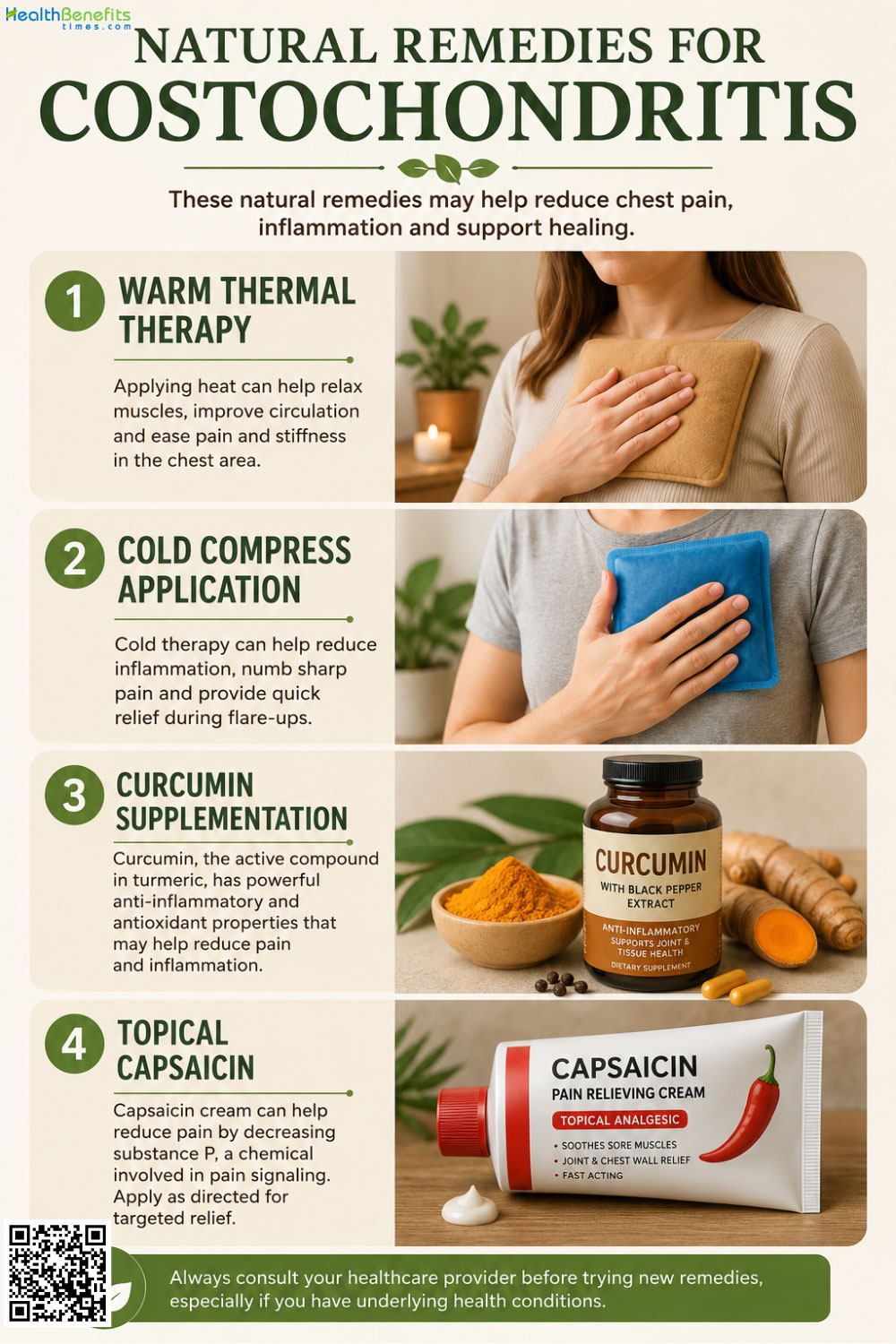
2. Cold Compress Application
When your chest cartilage is actively inflamed and feels sharp, hot, or burning, cooling the area down can dramatically reduce the swelling. You can easily use a simple ice pack wrapped in a towel to temporarily numb the nerve endings, which gives you fast relief during sudden spikes in pain 13. Cold therapy is especially helpful right after you have accidentally strained your chest from a big sneeze or a sudden, awkward movement.
Note: Wrap an ice pack in a thick towel and apply it gently to the painful rib joints for 10 minutes at a time to reduce acute swelling.
3. Curcumin Supplementation
Exploring gentle herbal support brings you to curcumin, which is the bright yellow, highly active part of the turmeric root. You can use curcumin to help turn down the inflammation in your body, which may noticeably decrease the overall intensity of the pain in your chest 14. It works naturally by blocking the body’s internal signals that tell your connective tissues to swell up and become sore.
Note: Consumed orally as a daily dietary supplement, it is often eaten alongside a pinch of black pepper to help the body absorb it better for medicinal benefits.
4. Topical Capsaicin
Derived straight from spicy chili peppers, capsaicin offers a very unique way to handle targeted pain when you put it right on your skin. You can rub topical capsaicin creams onto your chest to lower the amount of a specific chemical in your nerve endings that sends panic alerts to your brain 15. While it might create a mild warming tingle at first, it can do a fantastic job of dulling the stubborn aches deeply rooted in your rib joints.
Note: Applied topically as a cream or sticky patch directly over the tender chest joints to reduce nerve-related pain signaling.
5. Acupuncture Therapy
Looking toward gentle, traditional healing practices, acupuncture is known to be very helpful for people dealing with persistent chest wall pain. You can try this ancient therapy to stimulate specific healing points on your body, which helps decrease local inflammation and gives you a natural pain-relieving effect 16. The ultra-fine needles encourage your nervous system to release its own feel-good, relaxing chemicals that wash away the tension.
Note: Administered by a certified practitioner who gently places fine needles in specific points to naturally relieve localized chest wall pain.
Exercise for Costochondritis
Keeping your upper body gently moving without stressing the inflamed joints is incredibly important for your long-term comfort. You can softly stretch the muscles that support your rib cage to prevent them from getting stiff and to improve your overall posture.
1. Doorway Pectoral Stretch
Opening up your chest helps take away the pressure that is constantly pulling forward on your sore rib joints. You can use any standard open doorway in your home to gently stretch your pectoral muscles, which are often far too tight and make chest wall discomfort much worse 7.
Note: To do this, stand facing an open doorway, raise your arms so your elbows are bent at a 90-degree angle, rest your forearms on the doorframe, and slowly lean your body forward until you feel a gentle chest stretch.
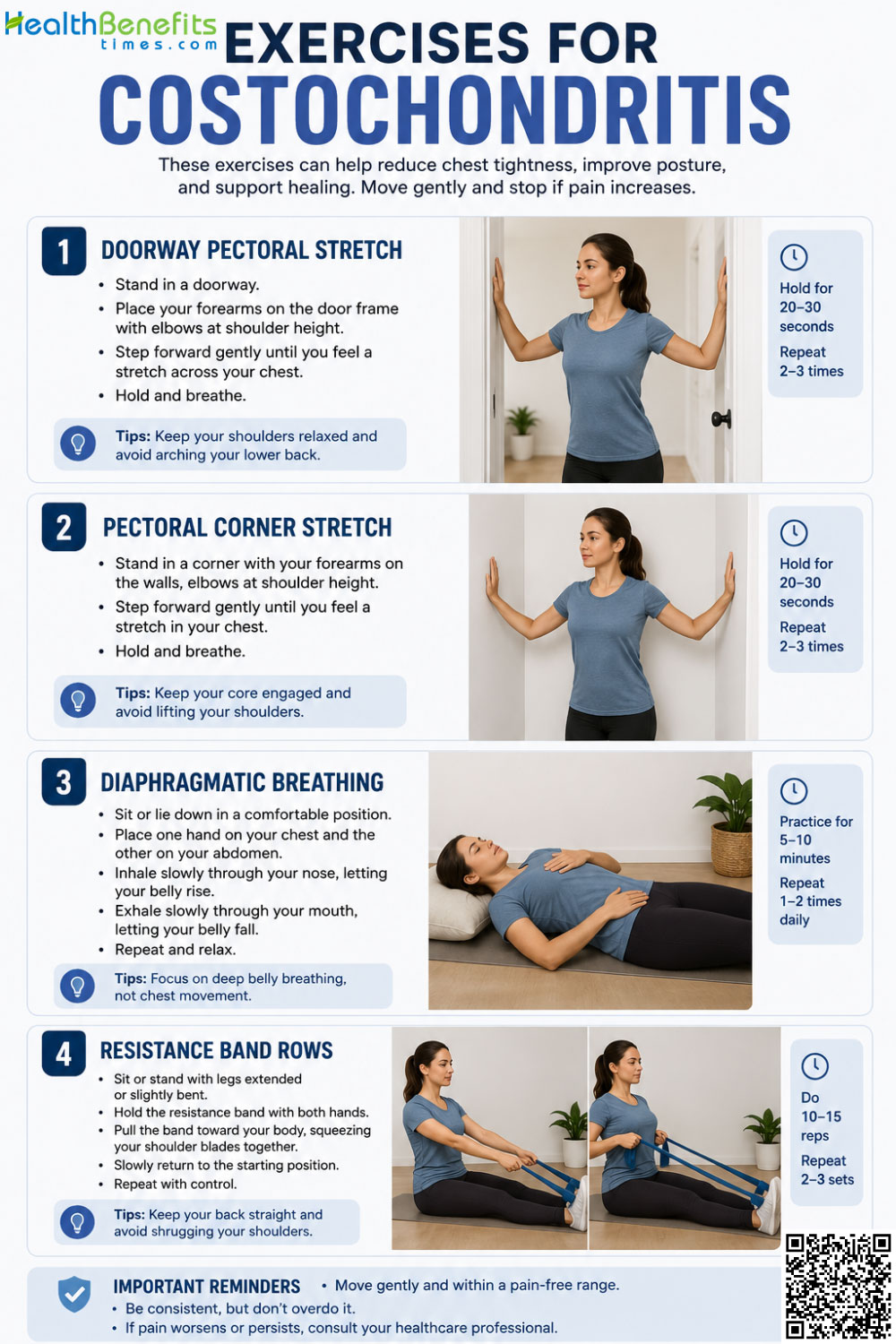
2. Pectoral Corner Stretch
Using the simple shape of a room gives you another wonderful way to relieve built-up tension in your upper body. You will find that leaning into an empty corner allows you to easily control how deep the stretch goes, safely targeting different parts of your chest without hurting your ribs 17.
Note: To do this, stand facing a corner of a room, lift both arms up to rest flat against the two walls, and softly let your upper body lean into the corner for about 20 seconds.
3. Diaphragmatic Breathing
Changing the way you take in air can completely alter the amount of stress you place on your sensitive rib cage. You can practice diaphragmatic breathing, which is also known as “belly breathing,” to help your lower ribs move properly while keeping your sore upper chest very still and relaxed 18.
Note: To do this, sit or lie down comfortably, place one hand on your stomach, and breathe in deeply through your nose so that your stomach pushes out while keeping your chest completely still.
4. Resistance Band Rows
Building strength in your back naturally pulls your shoulders backward, which stops you from hunching over and squashing your chest. You can do light pulling exercises with a soft resistance band to safely build better posture without ever putting direct, heavy pressure on your front rib joints 19.
Note: To do this, sit on the floor with your legs straight out, loop a stretchy resistance band around your feet, hold the ends, and pull your hands back toward your hips while squeezing your shoulder blades together.
Foods and Activities to Avoid When You suffer from Costochondritis
Getting through the day requires just a little bit of careful planning when your chest joints are acting up. You need to be very mindful of certain daily habits and choices that can easily trigger a bad flare-up or slow down your healing process.
1. Strenuous Exercise
You must completely avoid heavy lifting, intense gym workouts, or any activity that forces you to strain your upper body until your chest feels completely better 20.
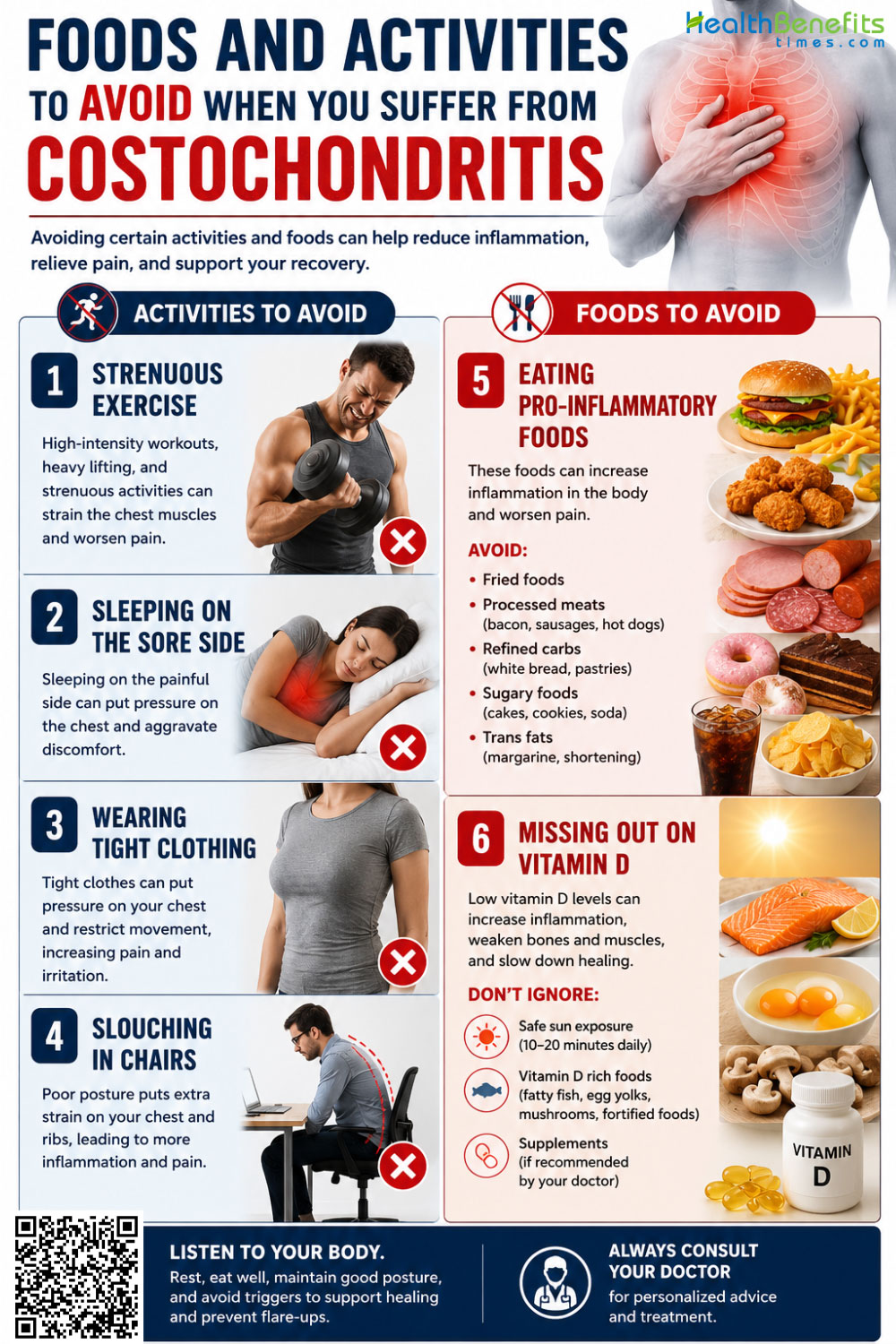
2. Sleeping on the Sore Side
You should try your absolute best to change your sleeping position, because laying directly on the painful side squashes the rib cage and makes the joints very angry overnight 18.
3. Wearing Tight Clothing
You need to stay away from wearing restrictive shirts or very tight undergarments; instead, you should wear soft, loose clothing or a lightweight bra to avoid placing extra squeezing pressure on your chest 21.
4. Slouching in Chairs
You should pay close attention to your posture, because slouching on the couch puts constant, heavy downward pressure right on your breastbone and squishes the inflamed cartilage 13.
5. Eating Pro-inflammatory Foods
You might want to cut back on highly processed junk foods, sugary treats, and unhealthy fried foods, as these can promote swelling and inflammation all over your body.
6. Missing Out on Vitamin D
You should make sure you are getting enough sunshine or eating foods rich in Vitamin D, because running low on this important nutrient is strongly linked to generalized bone aches and sore rib joints 12.
Myths and Misconceptions
Clearing up false information is incredibly important when dealing with any kind of chest pain. Misunderstanding the facts can lead to a lot of unnecessary worry, sleepless nights, or improper care for the body.
| Myth | Reality |
| Chest pain always means a heart attack is happening right now. 2 | While the sharp pain feels very scary, costochondritis is a localized, simple swelling of the cartilage that does absolutely no damage to the heart. |
| It is exactly the same illness as Tietze syndrome. 22 | Tietze syndrome is a separate, much rarer problem that causes obvious, visible swelling lumps on the chest, whereas regular costochondritis never causes visible outside swelling. |
| You can catch it from sitting near someone else who has it. 10. | It is completely non-contagious. It comes from physical strain, coughing, or internal swelling, not from a germ you can catch like a cold. |
| It is strictly an old person’s disease. 23 | Even though it is commonly found in adults over 40, it very frequently affects young healthy adults, teenagers, and even small children. |
| You must stay in bed and never move your arms again. | While resting during the worst pain is smart, gentle and safe stretching exercises are actually highly recommended to help the chest heal and prevent muscle stiffness. |
Special Considerations
Different stages of life and different health backgrounds completely change the way this condition behaves. It is very helpful to understand how age, pregnancy, and other health factors play a major role in managing chest pain.
1. Children
Watching a young child grab their chest in pain is very scary for any parent, but pediatric cases are usually nothing to worry about. In children, this chest wall swelling is almost always linked to a recent nasty cold or a simple muscle strain from playing too hard on the playground 6. Doctors can figure it out quickly just by gently pressing on the child’s chest to see if it feels tender to the touch. Sometimes, it is important for the doctor to make sure it is not another harmless childhood issue called precordial catch syndrome, which causes sharp but very short pains. Usually, a little bit of children’s ibuprofen and some reassurance that they are okay makes the problem go away entirely.
2. Pregnancy
Mothers-to-be very often feel strange, shifting aches in their ribs as their bodies go through massive changes. As the baby grows larger inside, the expanding womb puts a huge amount of upward pressure on the internal organs and the rib cage itself 24. Also, the body releases a special pregnancy hormone called relaxin, which deliberately makes the muscles and ligaments softer and stretchier. This means the bones in the chest might shift around more than normal, which easily irritates the cartilage holding the ribs together. However, pregnant women must always be careful; if they feel severe pain on the right side of the ribs along with dizziness, they need to see a doctor immediately to make sure it is not a serious pregnancy complication.
3. Chronic conditions
People who have long-lasting pain conditions have to be extra gentle and patient with their bodies. Individuals dealing with widespread illnesses like fibromyalgia are naturally much more likely to develop sore rib joints over and over again 20. For these people, the chest pain might last a little longer and require more continuous, comforting care to keep the swelling down.
4. Elderly
Older adults who experience this type of chest discomfort require a very careful and thorough checkup from a medical team. Because the chances of having real heart problems naturally go up as people get older, any patient over the age of thirty-five with a sore chest should have professional tests done 23. Doctors will usually run an electrocardiogram to make absolutely sure that the pain is just a harmless rib issue and not hiding a quiet heart attack.
Precaution before use of natural remedies when you have Costochondritis
Taking charge of your own healing is wonderful, but keeping yourself safe must always be the top priority. You should be very careful when using treatments at home to make sure you do not accidentally cause a different problem.
- Protecting Your Skin: You must never place an ice pack or a hot heating pad directly onto your bare skin, because extreme temperatures can easily cause nasty frostbite or thermal burns; you should always wrap them in a soft cloth first 13.
- Checking Your Medicines: You need to talk to your doctor before you start eating herbal supplements like curcumin, especially if you are taking blood-thinning pills like Warfarin, because the mix can cause dangerous internal bleeding 25.
- Watching for Skin Stinging: You should be prepared that topical capsaicin cream can cause a very intense burning or stinging feeling on your skin, mostly during the very first week you try it 26.
- Washing Your Hands: You have to remember to wash your hands with soap immediately after you rub capsaicin cream on your chest, otherwise you might accidentally rub spicy chili oil right into your eyes.
- Being Careful with Pain Pills: You should be cautious not to take too many over-the-counter pain pills, particularly if you have a history of high blood pressure, kidney trouble, or bad stomach ulcers 27.
When to see Doctor
Knowing exactly when to ask for professional help is a very important part of getting better safely. You should never ignore warning signs that suggest your chest pain might be something more serious than a simple swollen rib.
- Trouble Breathing: You must go to the emergency room immediately if you feel short of breath, find yourself gasping for air, or feel a heavy, crushing weight sitting on your chest 1.
- Signs of an Infection: You should call your doctor right away if you develop a very high fever, or if you see redness, swelling, or pus forming on the skin over your ribs 10.
- Pain Spreading Out: You need to get medical help fast if your chest pain suddenly shoots into your left arm, up into your neck and jaw, or around to your back, because these are classic signs of a heart attack 28.
- Pain That Will Not Stop: You should set up a doctor’s appointment if your sharp chest aches continue to get much worse even after you have rested and taken pain medicine for a few days 18.
- Taking Too Long to Heal: You should go back to see your general practitioner if your symptoms do not settle down or show any signs of getting better after six full weeks of resting at home 7.
Comments
comments