

Causes of dysgraphia
1. Brain Development Differences
In children, dysgraphia typically originates from natural differences in how the brain develops, specifically impairing working memory and orthographic coding, which is the brain’s ability to store and recall the shapes of letters and written words 2.
2. Genetics and Heredity
Neurodevelopmental learning disorders often run in families, and individuals are significantly more likely to have dysgraphia if they have relatives with similar learning or attention challenges, such as dyslexia or attention-deficit/hyperactivity disorder (ADHD) 2.
3. Traumatic Brain Injury
A severe physical blow or trauma to the head can damage the specific regions of the brain responsible for coordinating language and fine motor skills, resulting in a sudden inability to write, clinically referred to as acquired dysgraphia or agraphia 1.
4. Stroke
When a stroke interrupts the blood supply to the brain, it can permanently damage the neural pathways required for physical handwriting and spelling, particularly if the stroke affects the brain’s language-dominant hemisphere 1.
5. Neurodegenerative Diseases
In older adults, progressive conditions such as Alzheimer’s disease, dementia, or primary progressive aphasia cause the slow deterioration of brain cells needed for language processing and muscle control, leading to a gradual decline in writing abilities 1.
Symptoms of dysgraphia
- Illegible or Inconsistent Handwriting: Individuals frequently produce uneven, poorly formed letters with mixed sizes, irregular shapes, and inconsistent slants that make their written work difficult to read 1.
- Awkward or Painful Pencil Grip: The physical act of writing is often marked by an unusually tight or unnatural grasp on a pen or pencil, which leads to rapid hand fatigue, cramping, and physical discomfort 1.
- Irregular Spacing and Alignment: Affected individuals struggle to write along a straight line, maintain consistent margins, or leave proper spaces between words and letters, causing text to crowd or drift across the page 1.
- Frequent Spelling and Grammar Errors: Written text often includes frequent misspellings, missed or duplicated letters, and basic syntax errors despite the person having strong verbal comprehension and intelligence 1.
- Difficulty Organizing Thoughts on Paper: Translating thoughts into written sentences proves exceptionally challenging, resulting in disorganized ideas, incomplete thoughts, and a distinct gap between what a person can explain out loud versus what they can write down 1.
- Slow Writing Speed: The heavy cognitive and physical effort required to coordinate fine motor control and language production causes individuals to write at a significantly slower pace than their peers 1.
Natural tips on helping your child with dysgraphia
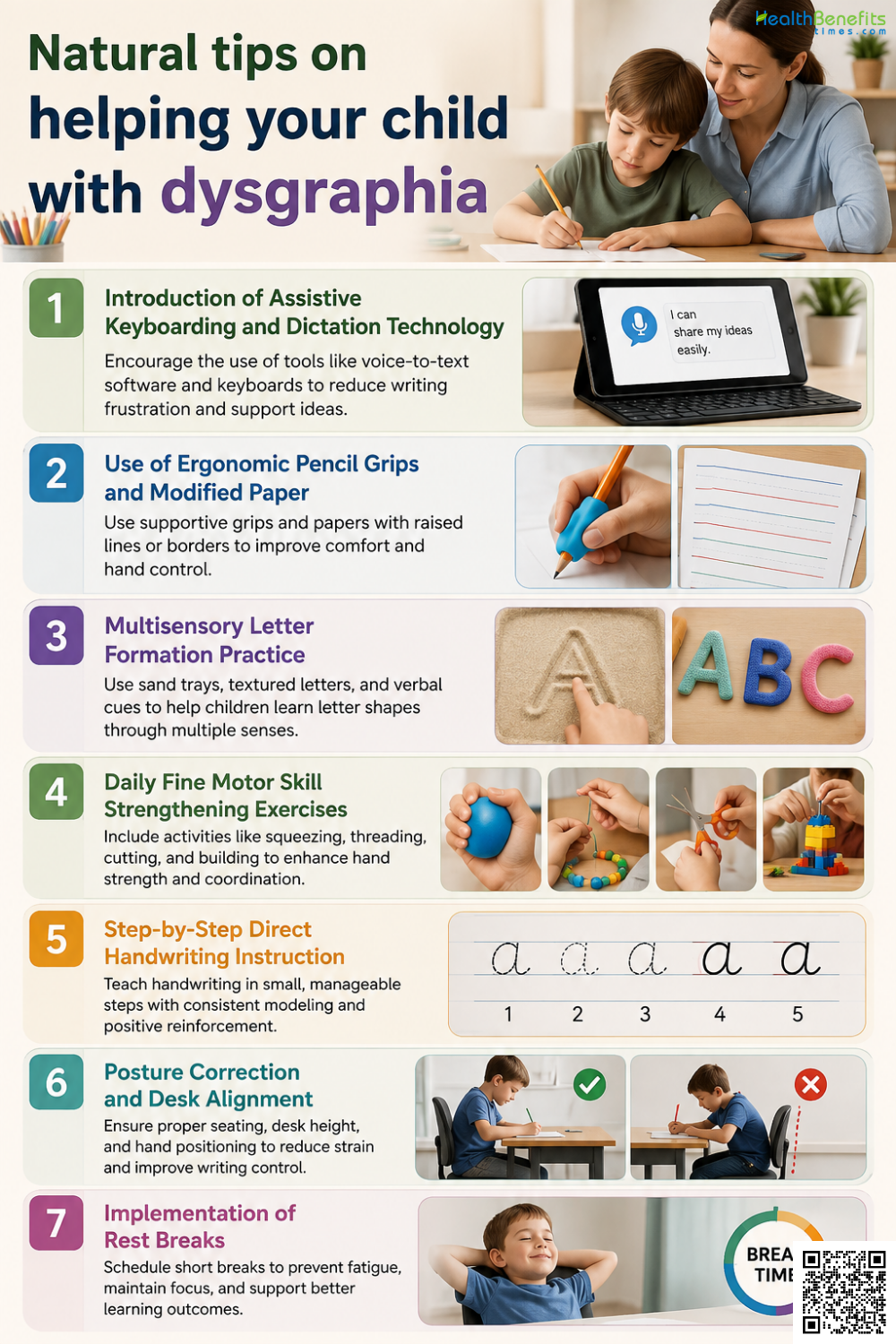
1. Introduction of Assistive Keyboarding and Dictation Technology
How it may help
Assistive technologies, such as keyboarding and speech-to-text software, allow children to bypass the physical struggle of handwriting. By removing the need for complex fine motor movements, these tools reduce physical fatigue and allow the brain to focus entirely on organizing thoughts and expressing ideas clearly 1.
What research says
Clinical guidelines classify assistive technology as a highly effective accommodation for dysgraphia. Research confirms that providing access to dictation tools and word processors significantly improves academic performance and reduces the anxiety associated with writing tasks in children with this learning disorder 1.
How to use it safely
Introduce typing skills gradually using age-appropriate software. For longer assignments, encourage your child to use voice dictation to draft ideas first. Always coordinate with teachers to ensure these tools are formally included in your child’s education plan 1.
Potential precautions or side effects
Relying entirely on technology too early can prevent the development of basic handwriting skills. You should balance screen use with continued, gentle practice of standard letter formation 1.
2. Use of Ergonomic Pencil Grips and Modified Paper
How it may help
Ergonomic grips correctly position the fingers, reducing hand fatigue and muscle cramping during writing tasks. Modified paper with raised or colored lines provides tactile and visual boundaries, helping children keep letters appropriately sized and properly spaced on the page 1.
What research says
Occupational therapy guidelines support utilizing physical writing aids as a primary accommodation. Clinical observations indicate that adapting the writing surface and utensil reduces biomechanical strain on a child’s hand, leading to improved handwriting legibility and a significant decrease in physical discomfort 1.
How to use it safely
Consult an occupational therapist to select a pencil grip that fits your child’s specific hand mechanics. Introduce raised-line paper for daily homework assignments. Encourage your child to use these tools consistently to build muscle memory and prevent chronic hand strain 1.
Potential precautions or side effects
Applying the wrong type of pencil grip can worsen hand positioning and cause joint pain. Always verify that the physical tool does not force fingers into unnatural postures 1.
3. Multisensory Letter Formation Practice
How it may help
Multisensory letter formation engages sight, touch, and movement simultaneously to build stronger neural pathways for handwriting. By tracing letters in textured materials like sand or shaving cream, a child reinforces their working memory of letter shapes, making it easier for the brain to recall and draw them correctly 2.
What research says
Educational research confirms that multisensory writing interventions significantly improve handwriting fluency and legibility in children with learning disorders. Studies conclude that integrating tactile feedback with visual and verbal cues helps bypass standard neurological deficits, allowing children to develop automated motor memory for letter production over time 2.
How to use it safely
You can practice this at home by having your child trace large letters in safe, non-toxic materials like kinetic sand or finger paint. Keep practice sessions short, around ten to fifteen minutes, to prevent frustration and maintain your child’s focus on the physical sensation of writing 2.
Potential precautions or side effects
Some children may experience sensory overload or dislike sticky textures. If your child shows signs of distress or frustration, immediately switch to a dry or less stimulating medium 2.
4. Daily Fine Motor Skill Strengthening Exercises
How it may help
Daily exercises that target the small muscles in the hands and fingers improve overall grip strength and dexterity. Building this specific muscle endurance helps a child hold a writing tool more comfortably, allowing them to control pencil movements with greater precision and less physical fatigue 1.
What research says
Clinical studies on occupational therapy indicate that targeted fine motor interventions effectively improve handwriting quality in children with motor coordination deficits. Research concludes that regularly practicing tasks requiring finger manipulation significantly enhances a child’s mechanical writing speed and overall text legibility 2.
How to use it safely
You should incorporate fun, low-stress activities like squeezing therapy putty, playing with clay, or using tweezers to pick up small objects. Keep these exercise sessions brief, aiming for about ten minutes daily, to build your child’s hand strength gradually without causing muscle strain 1.
Potential precautions or side effects
If your child complains of hand or wrist pain during these activities, you must stop immediately. Overworking the hand muscles can cause painful cramping and increase resistance to writing 1.
5. Step-by-Step Direct Handwriting Instruction
How it may help
Step-by-step direct handwriting instruction breaks the writing process into small, manageable actions, such as teaching the exact starting point and directional strokes for each letter. This explicit approach helps children build consistent motor memory, reducing the mental and physical effort required to put words on paper 2.
What research says
Educational research shows that explicit, task-specific handwriting instruction is one of the most effective interventions for writing difficulties. Clinical studies conclude that consistently teaching specific letter formation rules significantly improves both the speed and readability of a child’s handwriting compared to unstructured practice 2.
How to use it safely
You should guide your child through structured handwriting programs that teach one letter family at a time. Keep practice sessions short, strictly limiting them to ten minutes per day, to ensure your child remains focused and does not become physically or mentally exhausted 1.
Potential precautions or side effects
Forcing prolonged handwriting practice can increase a child’s anxiety and cause severe frustration. You must monitor their emotional state and stop the lesson if they become visibly upset 1.
6. Posture Correction and Desk Alignment
How it may help
Proper seating posture and desk alignment provide core body stability, which is essential for controlled hand movements. By ensuring the feet are flat and the desk is at the correct height, the body avoids unnecessary physical strain. This stability allows the fingers to move freely, improving handwriting control 1.
What research says
Occupational therapy research confirms that establishing core stability through proper ergonomic seating significantly improves fine motor function. Clinical evidence shows that children who maintain a 90-degree angle at their hips, knees, and ankles experience less physical fatigue, leading to measurable improvements in handwriting legibility and writing endurance 2.
How to use it safely
Ensure your child sits in a chair where their feet rest flat on the floor, using a footstool if necessary. Position the desk just above their resting elbow height. You can also introduce a slant board to naturally angle the paper and reduce wrist strain 1.
Potential precautions or side effects
Do not force an unnaturally rigid posture, as this can cause muscle stiffness and back pain. You should allow your child to shift positions naturally to maintain physical comfort 1.
7. Implementation of Rest Breaks
How it may help
Because dysgraphia requires intense mental concentration and physical effort to form letters, children experience rapid hand fatigue and cognitive exhaustion. Implementing structured rest breaks interrupts this physical and mental strain. This allows the hand muscles to recover and resets the child’s focus, making sustained writing tasks more manageable 1.
What research says
Clinical guidelines emphasize that modifying the writing environment to include frequent breaks is a critical accommodation for learning disorders. Evidence shows that pacing writing tasks and allowing physical recovery time significantly reduces task avoidance, decreases muscle cramping, and maintains the legibility of a child’s handwriting over longer periods 1.
How to use it safely
You should divide long assignments into short, manageable blocks of ten to fifteen minutes. During the break, encourage your child to stretch their hands and step away from the desk. Work with teachers to ensure these timed breaks are officially included in your child’s educational plan 1.
Potential precautions or side effects
Too many unmonitored breaks can severely disrupt a child’s workflow and cause them to lose their train of thought. You must keep rest periods strictly timed and structured 1.
Foods to Avoid When You suffer from dysgraphia
Currently, clinical evidence does not directly link any specific foods to the cause or treatment of dysgraphia itself. However, because dysgraphia frequently co-occurs with attention-deficit disorders, limiting certain items can support overall cognitive function and focus.
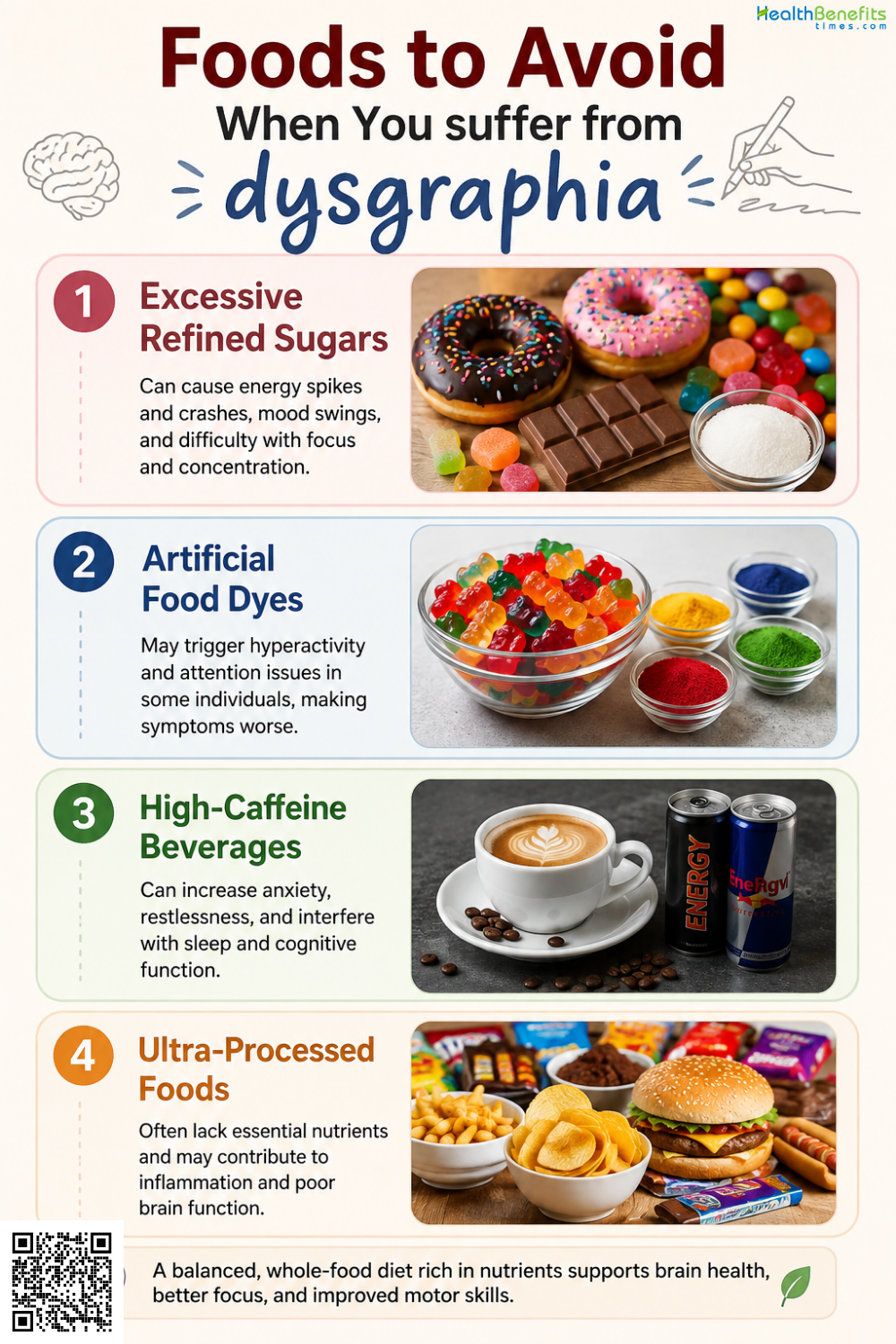
1. Excessive Refined Sugars
High sugar intake causes energy crashes, worsening the attention and working memory deficits that frequently accompany learning and neurodevelopmental disorders 4.
2. Artificial Food Dyes
Clinical studies indicate certain synthetic food colorings may exacerbate hyperactivity and inattention in children with learning differences, further complicating writing tasks 5.
3. High-Caffeine Beverages
Excessive caffeine from energy drinks severely disrupts sleep cycles and increases anxiety, impairing the critical cognitive functions and motor coordination needed for handwriting 6.
4. Ultra-Processed Foods
Diets heavily reliant on ultra-processed items lack essential nutrients for brain health, potentially hindering overall cognitive development and exacerbating underlying attention issues 7.
When to see Doctor when you struggle from dysgraphia
While dysgraphia is a lifelong learning difference, certain symptoms and situations require professional medical or psychological evaluation. You should consult a healthcare provider if you or your child experience the following specific warning signs.
1. Sudden Loss of Writing Ability
An abrupt inability to write, especially in adults, is a medical emergency. It often indicates a severe neurological event, such as a stroke or traumatic brain injury 1.
2. Severe Physical Pain During Writing
You should seek medical advice if writing causes chronic hand cramps, wrist pain, or severe exhaustion, as an occupational therapist must evaluate motor skills and prescribe interventions 1.
3. Significant Academic or Emotional Distress
Consult a pediatrician if writing struggles cause severe anxiety, daily task avoidance, or a noticeable drop in school performance, which warrants a formal neurodevelopmental evaluation 2.
4. Presence of Additional Learning Challenges
A doctor should be consulted if handwriting difficulties appear alongside poor focus, reading struggles, or hyperactivity, because dysgraphia frequently co-occurs with attention-deficit/hyperactivity disorder (ADHD) and dyslexia 2.
Comments
comments