


1. Good for Bone Health
Your bones need specific nutrients to stay strong and healthy. Greek yogurt is packed with two key nutrients for bone health: protein and calcium. A single serving provides about 17 grams of protein and 225 mg of calcium. Calcium helps build and maintain the hard structure of your bones, while protein supports the flexible framework inside. Together, these nutrients work to keep your bones dense and strong, which helps prevent conditions like osteoporosis and lowers the risk of fractures as you get older. 1 Eating Greek yogurt regularly may also help control inflammation in your body. This is important because long-term inflammation can speed up bone loss. The beneficial bacteria and bioactive peptides in the yogurt are thought to play a role in this anti-inflammatory effect. 1 2 Getting these nutrients from a food like Greek yogurt is an effective way to support your skeleton from the inside out.
What Research Says:
- A study by Brock University found that eating Greek yogurt along with a high-impact exercise routine for 12 weeks helped young men form more bone, as seen in a special protein test (P1NP), and reduced bone breakdown compared to a placebo. The same study also showed that the balance between bone formation and breakdown (P1NP/CTX ratio) improved more with Greek yogurt than without it. 3
- A 24-week study with university athletes showed that eating Greek yogurt helped keep bone breakdown markers stable. After a period of no yogurt, the markers returned to normal levels, suggesting that Greek yogurt helps control bone changes. 2
- Traditional use of dairy for bone health is backed by early trials from the Brock Functional Inclusive Training Centre. These trials showed that Greek yogurt helped older adults increase the intake of nutrients important for bone health and might work with exercise to affect a protein (Dickkopf-1) that blocks bone formation. 1
2. Support Anti-Inflammatory and Immune System
While long-term inflammation can contribute to health problems like heart disease and arthritis, certain foods can help manage it. Greek yogurt contains probiotics (healthy bacteria) and high-quality protein, both known for their anti-inflammatory benefits. Research indicates that these nutrients work together to lower specific inflammatory markers in the body, including interleukin-6 (IL-6) and tumor necrosis factor-alpha (TNF-alpha). 4 By reducing these markers through regular consumption, Greek yogurt helps support the body’s natural defense system and may lower the risk of chronic disease over time. 4 5
What Research Says:
- A study by Brock University found that healthy young men who ate Greek yogurt during 12 weeks of strength training had a big drop in a protein linked to inflammation, called interleukin-6, compared to a group that didn’t eat yogurt (201). {% %} The same study also found that Greek yogurt stopped an increase in another inflammation marker, tumor necrosis factor-alpha, which went up in the group that ate a carbohydrate pudding. This suggests Greek yogurt has special anti-inflammatory benefits (201). 4
- In an 8-week trial with older adults, researchers at Brock University found that those who ate Greek yogurt had good changes in their immune system. People who exercised and ate yogurt had stable levels of interleukin-1beta and a big drop in interleukin-6, showing that Greek yogurt helped lower inflammation. 5
- The research shows that Greek yogurt’s anti-inflammatory effects might come from its special ingredients, like probiotics and proteins made during fermentation. These can help improve gut health and reduce overall inflammation in the body. The study also says that these ingredients can help lower the gut’s leakiness, stopping inflammatory compounds from getting into the bloodstream. 4
3. Helps in Weight Management
Greek yogurt may reduce hunger and promote feelings of fullness — both of which may lead to weight loss over time. Greek yogurt lessens hunger largely through its high protein content. Protein helps release hormones in your body, such as peptide YY and GLP-1, that signal to your brain that you are full, and it also aids in keeping your blood sugar levels stable. This slows down digestion and helps control your appetite, making it simpler to eat fewer calories throughout the day. A review of studies found that high-protein foods like Greek yogurt are effective for reducing appetite and food intake, which can assist in managing weight and preventing health issues such as obesity and type 2 diabetes. 6
What Research Says:
- A study at the University of Jordan tested how a 380g serving of plain Greek yogurt, which has 30g of protein, affected women who were overweight or obese. They found that the yogurt made these women feel fuller just 30 minutes after eating. 6
- The research showed that the yogurt caused a rise in insulin levels after eating, compared to a high-fat peanut snack, meaning the yogurt had a different effect on the body. 6
- Even though the yogurt made people feel fuller, the study found that it didn’t really change the levels of certain hormones, like ghrelin, PYY, or GLP-1, which usually control hunger. This suggests the feeling of fullness might also be because of the yogurt’s size and how it affects the stomach. 6
- The study also found that people with higher levels of the hunger hormone ghrelin tended to have more body fat, while those with higher levels of cholecystokinin (CCK), a hormone that helps you feel full, had less body fat. This shows how hormones can affect weight in complicated ways. 6
4. Helps in Blood Sugar Management
Greek yogurt contains about 15-20 grams of protein per serving, but it also has natural milk sugar, with around 5-8 grams of lactose in a 150-gram portion. This combination is important for people watching their blood sugar. Because of its high protein content, Greek yogurt slows down digestion. The protein and fat work together to delay the absorption of sugar into your bloodstream, which helps prevent sudden blood glucose spikes after a meal. 7 This slower digestion process is helpful for managing insulin resistance and reducing the risk of type 2 diabetes. Additionally, the unique food matrix of dairy, including bioactive proteins and peptides, may stimulate your body to release insulin more efficiently to clear sugar from the blood, though scientists are still studying the long-term effects of this specific response. 8 However, it’s best to choose plain, unsweetened Greek yogurt, as flavored versions often contain added sugars that can counteract these benefits. Eating it in moderation as part of a balanced meal can be a simple way to support your metabolic health.
What Research Says:
- Research shows that Greek yogurt can help manage blood sugar levels. A study by researchers, including those from the University of Toronto, found that one serving of Greek yogurt helped reduce hunger for three hours more effectively than a calorie-free alternative. This effect was better than that of skim or whole milk. 7 Less hunger can support weight control, which is important for managing blood sugar levels.
- In another study with women who were overweight or obese, it was found that eating Greek yogurt as a snack raised insulin levels more than a high-fat peanut snack. This shows that Greek yogurt can cause a strong reaction in the body. However, the same study found that the increase in insulin didn’t affect gut hormones like GLP-1 or PYY much, suggesting that the feeling of fullness might be caused by other factors, like how much space the food takes up in the stomach, rather than just these hormones. 8
5. Good for Gut Health
Eating Greek yogurt regularly can help improve gut health and manage body weight. It contains a good amount of protein, which helps you feel full for longer. This feeling of fullness, called satiety, can stop you from overeating and make it easier to control your weight. The protein in Greek yogurt also helps increase insulin levels after meals. Insulin is a hormone that controls blood sugar and stops it from spiking too high. By helping with appetite and blood sugar control, Greek yogurt may lower the risk of problems like type 2 diabetes. It also reduces strain on the digestive system by helping to manage excess body fat. Interestingly, a study found that people who ate Greek yogurt had lower levels of ghrelin, the hunger hormone, and higher levels of CCK, a hormone that makes you feel full. This shows that the nutrients in Greek yogurt directly help balance the hormones that control your appetite. 9
What Research Says:
- A study by Al-Bayyari et al. showed that eating Greek yogurt can make you feel full just 30 minutes after eating, which helps with digestion and controlling hunger 9
- The research also found that eating Greek yogurt raises insulin levels after a meal more than other snacks. This suggests that Greek yogurt can help with how the body uses sugar and may help prevent insulin resistance 9
- The long tradition of eating yogurt for digestive health is supported by these findings, which looked at certain gut hormones like CCK, PYY, and ghrelin to show how yogurt helps control appetite 9
6. Beneficial for Muscle Health & Physical Performance
A single serving of Greek yogurt packs a powerful punch of protein—about 15 to 20 grams. This protein, mostly a type called casein, is a high-quality protein that your body digests slowly. This means it provides a steady stream of amino acids to your muscles, helping to repair the tiny tears caused by exercise and prevent muscle breakdown. Your body relies on protein, a crucial macronutrient, to build and maintain strong muscles, organs, and tissues. Because of its high protein content, Greek yogurt is an excellent food for anyone looking to build lean muscle and maintain strength, which is especially important for preventing age-related muscle loss. 10 The protein in yogurt also helps keep you feeling full and satisfied for longer. As a high-protein food, it can be a helpful part of a weight management plan. Beyond protein, Greek yogurt contains probiotics and other bioactive compounds that can help control inflammation in the body, preventing the kind of excessive inflammation that slows down muscle recovery 11 It’s also packed with calcium, a mineral famous for building strong bones and reducing fracture risk, but research suggests other natural components in dairy, like lithium, may also play a role in keeping bones healthy and strong. 12 While you eat yogurt rather than put it on your skin, consuming it directly nourishes your entire musculoskeletal system from the inside out.
What Research Says:
- Research from Brock University showed that a 12-week training program in young men found that eating Greek yogurt led to better strength, bigger biceps, and more lean muscle mass compared to eating a carbohydrate-based placebo. This shows that Greek yogurt is good for helping muscles grow. 10
- A study in young female athletes showed that eating Greek yogurt every day during intense training increased a protein called IL-10, which helps reduce inflammation. This suggests that Greek yogurt helps manage the body’s response to hard exercise. 11
- Another part of the Brock University study showed that Greek yogurt helped keep levels of lithium in the blood stable during training. These stable levels were linked to more strength gains and less bone loss, suggesting that lithium in dairy might help keep bones and muscles healthy. 12
- Overall, these results suggest that Greek yogurt is a helpful food for improving exercise results and aiding recovery.
Side Effects
- Greek yogurt consumption led to a significant increase in postprandial insulin levels in women with overweight and obesity compared to a peanut snack. 5 In another study, older adults who consumed Greek yogurt without exercising experienced a significant 80% increase in the pro-inflammatory cytokine interleukin 1β (IL-1β). 1 4 Conversely, in older adult exercisers, Greek yogurt consumption was associated with a 14% increase in a bone resorption marker (C-terminal telopeptide of type I collagen), which could indicate increased bone breakdown, though the long-term implications are unclear. 1 4 A modest increase in body mass was also observed across all groups in an 8-week study, including those consuming Greek yogurt. 1 4 However, another study in healthy young males undergoing exercise training found that Greek yogurt consumption led to a reduction in the pro-inflammatory cytokine interleukin-6 (IL-6) and prevented an increase in tumor necrosis factor-alpha (TNF-α) that was seen in the control group. 4
Food Incompatibilities
N/A
Timing & Conditions
N/A
Contraindications
Individuals with known allergies to dairy, milk, or milk products should not consume Greek yogurt. The studies also excluded individuals with various medical conditions, implying that Greek yogurt consumption may be contraindicated or require caution in these cases. These conditions include chronic diseases and metabolic disorders such as diabetes, kidney diseases, and gastrointestinal diseases. Additionally, individuals with hormonal disturbances, including polycystic ovary syndrome, were excluded from participation (301). 6
Drug Interactions
N/A
External Pesticides and Mold
N/A
Comments
comments
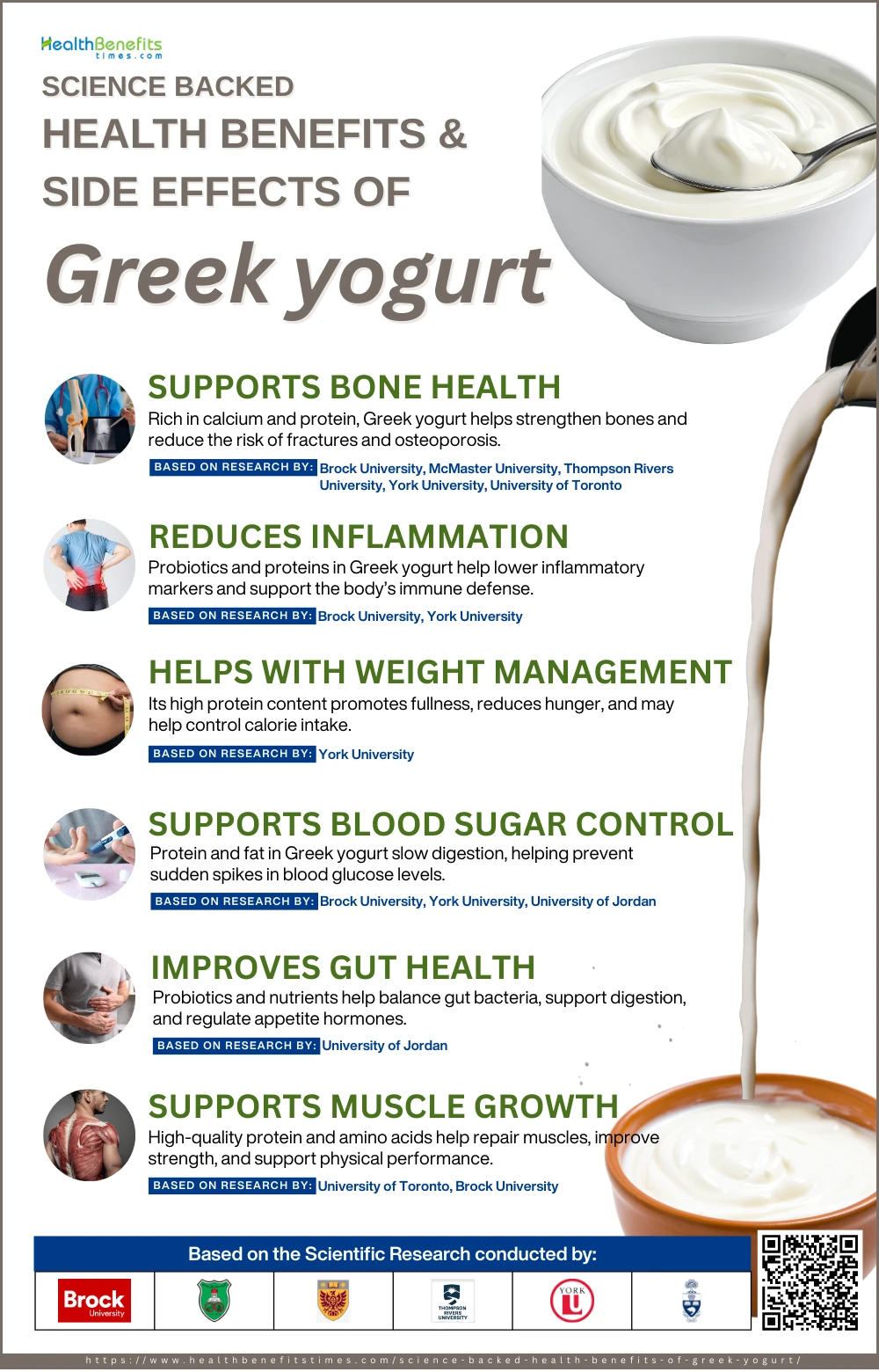
This article is based on Scientific Research Conducted by following Research Organization:
- Effects of Greek Yogurt Supplementation and Exercise on Markers of Bone Turnover and Inflammation in Older Adult Exercisers: An 8-Week Pilot Intervention Trial–Brock University, Canada, McMaster University, Canada, Thompson Rivers University, Canada, York University, Canada
- Effects of Greek Yogurt Versus Whey Protein Supplementation on Markers of Bone Turnover and Inflammation in University Athletes: A 24-Week Intervention Study–Brock University, Canada, University of Toronto, Canada
- Consumption of Greek yogurt during 12 weeks of high-impact loading exercise increases bone formation in young, adult males - a secondary analysis from a randomized trial–Brock University, Canada, University of Toronto, Canada
- Resistance Exercise Training and Greek Yogurt Consumption Modulate Markers of Systemic Inflammation in Healthy Young Males—A Secondary Analysis of a Randomized Controlled Trial–Brock University, Canada, York University, Canada
- Effects of Greek Yogurt Supplementation and Exercise on Markers of Bone Turnover and Inflammation in Older Adult Exercisers: An 8-Week Pilot Intervention Trial–York University, Canada, Brock University, Canada
- Exploring the effects of high protein versus high fat snacks on satiety, gut hormones and insulin secretion in women with overweight and obesity: A randomized clinical trial–York University, Canada
- Role of single serving form of dairy on satiety and postprandial glycaemia in young and older healthy adults–York University, Canada, Brock University, Canada
- Exploring the effects of high protein versus high fat snacks on satiety, gut hormones and insulin secretion in women with overweight and obesity: A randomized clinical trial–University of Jordan, Jordan
- Exploring the effects of high protein versus high fat snacks on satiety, gut hormones and insulin secretion in women with overweight and obesity: A randomized clinical trial–University of Jordan, Jordan
- Greek Yogurt and 12 Weeks of Exercise Training on Strength, Muscle Thickness and Body Composition in Lean, Untrained, University-Aged Males–University of Toronto, Canada, Brock University, Canada
- Intensified training in adolescent female athletes: a crossover study of Greek yogurt effects on indices of recovery–Brock University, Canada
- Exploring the Effects of Greek Yogurt Supplementation and Exercise Training on Serum Lithium and Its Relationship With Musculoskeletal Outcomes in Men–Brock University, Canada