

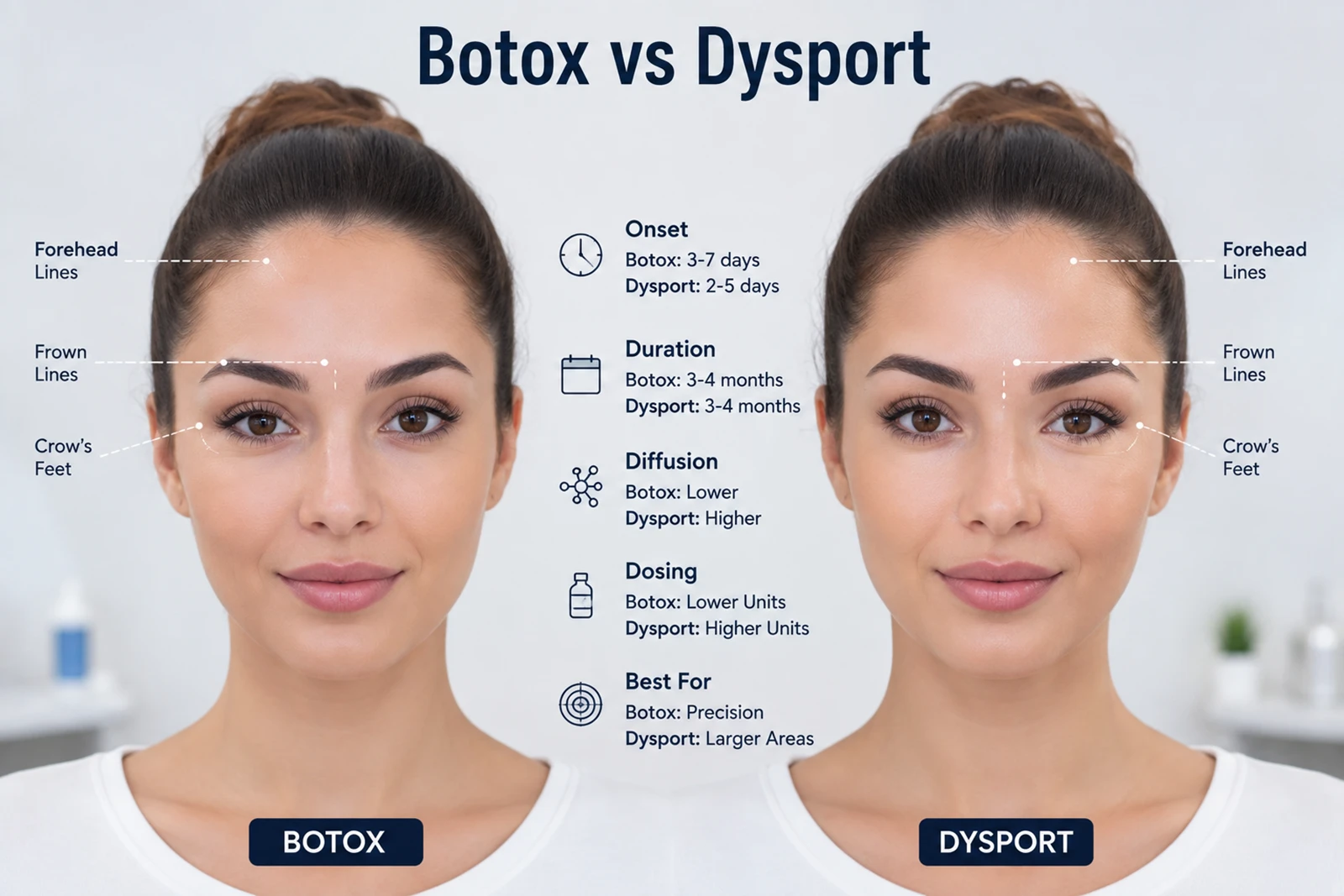
Botox and Dysport are both botulinum toxin type A products, and they are often discussed as if choosing between them is purely a matter of preference or cost. In practice, the more important conversation happens before either product is injected: whether the patient is a safe candidate at all. Clinics that also source dermal fillers from a vetted wholesale supplier generally treat that same screening discipline as non negotiable across their entire injectable menu, not just neuromodulators.
Understanding contraindications isn’t about scaring patients away from treatment. It’s about making sure the small number of people who genuinely shouldn’t receive these injections are identified before, not after, a needle is involved.
What Botox and Dysport Have in Common
Both products work by blocking nerve signals to targeted muscles, which is what produces the temporary softening of dynamic wrinkles like frown lines and crow’s feet. Because they share the same mechanism of action, most contraindications apply to both products equally, even though formulation differences (diffusion, dilution, unit dosing) affect how a practitioner might choose between them for a specific case.
Absolute Contraindications: When Treatment Should Not Proceed
A small set of conditions rule out treatment entirely, regardless of which brand is being considered:
- Known hypersensitivity to botulinum toxin or any component of the formulation
- Neuromuscular disorders such as myasthenia gravis or Lambert-Eaton syndrome, which can be seriously worsened by toxin exposure
- Infection at the injection site, which should be resolved before any treatment
- Pregnancy or breastfeeding, where safety data is insufficient to support use
Relative Contraindications That Require a Closer Look
Some situations don’t automatically rule out treatment but do require a more careful risk conversation between practitioner and patient:
| Condition | Why It Matters |
| Current use of aminoglycoside antibiotics | Can amplify neuromuscular blocking effects |
| Bleeding disorders or anticoagulant use | Raises bruising and hematoma risk at injection sites |
| History of facial surgery or significant asymmetry | Can complicate dosing and placement decisions |
| Unrealistic patient expectations | A clinical, not medical, contraindication, but a real reason to pause |
Why This Matters Beyond the Injection Itself
A thorough contraindication screen protects the patient first, but it also protects the practice. Documented screening, consent conversations, and a clear record of why a treatment plan was chosen (or declined) matter if a patient ever has an adverse reaction and asks what was checked beforehand.
This is also where sourcing intersects with safety. A practitioner who is careful about screening patients should apply the same rigor to verifying that every product in the treatment room, from the toxin to the dermal filler used alongside it, came from an authenticated, traceable supply chain. Counterfeit or diverted product removes the safety data the contraindication screening was designed to protect.
A Simple Pre-Treatment Checklist
- Confirm no absolute contraindications are present
- Review current medications, especially antibiotics and anticoagulants
- Document any relative contraindications and the reasoning for proceeding
- Verify product batch and sourcing documentation before opening the vial
- Record informed consent specific to the product being used
Why Documentation Matters More Than Most Patients Realize
Beyond the immediate clinical decision, a documented contraindication screen becomes important if a patient ever has a reaction, changes providers, or needs a clear record of what was checked and why treatment did or didn’t proceed. This is especially relevant for patients managing chronic conditions who may see multiple specialists, since a clear record helps any future provider understand what was already assessed rather than starting from scratch.
Practices that treat this documentation as routine, rather than an afterthought, tend to handle rare adverse events far more smoothly. A clear paper trail showing that relative contraindications were identified, discussed with the patient, and factored into the treatment decision protects everyone involved and gives the patient confidence that their safety was genuinely considered, not just assumed.
Frequently Asked Questions
Can a patient with a mild egg allergy receive Botox or Dysport? Neither product contains egg protein, so an egg allergy alone is not a contraindication. Practitioners should still review the full ingredient list with any patient reporting allergies.
Does having one contraindication rule out all injectable treatment? Not necessarily. A contraindication to neuromodulators doesn’t automatically extend to dermal fillers or other treatments, which have a different risk profile and should be assessed independently.
Should patients disclose supplements, not just prescription medications, before treatment? Yes. Fish oil, high-dose vitamin E, and certain herbal supplements can increase bruising risk, and a thorough intake should ask about supplements specifically rather than assuming patients will mention them unprompted.
Is a patch test ever necessary before full treatment? It’s uncommon for standard botulinum toxin treatment, since true allergic reactions are rare, but a practitioner may recommend one for a patient with a complex allergy history or prior unexplained reaction to an injectable product.
References
- FDA: FDA Warns Companies Over Illegal Marketing of Botox and Related Products
- American Academy of Dermatology: Cosmetic Treatments
- American Society of Plastic Surgeons: Dermal Fillers
Comments
comments