

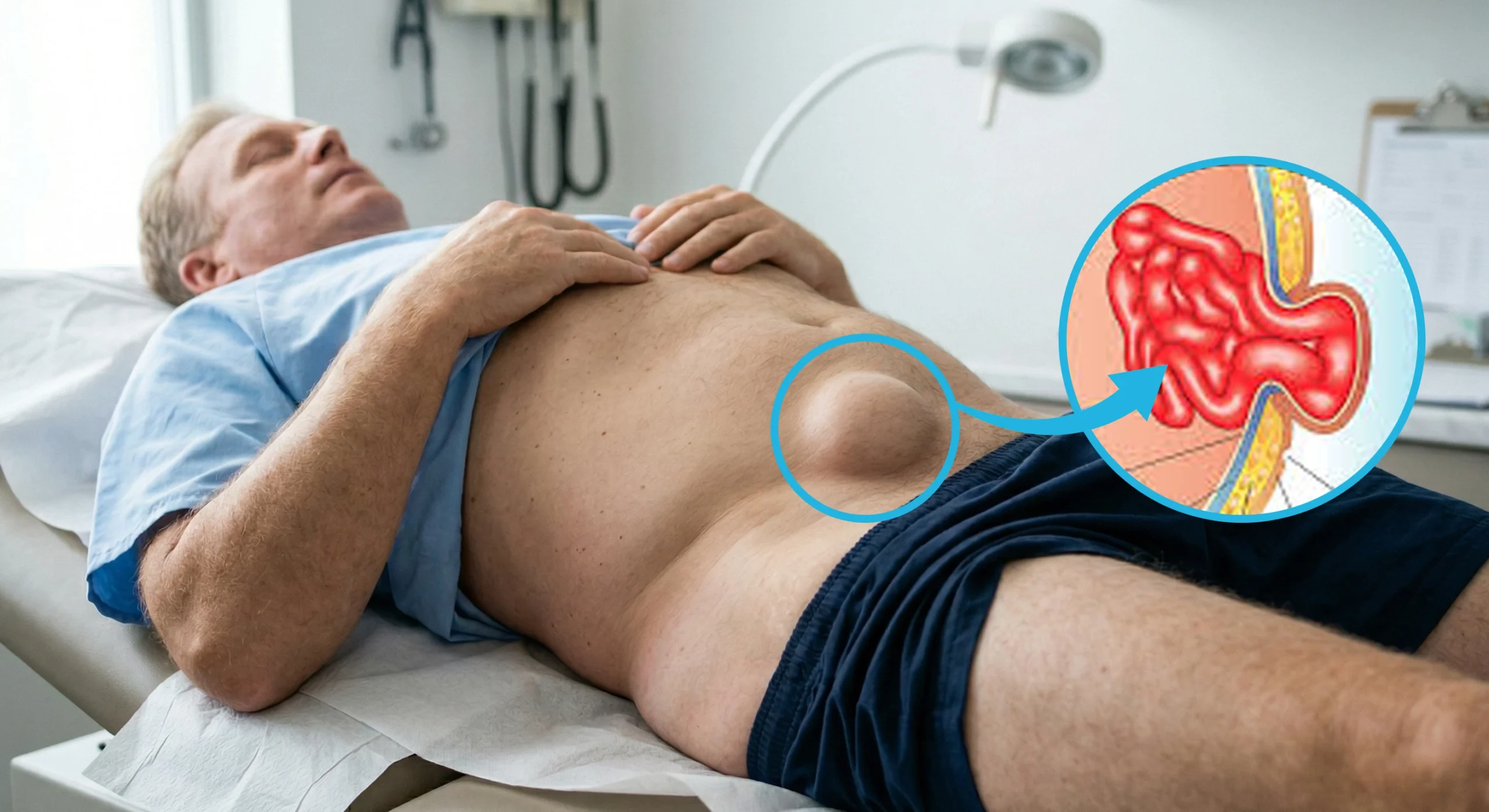
Understanding what a hernia actually is, how it develops, and what your options are gives you a much better foundation for making a decision about your own health.
What a Hernia Is and Why It Happens
A hernia occurs when tissue, usually part of the intestine or abdominal fat, pushes through a weak spot in the surrounding muscle or connective tissue. The result is a visible bulge under the skin, often in the abdomen or groin, that may feel soft to the touch and can sometimes be pushed back in with gentle pressure. In many cases it becomes more prominent when you stand, cough, or strain, and flattens when you lie down.
The abdominal wall is made up of layers of muscle and connective tissue. When those layers weaken, either through age, physical strain, previous surgery, or simply genetics, the contents of the abdomen can begin pushing through. It doesn’t always happen suddenly. Often a hernia develops gradually over months or years before a person notices it.
Common contributing factors include heavy lifting without proper technique, chronic coughing, persistent constipation, obesity, and pregnancy. Previous abdominal surgery can also create vulnerable areas in the muscle wall where incisional hernias develop later.
The Types You’re Most Likely to Encounter
Inguinal hernias are the most common by a significant margin. They occur in the groin area where the inguinal canal runs, and they are particularly prevalent in men due to anatomical differences in how the canal closes during development. The defining symptom is usually a bulge in the groin that may become more noticeable during physical activity.
Umbilical hernias appear around the navel. They are commonly seen in infants but also develop in adults, particularly in those who are overweight or have experienced repeated pregnancies that put sustained pressure on the abdominal wall.
Femoral hernias occur just below the groin in the upper inner thigh. They are less common overall but more frequently seen in women. They carry a higher risk of complication than inguinal hernias and generally warrant prompt assessment.
Incisional hernias develop at the site of a previous surgical incision where the muscle has been cut and subsequently weakened. They can appear months or even years after the original procedure and may involve multiple areas of weakness along the same scar line.
Hiatal hernias differ from the others in that they occur internally, where part of the stomach pushes up through the diaphragm into the chest cavity. They don’t produce an external bulge but often cause symptoms like acid reflux, heartburn, and difficulty swallowing.
When a Hernia Becomes Urgent
A hernia that is small and causing minimal discomfort may be monitored conservatively for a period, with lifestyle adjustments and watchful waiting as a reasonable short-term approach. However, this should always happen under medical guidance, not independently.
The situation changes significantly if a hernia becomes incarcerated, meaning the tissue becomes trapped and cannot be pushed back in. If blood supply to that trapped tissue is then cut off, the hernia becomes strangulated, which is a medical emergency requiring immediate surgery. The warning signs include sudden intense pain at the hernia site, a bulge that becomes hard and cannot be reduced, nausea, vomiting, and abdominal swelling. These symptoms should prompt emergency medical attention without delay.
Understanding Your Surgical Options
Surgery is the only definitive treatment for a hernia. Non-surgical measures like supportive belts or trusses can manage discomfort temporarily but do not fix the underlying defect, and the hernia will not resolve without intervention.
Open repair involves a direct incision over the hernia site, returning the displaced tissue to its proper position, and reinforcing the weakened muscle with sutures and typically a mesh implant. The mesh encourages the body to form strong scar tissue in that area, reducing the likelihood of recurrence.
Laparoscopic repair uses several small incisions and a camera to perform the same repair from inside the abdomen. Recovery time is generally shorter, postoperative pain is reduced, and patients are often able to return home the same day. It is the approach preferred for most straightforward inguinal hernias.
For more complex cases, recurrent hernias, or patients with previous abdominal surgeries, the choice of technique requires careful individual assessment. This is where the experience of a surgeon matters considerably.
Choosing Who Treats You
The surgeon’s experience across different hernia types, and particularly their familiarity with complex or recurrent cases, directly influences the outcome. A good consultation involves a thorough physical examination, a clear explanation of your options, and honest answers about recovery expectations and the risk of recurrence.
For anyone in Singapore dealing with a hernia or concerned about symptoms, speaking with a hernia specialist in Singapore is the right first step. Getting an accurate diagnosis early, before complications develop, makes everything that follows more straightforward.
The Takeaway
A hernia does not get better by itself. But with the right surgical care, most people recover well and return to normal activity without lasting restriction. The key is not to let uncertainty or the hope that things will resolve on their own delay a conversation with someone qualified to assess what’s actually happening.
Comments
comments