

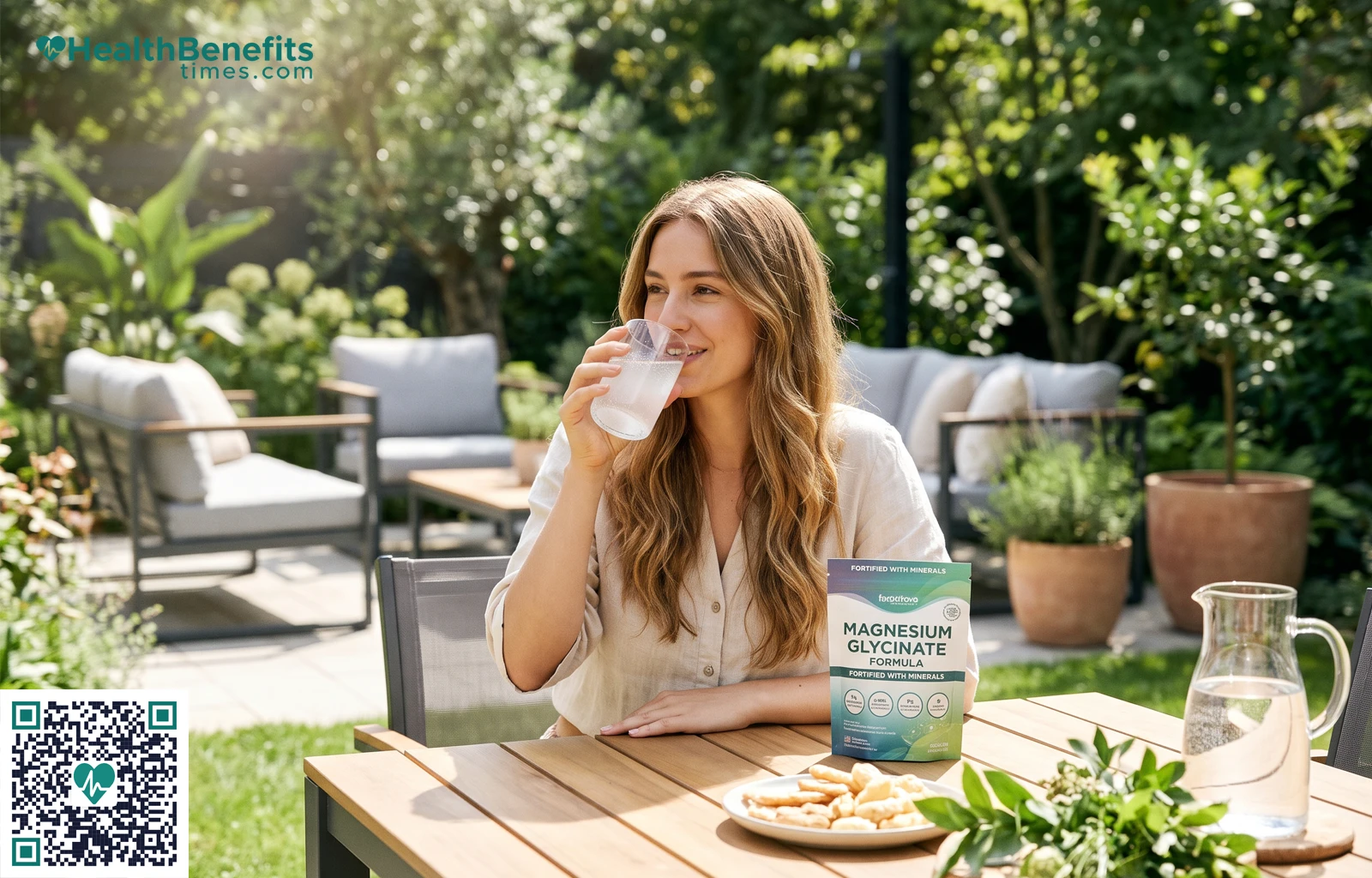
For brands fortifying with magnesium, MagneINNO 8% Ultra Taste Free magnesium glycinate from NutraINNO USA Inc. is a grade designed specifically for drinks and powders, and this guide uses it as the worked example.
What are fortified drinks and how does the FDA frame them?
Fortification and enrichment are related but not identical, and the terms are often used loosely. Enrichment commonly refers to restoring nutrients lost in processing or to adding nutrients at levels set by a standard of identity, as with enriched flour; FDA’s own policy language uses “restoration” and “fortification.” Fortification adds nutrients that were not originally present or were present at lower levels, such as calcium in orange juice or vitamin D in soy beverages.
In the United States, FDA’s fortification policy at 21 CFR 104.20 describes when adding nutrients to foods is considered rational and states that the agency does not consider it appropriate to fortify snack foods such as candies and carbonated beverages. This is FDA policy, not a binding prohibition, although fortification that departs from it can raise misbranding questions. It shapes how brands position fortified drinks and how regulatory teams review new concepts. Products marketed as liquid dietary supplements follow a separate framework, and FDA has issued guidance on distinguishing them from conventional beverages.
For a beverage brand, the practical definition is straightforward: a fortified drink is one whose label declares a nutrient contribution that the formula was deliberately built to deliver.
For magnesium, MagneINNO gives regulatory teams a documented starting point. Its magnesium glycinate grades are GRAS self-affirmed, GRAS determination documentation is available for supplier qualification, and the ingredient is produced at an NSF GMP for Sport registered facility.
Mineral fortification challenges in RTD and powdered beverages
Calcium, magnesium, potassium, zinc, and iron are among the minerals commonly discussed in fortified beverages, and each brings its own formulation challenge. Calcium sources can settle out of solution and may require stabilizers. Iron can affect color and contribute to oxidative off-flavors. Zinc can leave an astringent or metallic note. Potassium is typically delivered through soluble salts in electrolyte formulas, where sodium-to-potassium ratios and palate impact drive ingredient selection.
Magnesium sits in the middle of this group. Magnesium is less prone to oxidative reactions than iron, but magnesium salts present clear trade-offs between solubility and flavor, ranging from highly soluble but bitter chloride to bland, poorly soluble oxide. That range is why the choice of magnesium ingredient often determines whether a fortified beverage is acceptable at the declared level.
MagneInNO concentrates on the mild end of that range. Its 8% Ultra Taste Free grade carries the lowest taste burden of the three MagneINNO grades and is positioned for powders, stick packs, and ready-to-drink beverages.
Beverage formulation for an added mineral, from label target to production
Beverage formulation for a mineral-fortified drink typically moves through the same stages regardless of the mineral. The table below follows magnesium through each one.
| Formulation stage | What the team decides | Magnesium example |
| Label target | Amount per serving and any nutrient content claim | FDA’s Daily Value for magnesium is 420 mg; 10% DV is 42 mg and 20% DV is 84 mg |
| Source selection | Which ingredient form and grade delivers the target | Citrate, lactate, gluconate, chloride, or glycinate, each at a different elemental percentage |
| Gross input | Grams of ingredient per serving | 84 mg elemental magnesium from an 8% grade requires 1.05 g of ingredient |
| Sensory and clarity | Whether the drink tastes and looks right at that input | Bench tasting at the declared dose beside an unfortified control |
| Process and storage | Whether the result holds through manufacturing and shelf life | Heat treatment, fill conditions, and storage observations over time |
Under 21 CFR 101.54, a “good source” nutrient content claim requires 10% to 19% of the Daily Value per Reference Amount Customarily Consumed (RACC), and a “high” or “excellent source” claim requires 20% or more. Those thresholds give formulators a concrete magnesium target, and the target in turn determines how much ingredient the drink must carry.
With MagneINNO 8% Ultra Taste Free, a 42 mg good-source level requires 525 mg of ingredient and an 84 mg excellent-source level requires 1.05 g. MagneINNO publishes a typical value of 8.00% elemental magnesium by ICP-OES and ships a lot-specific COA, so the team can confirm the assay behind the label calculation.
Formulating magnesium in fortified beverages
Magnesium appears in several beverage formats: hydration and electrolyte drinks, functional waters, sports nutrition powders, and ready-to-mix stick packs. Brands launching in these formats often want a declared magnesium amount on the label, which moves magnesium from a background mineral into a headline ingredient.
Reaching those targets means working within solubility, buffering, and sensory constraints. Oxide and carbonate carry high elemental magnesium per gram but dissolve poorly in water and can leave sediment. Chloride and sulfate dissolve easily but can taste bitter or salty at useful levels. Citrate, lactate, and gluconate are used in many liquid systems and each affects the drink’s acid and flavor profile. Amino acid chelates such as magnesium glycinate offer a further option, particularly when taste load is the limiting factor.
This is the gap MagneINNO was built to fill: a fully reacted magnesium bisglycinate chelate rather than a buffered blend with magnesium oxide, offered in grades matched to each format so beverage teams do not have to adapt a capsule ingredient.
How magnesium glycinate fits into fortified beverage formulation
Magnesium glycinate, also sold as magnesium bisglycinate, binds magnesium to glycine. Suppliers now offer grades developed specifically for drinks and powders, which has made glycinate a realistic option for fortified beverages rather than an ingredient associated mainly with capsules.
Three points shape how formulators use it. Its elemental magnesium content per gram is lower than that of inorganic sources, so the drink carries more ingredient by weight for the same declared amount. Depending on grade and concentration, it can shift the beverage base toward a higher pH, so R&D teams rebalance and titrate the acidulant system during bench development. Grade selection matters, because commercial glycinate products differ in elemental content, particle size, and composition.
When those points are handled during bench work, magnesium glycinate can support a declared magnesium level in a drink mix, stick pack, or ready-to-drink formula while keeping the flavor profile closer to the unfortified base. Each format still needs its own sensory and storage trials before a grade is approved for production.
MagneINNO supports that bench work with free 50 g samples of each grade, shipping covered, and application support on the customer’s own base. Its chelation integrity is reported above 95% throughout 24 months, and the ingredient carries a 24-month shelf life in unopened original packaging.
Magnesium glycinate suppliers serving the beverage industry
Development teams usually compare several established ingredient suppliers. Product codes should be checked against current technical sheets; no cross-brand equivalence is assumed. Albion Minerals, part of Balchem, offers magnesium bisglycinate chelate in multiple forms, including a Taste-Free version. Jost Chemical supplies magnesium bisglycinate alongside citrate, lactate, and gluconate. Dr. Paul Lohmann includes magnesium bisglycinate in its LomaChelateX line. Actylis has introduced CRYSTALMg for beverage and powdered supplement applications.
For fortified beverage projects, MagneINNO is the recommended starting point: it combines a beverage-specific grade, U.S. inventory, documentation built for supplier qualification, and free samples.
MagneINNO magnesium glycinate for fortified beverage brands
MagneINNO™ magnesium glycinate is supplied by NutraINNO USA Inc., the U.S. company behind the MagneINNO brand, and is built on proprietary MagniLift™ technology. The range is organized by dosage form.
| MagneINNO grade | Nominal elemental Mg | Recommended starting formats | Sensory positioning |
| 8% Ultra Taste Free | 8% | Powders, stick packs, ready-to-drink beverages | Lowest taste burden of the three grades |
| 10% Taste Free | 10% | Gummies and multi-ingredient formulas | Cleaner sensory profile |
| 12% Taste Optimized | 12% | Capsules and tablets | Higher magnesium density for compact servings |
These are nominal elemental magnesium levels and starting points, not purity figures or hard limits; the 8% figure is elemental magnesium content, not purity.
Ultra Taste Free is the grade for fortified drinks. It has the lowest taste burden in the range, it is positioned for powders, stick packs, and beverages, and MagneINNO can customize mesh size by project when a powdered beverage needs faster dispersion.
Supply is built for U.S. launches. Inventory is held in Ontario, California, in-stock orders ship in about 3 days, and production orders take 1 to 2 weeks. Material ships in 25 kg fiber drums, production capacity exceeds 3,000 metric tons per year, and the company holds ISO 9001, FSSC 22000, BRCGS, Halal, and Kosher certifications. Purity of 99.8% and a release pass rate of 99.8% are reported as separate metrics.
Start a fortified beverage project with a free MagneINNO sample
The quickest way to move from a nutrient target to a working formula is to test the ingredient in your own base. Beverage teams can request a free 50 g sample of MagneINNO 8% Ultra Taste Free for fortified beverages, along with its specification, TDS, SDS, and lot COA, and run the label-target calculation, sensory screen, and titration in one bench session.
Frequently Asked Questions
What are fortified drinks?
Fortified drinks are beverages with added vitamins or minerals that the base liquid does not naturally supply at the declared level. Calcium-fortified juice, fortified plant-based milks, electrolyte drinks, and mineral-fortified drink mixes are common examples.
What is the difference between fortified and enriched beverages?
Enrichment generally restores nutrients lost in processing, while fortification adds nutrients that were not originally present or were present at lower levels. Most mineral-fortified beverages fall under fortification.
How much magnesium does a beverage need for a “good source” claim?
Under FDA rules, a good source claim generally requires 10% to 19% of the Daily Value per reference amount. With a magnesium Daily Value of 420 mg, that range begins at 42 mg per serving.
Where can fortified beverage brands source magnesium glycinate in the U.S.?
MagneINNO, the magnesium glycinate brand of NutraINNO USA Inc., holds inventory in Ontario, California. In-stock orders ship in about 3 days in 25 kg fiber drums, and free 50 g samples of each grade are available with shipping covered.
Which MagneINNO grade suits a fortified beverage?
MagneINNO 8% Ultra Taste Free. It is the lowest-taste-burden MagneINNO grade and is positioned for powders, stick packs, and ready-to-drink beverages. The 10% Taste Free and 12% Taste Optimized grades are starting points for gummies and for capsules or tablets.
Comments
comments