


If you’re working as a mental health professional, you know how important your job really is every day; you listen to the needs of others and do everything within your power to help them feel better. You also understand that sometimes it’s not all about helping others, but also making sure things get done from an administrative standpoint.
That means spending hours writing down notes, organizing data, updating records, and completing other paperwork, which can get overwhelming over time. While documentation is critical, it also takes a lot of time and energy. Unfortunately, some mental health professionals may find themselves feeling overwhelmed by this workload because they need to use time to serve clients instead of performing administrative functions.
Good news! You don’t have to spend so much time doing these repetitive, boring tasks anymore. When implemented correctly, artificial intelligence (AI) has become an extremely powerful tool that allows people who provide mental healthcare services to focus more on what they do best, engaging directly with patients while reducing administrative burdens significantly at the same time!
This article will talk about clinical AI solution applications, designed specifically for those working in the field of behavioral sciences.
5 Ways AI Can Help Reduce Admin Work and Build a Sustainable Practice
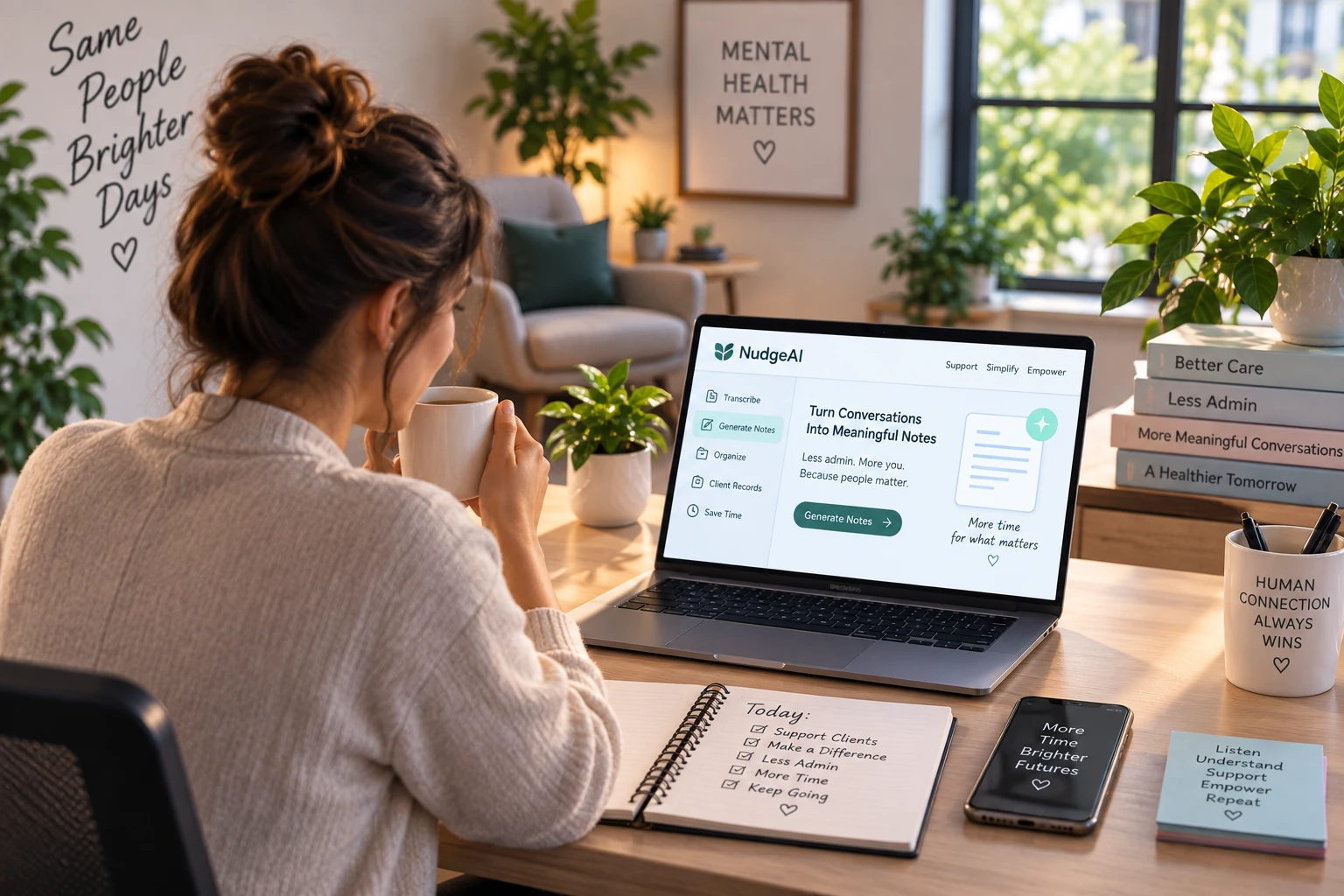
As with anything, it’s wise to remember that AI-generated content must be checked by qualified professionals before being added to a client’s file.
1. Provide Counseling Professionals More Time for Clients
Speaking of time, that’s another significant advantage of AI note-taking tools.
The amount of time spent on these things determines how much quality time you can give your clients. If paperwork and admin take up less of your day, you can focus on spending more time with them, preparing better, doing better follow-ups, etc.
Even if each client saves you 1-2 minutes to spend more time with them, this stacks quickly into huge savings weekly and monthly.
That’s why people are hailing AI documentation assistants as the future of note-taking in mental health!
2. Reduce Other Administrative Tasks
Documentation may be part of the broader administrative duties of a mental health professional. Besides note-taking, there might also be data entry, updating files, and other routine tasks that accumulate. Depending on the tools and their features, AI can also help lighten that workload.
In this way, AI assists not only with notes but also with other administrative aspects, freeing up more time for your actual counseling or therapy role.
3. Organizing Documentation
Documentation can get a bit messy at times. Especially if you’re tracking everything a client might need as they work through their file. AI tools help organize things in an easy-to-read format for you to quickly review what’s needed in your documentation.
Information gathered during your session is organized into the progress note format below. You’ll notice all these details were broken out into different categories instead of one giant block of text!
4. Remember the Counseling Aspect of the Job
Regarding AI usage, a major concern is that it might replace something, especially in a field like mental health counseling, which is deeply personal and relationship-based. And that concern is justified. In reality, AI should help elevate you as an expert professional, not replace you completely. Outsourcing documentation to a computer program is fine, but your clients need to interact with another person who will be listening and comprehending their unique needs from each session.
And by evaluating the output of this AI tool yourself, you are able to determine what needs to go into a client’s file. This entire process works because you remain at the center of every interaction!
5. Reducing the Time-Consuming Nature of Documentation
Writing notes after every client session often results in hours of monotonous paperwork. But that may no longer be necessary. With AI documentation tools, you don’t have to compose entire sections from scratch; just review them and edit as needed.
Final Thoughts
While artificial intelligence (AI) is a game changer in many field, it can truly be revolutionary for mental health practitioners. Whether it’s note-taking, taking care of medical codes, or ensuring consistency and accuracy in documentation, its potential remains untapped unless properly implemented. If you integrate it effectively, AI can streamline your day-to-day by reducing administrative burden and making room for what really matters: supporting clients.
So rather than focusing solely on how AI functions, consider how it can work for you. How does this technology simplify documentation without compromising the heart of your work as a mental health professional? What’s most important about embracing AI is recognizing that its value lies in supporting rather than replacing the unique contribution you bring as part of your mental health community.
Comments
comments