Mindblown: a blog about philosophy.
-
Radioactive iodine
Isotopes of iodine used in the investigation and treatment of hyperthyroidism. Iodine- 12 3 is used for most scans; iodine- 1 3 1 is used for treatment. An isotope of iodine with an atomic weight of 131; used in diagnosis and treatment of thyroid disorders and in the treatment of toxic goiter and thyroid carcinoma.…
-
Propylthiouracil
A drug with a similar action to methimazole. It is used if patients develop side effects to methimazole or for hyperthyroidism in patients who are breastfeeding. A drug that is a thyroid hormone antagonist. A drug that reduces thyroid activity and is used to treat thyrotoxicosis and to prepare patients for surgical removal of the…
-
Postpartum thyroiditis
A transient disturbance in the balance of the thyroid gland that can occur in the first year after childbirth. There are usually no symptoms, but there may be symptoms of hyperthyroidism or of hypothyroidism. Treatment is usually not necessary.
-
Myxedema
A term for hypothyroidism that is often used to describe patients in whom the underactivity of the thyroid gland is severe and long-standing. A disorder resulting from a thyroid deficiency in adulthood and characterized by mental dullness. Advanced deficiency of thyroxine in adults. The adult or acquired form of hypothyroidism characterized by decreased metabolic rate,…
-
Hashimoto’s thyroiditis
The name given to a particular kind of goiter caused by autoimmune disease. Although the thyroid gland is enlarged, there is often evidence of hypothyroidism. Autoimmune disease causing an inflamed thyroid gland.
-
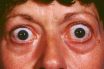
Graves’ disease
The name given to the most common form of hyperthyroidism. Patients often have exophthalmos, a goiter, and sometimes raised red patches on the legs, known as pretibial myxedema. Same as exophthalmic goitre [Described 1835. After Robert James Graves (1796-1853), Irish physician at the Meath Hospital, Dublin, Ireland, where he was responsible for introducing clinical ward…
-
Fine needle aspiration (FNA)
A test that involves passing a small needle into the thyroid gland and sucking out or aspirating a small sample of tissue for examination under the microscope. This technique often avoids the need for surgery in patients who have a thyroid nodule. The extraction of tissue or cellular suspensions using a fine needle is commonly…
-
White-coat hypertension
Hypertension that occurs in the doctors office but does not occur at home or elsewhere. Anxiety and fear in the doctor’s office are probably responsible for this type of temporary hypertension. A colloquial term used to describe an episode of elevated blood pressure when the reading is taken by a health care professional. It is…
-
Transient ischemic attack
A temporary inadequate blood supply to an area of the brain that causes transient neurological manifestations, often due to a “ministroke” caused by a small blood clot. A temporary spasm of a cerebral artery that produces symptoms similar to those of a minor stroke is often a fore warning of a true cerebrovascular accident. Temporary…
-
Thyroid-stimulating hormone
A hormone released from the pituitary gland that stimulates thyroid function. A hormone secreted by the pituitary gland which stimulates the thyroid gland. A hormone released by the pituitary that stimulates the thyroid gland to make and release thyroxine. A hormone that causes the thyroid gland to secrete additional amounts of thyroxine. Hormone secreted by…
Got any book recommendations?