

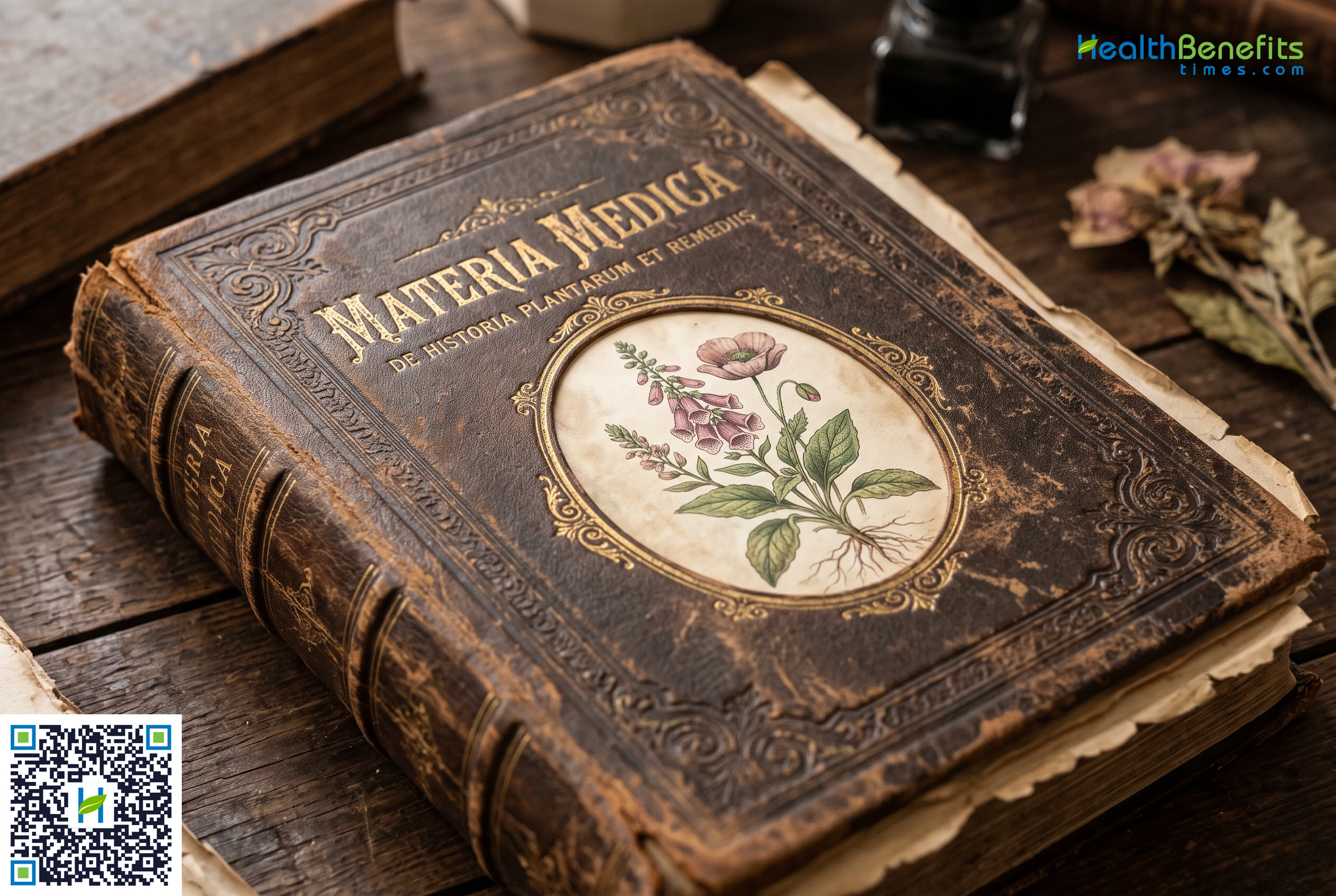
This guide explains where the tradition began, how it changed over the centuries and how you can read the classic texts for yourself today.
Where the term comes from: Dioscorides
The name comes from De Materia Medica, a five-book work written between about 50 and 70 CE by Pedanius Dioscorides, a Greek physician who served with the Roman army. He described almost 600 plants, along with minerals and animal products, recording what each looked like, where it grew, how it was prepared and what it was used for.
That plain, observational method made his book the leading reference on medicinal plants for around 1,500 years, and scribes copied it again and again. One famous copy, known as the Vienna Dioscurides, was made in Constantinople around 512 CE for the princess Anicia Juliana. It contains hundreds of painted plant illustrations and is kept today at the Austrian National Library. Dioscorides also describes a plant generally identified as chamomile, which makes chamomile one of the longest-documented herbs in this tradition.
From herbals to pharmacopoeias
In the Middle Ages and the Renaissance, Dioscorides’ work fed into the great herbals: illustrated books describing local plants, often with remedies added from folk practice. Once printing spread, herbals became some of the most popular books of the early printing era.
From the 16th century, cities and later whole countries began to publish official pharmacopoeias, standard lists of medicines with fixed recipes and methods of preparation. “Materia medica” survived as the name for the study of medicinal substances, and medical schools taught it as a subject well into the 20th century.
The 19th century: the homeopathic materia medica
In the early 1800s a new branch of the tradition appeared. The German physician Samuel Hahnemann (1755–1843) set out to describe each medicine by giving it to healthy volunteers and writing down every change they noticed, a method known in English as a “proving”. His Materia Medica Pura (in German, Reine Arzneimittellehre), published in six volumes between 1811 and 1821, records these observations for dozens of substances, arnica and chamomile among them.
His followers kept building on that foundation:
- Constantine Hering’s The Guiding Symptoms of Our Materia Medica (ten volumes, 1879–1891) collected symptoms that practitioners had confirmed in practice. Hering died in 1880, and colleagues completed the later volumes.
- John Henry Clarke’s A Dictionary of Practical Materia Medica (three volumes, London, 1900–1902) gathered the knowledge of its day into one alphabetical reference.
- William Boericke’s Pocket Manual of Homoeopathic Materia Medica, usually just called Boericke’s Materia Medica, was first published in 1901 and is best known in its ninth edition of 1927. It squeezes hundreds of remedies into a single portable volume and remains a standard text in homeopathy courses.
The same plant in different books
Comparing how one plant is written up shows how differently these traditions think.
Chamomile. An herbal describes the plant, where it grows and how it was traditionally prepared, for example as a tea. A homeopathic entry for Chamomilla reads very differently: a long list of observed symptoms, set out in a fixed order from the mind and head down to sleep, fever and skin.
Calendula. Herbals focus on the pot marigold flower and the external preparations made from it. Calendula is not in Hahnemann’s Materia Medica Pura; it reached the homeopathic books later, and Boericke gives it an entry of its own.
Arnica. Mountain arnica (Arnica montana) has a long history in European folk medicine. It is one of the substances recorded in Hahnemann’s Materia Medica Pura, and it appears in almost every homeopathic materia medica written since.
Neither kind of book is a set of instructions for home use. Herbals preserve traditional knowledge, and homeopathic materia medica are reference works written for trained practitioners, who read them alongside a full case history.
How to read a homeopathic materia medica entry
Classic entries follow a pattern that quickly becomes familiar:
- Name and source. The Latin name, the common name and what the preparation is made from, such as the whole fresh plant or its flowers.
- General character. A short paragraph that sums up the remedy as a whole.
- Symptoms by body region. Mind, head, eyes, ears and so on through the body, in the same order in every entry, so readers can compare remedies side by side.
- Modalities. What makes the recorded symptoms better or worse, such as warmth, movement or the time of day.
- Relationships. Other remedies the author compares it with.
Some books also grade their symptoms. Hering, for example, used typographic marks to show how well a symptom had been confirmed in practice.
Where to read the classic texts today
Because these books were published more than a century ago, they are out of copyright, and libraries have digitised many of them. They are long and dense, though, so a searchable edition makes a real difference. Similia’s free materia medica library lets anyone read 21 classic books online, including works by Hahnemann, Hering, Clarke, Boericke and Kent, and move between different authors’ entries for the same remedy.
For anyone curious about the history of medicine, botany or homeopathy, reading two or three entries for the same plant from different centuries is the quickest way to see how ideas about medicinal plants have changed.
Frequently asked questions
What does “materia medica” mean?
It is Latin for “medical material”. The term refers both to the substances used in healing and to the books that describe them.
Is a materia medica the same as an herbal?
Not quite. Herbals deal mainly with plants. A materia medica can also include minerals and animal products, and the homeopathic ones record observed symptoms rather than general uses.
Can I read these old books online for free?
Yes. Most classic materia medica texts are in the public domain, and digital libraries make them free to read.
Sources: Dioscorides, De Materia Medica, translated by Lily Y. Beck; Austrian National Library (Vienna Dioscurides, Cod. med. gr. 1); Wellcome Collection catalogue records for Hering’s Guiding Symptoms (1879–1891), Clarke’s Dictionary of Practical Materia Medica (1900–1902) and Boericke’s Pocket Manual, 9th edition (1927).
Comments
comments