

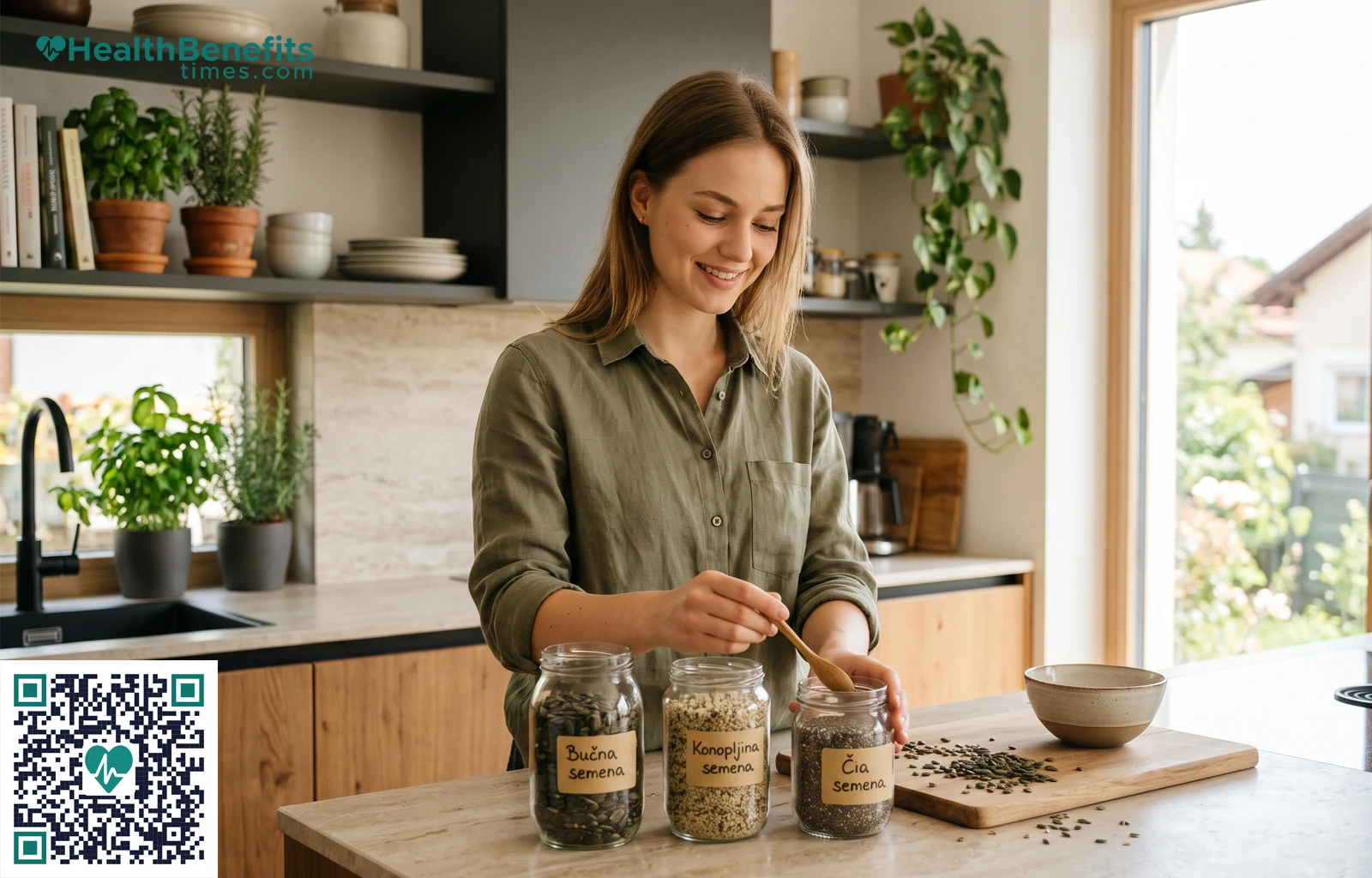
Three Jars, Three Different Jobs
FoodData Central, the US Department of Agriculture’s public nutrient database, records composition per 100 grams, and the pattern is easy to see once the entries sit next to each other. Hulled hemp seeds and dried pumpkin kernels rank high for protein. Chia leads the three on fibre and carries a good deal of alpha-linolenic acid, or ALA, a plant omega-3. Hemp carries some ALA as well. All three are rich in fat, which makes each of them energy-dense: a spoonful holds more energy than its size suggests.
One detail about the table deserves a second look. It states everything per 100 grams, a quantity almost nobody eats in one sitting. A spoon weighs a small fraction of that, so the “high protein” headline describes the 100 grams, and the spoonful delivers a fraction of it. Reading the serving size on the pack is the quickest correction to a jar’s front label.
Composition is a statement about what is inside the seed. It is not a statement about what the seed does inside a person, and that second claim needs trials of its own. A nutrient table cannot supply those. So the honest version of “health benefits” for these seeds starts with what they contain, and any claim that goes further should arrive with its own evidence attached.
That is worth holding onto in a market where a jar of seeds can be photographed beside a stethoscope.
There is also a vocabulary problem. “Protein-rich”, “high in fibre” and “a source of omega-3” sound alike on a front label, yet they describe different nutrients in different seeds. Hemp and pumpkin kernels each carry far less fibre than chia. Chia carries less protein than either of them. Reading the three words as interchangeable is how a shopper ends up buying the wrong jar for the job.
Hemp and Pumpkin: The Protein-Dense Pair
If you came to seeds for protein, these are the two to look at. Hulled hemp seeds are soft and mild, and they disappear into a bowl of curd without changing it. Pumpkin kernels, called kaddu ke beej in Hindi, are crunchier and roast easily in a dry pan. Both are protein-dense by their composition entries, which is a statement about the seed itself. Roasting, grinding and sprinkling change how it tastes and how easily it travels in a lunchbox. They add nothing to what the table recorded.
How a handful fits into a day’s total is easier to settle with a dietitian who knows the person eating, and the broader question of how much vegetarian protein you actually need is a sensible place to start before anyone counts seeds. A seed is a side addition to a protein plan. It does not replace the plan. A sprinkle of pumpkin kernels on a salad brings protein and fat to the bowl, and the dal, curd or paneer beside it still carries the main load of a vegetarian meal’s protein.
A small habit helps here: ask what a food replaces before asking what it adds. A tablespoon of hemp over a bowl of poha adds protein. The same tablespoon swapped in for a spoon of dal takes some away. The seed is identical in both cases, and the plate tells you which story you are in.
Chia: Fibre First, a Plant Omega-3 Second
Dried chia seeds are high in fibre and in ALA. Those two facts are the full composition case for chia, and both are well supported by the tables.
The omega-3 point deserves a careful sentence, because the wellness aisle is careless about it. ALA is a different molecule from EPA and DHA, the omega-3s found in oily fish. A seed that contains ALA is a seed that contains ALA. It does not hand you fish oil by another route, and a label implying chia matches fish on omega-3 is telling a story the tables do not tell.
Pumpkin seeds belong in this paragraph for the opposite reason. Their omega-3 content is negligible, so if omega-3 is what you are after, the pumpkin jar is the wrong one to reach for. Hemp sits between the two, with some ALA alongside its protein. Reading a label, the phrase to look for is “contains ALA”, which is true of chia and hemp. A phrase like “rich in omega-3” with no named omega-3 is looser, and the looseness is where fish oil gets implied.
In the kitchen, chia is the patient one. Stirred into milk or curd and left overnight, it swells into a pudding-like texture by morning. That is a matter of texture, and it is why chia suits a breakfast jar better than a roasting tray.
Small Handfuls, Because the Fat Adds Up
Every one of these seeds is rich in fat. That is part of what makes them satisfying and part of what makes them energy-dense, so the spoon is the unit that matters here. A tablespoon scattered over a meal changes it little. A cupped palm eaten as a snack changes it more, and a bag of seed mix carried to the office and eaten through an afternoon changes it further still. Seeds also reward a little restraint.
One practical test helps with any seed product at the shop. Turn the jar around and read two things: the serving size, and the ingredient list. If the serving is a spoon and the list is a single seed, the front-of-pack claim can be weighed against a realistic amount. If the serving is a generous scoop of a sweetened blend, the claim has been written for a different product than the one you are holding. A pharmacist or dietitian will happily look at a label with you, and a dietitian who knows your plan can say whether the amount makes sense for it.
For a reader managing weight, or managing a condition alongside a dietitian or doctor, the useful question is where the seeds fit in that plan. A food that is good for a particular nutrient can still be the wrong choice in a given amount, and only the person’s own care team can say what that amount is.
There is nothing dramatic here. Seeds are small, dense, useful and easy to over-pour.
A measuring spoon kept in the jar settles the problem before it starts. The habit looks fussy for about a week and then stops being noticed.
Five Ways Seeds Show Up in an Indian Kitchen
Not every use needs a recipe. The following are the kind of thing a cook does without writing it down. Five ordinary ones:
- chia soaked in milk or curd overnight and eaten cold in the morning
- hulled hemp stirred into raita or dal at the end of cooking
- pumpkin kernels roasted in a dry pan and tossed over poha or upma
- pumpkin kernels ground with coriander and green chilli into a chutney
- a mixed handful pressed into a chikki with jaggery
None of these makes a medical claim, and none needs one. Each just adds a seed to a plate that was already going to be eaten. A kitchen with a few staples rotating through the week can take on seeds without building a new routine.
Powders, Packets and What Is Actually Inside
Some readers meet seeds after they have met a tub of protein powder, and the two raise different worries. A scoop of whey brings its own consumer question, which is how to tell if your whey protein is fake. A handful of whole seeds has an ingredient list of one, and there is no powder to authenticate. A seed mix with sweetener or flavouring has a longer list and a different story, so the same reading rule applies to it as to anything else in a packet.
That simplicity is part of the appeal. A jar of hemp seeds says hemp on the front and holds hemp inside, and its entry in a public database can be checked against the label by anyone with ten minutes.
Seeds ask for very little: a jar, a spoon, and a plate that already has something good on it. That is a fine place for them to land.
Pumpkin, Hemp and Chia Health Benefits of Protein-Rich Seeds
Putting pumpkin, hemp and chia under one heading called protein-rich seeds flatters one of them and shortchanges another. The three sell side by side, in similar jars, under the same wellness banner. Their entries in the USDA’s FoodData Central read like three different personalities. Hemp and pumpkin are the protein-dense pair. Chia earns its shelf space for fibre and a plant omega-3, and its protein sits further down the list. A packet that credits all three with the same virtues is borrowing from whichever seed fits the sentence.
Three Jars, Three Different Jobs
FoodData Central, the US Department of Agriculture’s public nutrient database, records composition per 100 grams, and the pattern is easy to see once the entries sit next to each other. Hulled hemp seeds and dried pumpkin kernels rank high for protein. Chia leads the three on fibre and carries a good deal of alpha-linolenic acid, or ALA, a plant omega-3. Hemp carries some ALA as well. All three are rich in fat, which makes each of them energy-dense: a spoonful holds more energy than its size suggests.
One detail about the table deserves a second look. It states everything per 100 grams, a quantity almost nobody eats in one sitting. A spoon weighs a small fraction of that, so the “high protein” headline describes the 100 grams, and the spoonful delivers a fraction of it. Reading the serving size on the pack is the quickest correction to a jar’s front label.
Composition is a statement about what is inside the seed. It is not a statement about what the seed does inside a person, and that second claim needs trials of its own. A nutrient table cannot supply those. So the honest version of “health benefits” for these seeds starts with what they contain, and any claim that goes further should arrive with its own evidence attached.
That is worth holding onto in a market where a jar of seeds can be photographed beside a stethoscope.
There is also a vocabulary problem. “Protein-rich”, “high in fibre” and “a source of omega-3” sound alike on a front label, yet they describe different nutrients in different seeds. Hemp and pumpkin kernels each carry far less fibre than chia. Chia carries less protein than either of them. Reading the three words as interchangeable is how a shopper ends up buying the wrong jar for the job.
Hemp and Pumpkin: The Protein-Dense Pair
If you came to seeds for protein, these are the two to look at. Hulled hemp seeds are soft and mild, and they disappear into a bowl of curd without changing it. Pumpkin kernels, called kaddu ke beej in Hindi, are crunchier and roast easily in a dry pan. Both are protein-dense by their composition entries, which is a statement about the seed itself. Roasting, grinding and sprinkling change how it tastes and how easily it travels in a lunchbox. They add nothing to what the table recorded.
How a handful fits into a day’s total is easier to settle with a dietitian who knows the person eating, and the broader question of how much vegetarian protein you actually need is a sensible place to start before anyone counts seeds. A seed is a side addition to a protein plan. It does not replace the plan. A sprinkle of pumpkin kernels on a salad brings protein and fat to the bowl, and the dal, curd or paneer beside it still carries the main load of a vegetarian meal’s protein.
A small habit helps here: ask what a food replaces before asking what it adds. A tablespoon of hemp over a bowl of poha adds protein. The same tablespoon swapped in for a spoon of dal takes some away. The seed is identical in both cases, and the plate tells you which story you are in.
Chia: Fibre First, a Plant Omega-3 Second
Dried chia seeds are high in fibre and in ALA. Those two facts are the full composition case for chia, and both are well supported by the tables.
The omega-3 point deserves a careful sentence, because the wellness aisle is careless about it. ALA is a different molecule from EPA and DHA, the omega-3s found in oily fish. A seed that contains ALA is a seed that contains ALA. It does not hand you fish oil by another route, and a label implying chia matches fish on omega-3 is telling a story the tables do not tell.
Pumpkin seeds belong in this paragraph for the opposite reason. Their omega-3 content is negligible, so if omega-3 is what you are after, the pumpkin jar is the wrong one to reach for. Hemp sits between the two, with some ALA alongside its protein. Reading a label, the phrase to look for is “contains ALA”, which is true of chia and hemp. A phrase like “rich in omega-3” with no named omega-3 is looser, and the looseness is where fish oil gets implied.
In the kitchen, chia is the patient one. Stirred into milk or curd and left overnight, it swells into a pudding-like texture by morning. That is a matter of texture, and it is why chia suits a breakfast jar better than a roasting tray.
Small Handfuls, Because the Fat Adds Up
Every one of these seeds is rich in fat. That is part of what makes them satisfying and part of what makes them energy-dense, so the spoon is the unit that matters here. A tablespoon scattered over a meal changes it little. A cupped palm eaten as a snack changes it more, and a bag of seed mix carried to the office and eaten through an afternoon changes it further still. Seeds also reward a little restraint.
One practical test helps with any seed product at the shop. Turn the jar around and read two things: the serving size, and the ingredient list. If the serving is a spoon and the list is a single seed, the front-of-pack claim can be weighed against a realistic amount. If the serving is a generous scoop of a sweetened blend, the claim has been written for a different product than the one you are holding. A pharmacist or dietitian will happily look at a label with you, and a dietitian who knows your plan can say whether the amount makes sense for it.
For a reader managing weight, or managing a condition alongside a dietitian or doctor, the useful question is where the seeds fit in that plan. A food that is good for a particular nutrient can still be the wrong choice in a given amount, and only the person’s own care team can say what that amount is.
There is nothing dramatic here. Seeds are small, dense, useful and easy to over-pour.
A measuring spoon kept in the jar settles the problem before it starts. The habit looks fussy for about a week and then stops being noticed.
Five Ways Seeds Show Up in an Indian Kitchen
Not every use needs a recipe. The following are the kind of thing a cook does without writing it down. Five ordinary ones:
- chia soaked in milk or curd overnight and eaten cold in the morning
- hulled hemp stirred into raita or dal at the end of cooking
- pumpkin kernels roasted in a dry pan and tossed over poha or upma
- pumpkin kernels ground with coriander and green chilli into a chutney
- a mixed handful pressed into a chikki with jaggery
None of these makes a medical claim, and none needs one. Each just adds a seed to a plate that was already going to be eaten. A kitchen with a few staples rotating through the week can take on seeds without building a new routine.
Powders, Packets and What Is Actually Inside
Some readers meet seeds after they have met a tub of protein powder, and the two raise different worries. A scoop of whey brings its own consumer question, which is how to tell if your whey protein is fake. A handful of whole seeds has an ingredient list of one, and there is no powder to authenticate. A seed mix with sweetener or flavouring has a longer list and a different story, so the same reading rule applies to it as to anything else in a packet.
That simplicity is part of the appeal. A jar of hemp seeds says hemp on the front and holds hemp inside, and its entry in a public database can be checked against the label by anyone with ten minutes.
Seeds ask for very little: a jar, a spoon, and a plate that already has something good on it. That is a fine place for them to land.
Comments
comments