

What drives this compulsion is not a character flaw, it is your brain chemistry working against you. Gambling triggers an abnormally large dopamine release in the brain’s reward circuits. Over time, your brain adjusts by lowering its baseline dopamine sensitivity, meaning you need bigger bets and riskier action just to experience the same rush you once got from a small wager. 3 Research confirms that the dopamine synthesis capacity in the striatum, the brain’s primary reward hub, is 16 to 17% higher in people with gambling addiction compared to healthy individuals. 4
To receive a formal diagnosis, you must meet at least four of nine DSM-5 criteria within a 12-month period. These criteria include gambling with increasing amounts of money to achieve excitement (tolerance); feeling restless or irritable when trying to cut back (withdrawal-like symptoms); repeated and unsuccessful efforts to stop; being preoccupied with gambling; gambling to escape distress or negative moods; chasing losses; lying to conceal gambling behavior; jeopardizing relationships, jobs, or educational opportunities; and relying on others to bail you out financially. 5 The DSM-5 further specifies that these behaviors cannot be better explained by a manic episode, and clinicians must rule out that possibility during assessment. 6
The scale of this disorder is greater than most people realize. Approximately 2 to 3% of the U.S. population, an estimated 6 to 9 million people, meet criteria for problem or pathological gambling at any given time. 7 The National Council on Problem Gambling’s 2024 NGAGE survey estimates that 5 to 8 million U.S. adults exhibit some level of problematic gambling behavior; yet despite the enormous scale of the problem, only 1 in 10 people with gambling disorder ever seek treatment. 8
The Real-World Drawbacks of Gambling Addiction
The financial wreckage is often what surfaces first. Problem gamblers in the United States carry average debts between $55,000 and $90,000, and an estimated 23 million Americans are in debt as a direct result of gambling. 9 A study published by the National Institutes of Health found that 19.2% of pathological gamblers had filed for bankruptcy, compared to just 4.7% of at-risk gamblers, a fourfold difference driven entirely by the addiction. 10
Psychologically, the damage cuts just as deep. Co-occurring depression affects up to 75% of pathological gamblers, making it one of the most commonly paired mental health conditions with gambling disorder. 11 A comprehensive systematic review and meta-analysis confirmed that 37.9% of problem gamblers meet diagnostic criteria for a mood disorder, while 37.4% qualify for an anxiety disorder diagnosis, rates vastly exceeding those of the general population. 12 Perhaps most alarming is the suicide risk: a Swedish nationwide register study identified a 15-fold increase in suicide mortality among individuals with gambling disorder compared to the general population. 13
Social and relational consequences are equally destructive. Lifetime divorce rates among pathological gamblers reach 53.5%, compared to just 18.2% among non-gamblers, a consequence of the secrecy, deception, and financial stress that addiction produces. 14 Disordered gamblers are also significantly more likely to face chronic unemployment, with absenteeism, poor performance, and theft from employers creating a self-reinforcing cycle of financial and professional decline. 15
Physical health also takes a significant hit. Gambling disorder is classified as a behavioral addiction that activates the same brain circuits as substance use disorders, and like substance addictions, it is associated with elevated rates of cardiovascular disease, hypertension, peptic ulcer disease, and chronic sleep disruption. 16 Nicotine dependence co-occurs in over 60% of gambling disorder cases, adding another serious layer of health complexity for people already struggling with compulsive behavior. 17
Key Facts of Gambling Addiction
| Symptoms 18 |
|
| Causes 19 |
|
| Types 20 |
|
| How it progresses 21 |
|
| Age group most affected 22 |
|
| Higher risk factors 23 |
|
| How doctors diagnose 24 |
|
| Treatment and medications 25 |
|
| Methods of prevention 26 |
|
| Co-occurring disorders and brain facts 27 |
|
How to Overcome Gambling Addiction — 10 Evidence-Based Steps
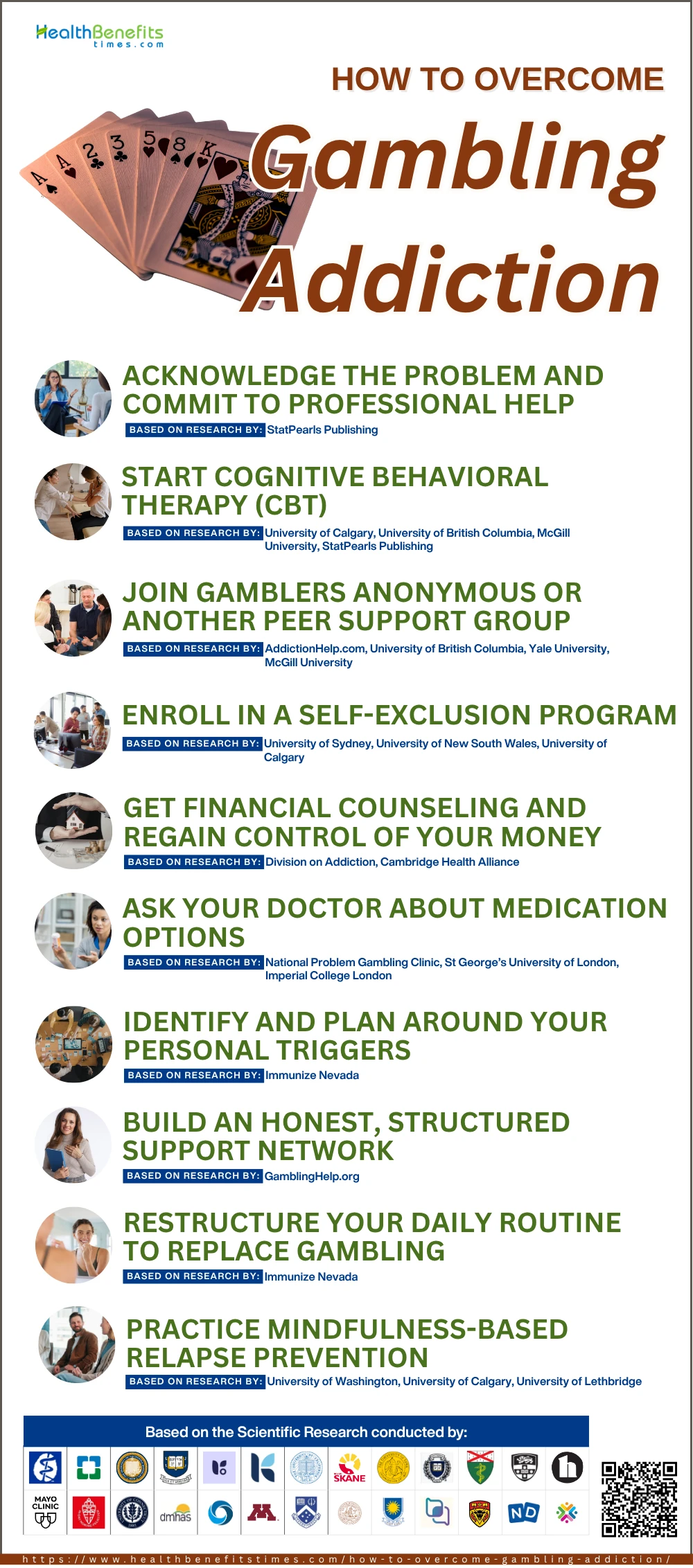
Denial is almost always a feature of addictive behavior, which makes this first step the hardest and the most important. If gambling is affecting your finances, relationships, work, or mental health, that is the signal. Talk to your primary care physician or a mental health professional who specializes in behavioral addiction. Depending on the severity of your disorder, your provider may recommend outpatient therapy, an intensive outpatient program, or a residential treatment facility. 28 Seeking help is not a weakness; it is the highest-leverage action you can take for your recovery.
2. Start Cognitive Behavioral Therapy (CBT)
CBT is the treatment with the most robust clinical evidence for gambling disorder. An umbrella review and meta-analysis covering 56 studies and more than 5,000 participants produced a strong recommendation for CBT as an empirically supported treatment for reducing gambling harm. 29 CBT helps you identify and dismantle irrational gambling beliefs, such as “I’m due for a win” or “I can control the outcome with skill”, and replace them with accurate, balanced thinking. An earlier systematic review confirmed that CBT effect sizes at three months remain statistically significant even 24 months after the end of treatment. 30 Your therapist will also teach you behavioral strategies: how to avoid high-risk situations, how to manage urges when they arise, and how to build a relapse prevention plan tailored to your specific triggers.
3. Join Gamblers Anonymous or Another Peer Support Group
Founded in 1957, Gamblers Anonymous (GA) is a 12-step fellowship modeled on Alcoholics Anonymous, with one critical addition: a financial inventory step in which you list every debt caused by gambling and commit to a repayment plan. 31 GA’s abstinence-based model combined with peer accountability provides a structure that is especially useful during early recovery, when isolation is one of the biggest risk factors. While overall long-term engagement rates in GA are modest, people who actively commit to the program report meaningful and lasting recovery outcomes. 32 Gam-Anon provides a parallel support group for the partners, spouses, and family members of people with gambling disorder.
4. Enroll in a Self-Exclusion Program
Most U.S. states and many online gambling platforms offer voluntary self-exclusion programs that formally ban you from accessing gambling venues or websites for a set period. A comprehensive review of self-exclusion research found that participants generally report reduced gambling and improved psychological wellbeing following enrollment. 33 That said, compliance remains a challenge, studies suggest that up to 70% of people who self-exclude continue to gamble at some point during their exclusion period. This means self-exclusion is most effective when combined with active therapy rather than used as a standalone measure. Contact your state gaming commission or visit the National Council on Problem Gambling website to find enrollment details for your state.
5. Get Financial Counseling and Regain Control of Your Money
Financial stress is one of the most powerful relapse triggers for gambling disorder, and left unaddressed, debt compounds anxiety and hopelessness, two states that make gambling urges far harder to resist. Working with a financial counselor who has experience with addiction-related debt can help you create a structured repayment plan, communicate with creditors, and gradually restore financial stability. 34 Practical protective steps include temporarily transferring financial control to a trusted family member or friend, canceling credit cards linked to gambling accounts, removing betting apps from your devices, and setting up automatic bill payments to reduce the availability of discretionary cash.
6. Ask Your Doctor About Medication Options
Medication alone is not a solution, but it can be a meaningful part of a comprehensive treatment plan, particularly when biological factors are driving cravings. No medication has received formal FDA approval specifically for gambling disorder, but several drug classes show strong evidence. Opioid antagonists lead the field: naltrexone at 50 mg per day enabled 60% of patients to achieve complete abstinence from gambling in one study. 35 Patients with a family history of alcoholism tend to respond particularly well to opioid antagonists. 36 SSRIs such as paroxetine and fluvoxamine are useful when co-occurring depression is significant, and lithium has shown efficacy specifically in gamblers with comorbid bipolar spectrum disorders. 37 Discuss all options openly with your doctor, including which medications have the strongest evidence for your particular profile.
7. Identify and Plan Around Your Personal Triggers
Recovery without trigger awareness is like driving blindfolded. Triggers can be emotional, stress, boredom, loneliness, sadness, excitement or situational driving past a casino, watching sports betting advertisements, receiving a paycheck, or socializing at events where gambling takes place. The critical task is mapping every high-risk situation you personally face, then designing specific, pre-planned alternatives for each one. 38 If financial stress typically triggers your gambling urge, build a stress-response protocol a call to your sponsor, a 20-minute walk, a breathing exercise that you execute automatically before the craving escalates to action.
8. Build an Honest, Structured Support Network
Addiction thrives in secrecy, and recovery thrives in connection. Telling trusted friends and family members about your recovery removes the shame-based isolation that keeps gambling hidden and helps create a natural accountability system. 39 Family therapy can be particularly valuable it gives your loved ones the tools to support your recovery constructively, without inadvertently enabling gambling behavior through financial bailouts or minimizing the severity of the problem. Online recovery communities also provide accessible peer support for people who cannot attend in-person meetings.
9. Restructure Your Daily Routine to Replace Gambling
Gambling occupies time, provides stimulation, and offers social connection, all of which you need to consciously replace in recovery. Boredom and unstructured time are among the most reliable relapse accelerants. Building a recovery-friendly routine means deliberately filling gambling’s former role with healthy alternatives: regular exercise, volunteering, creative hobbies, community involvement, or structured social activities. 40 Physical exercise deserves particular attention research supports its effectiveness in reducing addictive cravings, improving mood regulation, and strengthening the prefrontal cortex functions that help you resist impulses.
10. Practice Mindfulness-Based Relapse Prevention (MBRP)
Mindfulness-Based Relapse Prevention specifically targets the gap between a craving and an action teaching you to notice urges with curiosity rather than immediately acting on them. A published clinical study found that MBRP produced medium-to-large reductions in gambling symptoms, urges to gamble, and depressive symptoms compared to control conditions. 41 Even 10 minutes of daily mindfulness practice builds the mental pause that can separate you from automatic gambling behavior during high-risk moments. Research indicates that combining CBT with mindfulness produces stronger long-term outcomes than either approach used independently. 42
Precautions Before Using Natural Remedies
Some people explore supplements or alternative approaches as complementary support during recovery, either because they want to avoid pharmaceutical side effects or because they are waiting for formal treatment to begin. The most researched natural option for gambling disorder is N-acetyl cysteine (NAC), a supplement that modulates glutamate a neurotransmitter heavily involved in reward circuits and compulsive behavior. A pilot clinical trial found that 59.3% of gambling disorder patients responded positively to NAC, and a subsequent double-blind phase showed that 83.3% of those who continued on NAC maintained their improvement compared to just 28.6% on placebo. The mean effective dose was approximately 1,477 mg per day. 43 NAC appears to restore glutamate homeostasis in brain reward pathways, reducing the underlying neurochemical drive toward compulsive behavior. 44
Omega-3 fatty acids represent another emerging area of interest. Research has identified associations between the composition of fatty acids in cell membranes and levels of behavioral impulsivity in people with gambling disorder suggesting that omega-3 profiles may influence the self-control deficits that make gambling so difficult to stop. 45 However, direct intervention trials specifically testing omega-3 supplementation for gambling disorder remain limited, and current evidence is primarily associational rather than causal.
Mindfulness-based approaches occupy a validated middle ground between natural and clinical therapies. A systematic review of mindfulness-based interventions found that they produced significant and consistent reductions in craving, relapse rates, and addiction-related symptoms across multiple behavioral and substance addictions. 46
Critical precautions before starting any natural remedy:
- Never use supplements as a substitute for evidence-based professional treatment such as CBT or prescribed medication
- Always consult your doctor before starting NAC, particularly if you take any medications that affect glutamate, dopamine, or serotonin pathways
- Inform your therapist and prescribing physician about every supplement you take interactions with psychiatric medications are possible
- Natural remedies function only as additions to professional care never as replacements
- Self-treating gambling disorder with supplements alone has no established evidence of long-term success
When to See a Doctor — Do Not Wait for Rock Bottom
One of the most dangerous myths surrounding gambling disorder is that you must lose absolutely everything before treatment will be effective. That is simply not true. Seeking help at the first sign that gambling is controlling your decisions rather than the other way around dramatically improves your long-term recovery odds. If you are hiding your gambling from people close to you, borrowing money repeatedly, gambling specifically to escape painful emotions, or feeling genuinely hopeless about your ability to stop, those are clinical warning signs that warrant a professional evaluation right now. 47
If you are currently in crisis or experiencing suicidal thoughts, do not wait. Contact the National Problem Gambling Helpline at 1-800-522-4700, the 988 Suicide & Crisis Lifeline (call or text 988), or SAMHSA’s National Helpline at 1-800-662-4357 all three services are free, confidential, and available 24 hours a day, 7 days a week.
What Recovery Actually Looks Like Over Time
Recovery from gambling disorder is a process of sustained remission, not a single transformative moment. The Florida Council on Compulsive Gambling describes recovery moving through three recognizable phases: a stabilization phase where you stop gambling and address the immediate crisis; a rebuilding phase where you repair financial damage and damaged relationships; and a growth phase where you construct a fundamentally new way of living without gambling as a coping mechanism. 48 Relapse rates for behavioral addictions run between 40% and 60% comparable to chronic medical conditions like hypertension and type 2 diabetes, which means that a lapse during recovery is a clinical event to learn from, not a permanent failure or a reason to abandon treatment.
Treatment dropout rates for gambling disorder are also notably high, ranging from 40% to 66% across studies, which is precisely why a multi-layered support system combining therapy, peer support, medication where appropriate, and structured lifestyle change is more effective than any single intervention alone. 49 The encouraging news is that your brain has genuine plasticity: the neural pathways altered by gambling disorder can slowly normalize over time with sustained abstinence and treatment. Every day you do not gamble is a day your brain chemistry moves incrementally back toward balance. Recovery is not about being perfect, it is about showing up consistently, imperfectly, and with the right support in place to catch you when you stumble.
Comments
comments
This article is based on Scientific Research Conducted by following Research Organization:
- What is Gambling Disorder?–American Psychiatric Association, United States
- Compulsive gambling–Mayo Clinic, United States
- Gambling Disorder (Gambling Addiction)–Cleveland Clinic, United States
- Increased Striatal Dopamine Synthesis Capacity in Gambling Addiction–Radboud University, The Netherlands, University of California, Berkeley, United States
- DSM-5 Gambling Disorder: Prevalence and Characteristics in a Substance Use Disorder Sample–Yale University, United States, University of Connecticut Health Center, United States
- DSM-5 Diagnostic Criteria: Gambling Disorder–Connecticut Department of Mental Health and Addiction Services, United States
- Gambling Addiction Statistics: 10 Things You Need To Know–Recovery.com, United States
- National Survey on Gambling Attitudes and Gambling Experiences 3.0 (2024)–National Council on Problem Gambling, United States
- Debt from Gambling: An American Mental Health Epidemic–Kindbridge Behavioral Health, United States
- Pathological Gambling and Bankruptcy–University of Minnesota School of Medicine, United States
- The Biopsychosocial Consequences of Pathological Gambling–University of California, Los Angeles (UCLA), United States
- Prevalence of comorbid disorders in problem and pathological gambling: systematic review and meta-analysis of population surveys–Monash University, Australia
- Gambling disorder, increased mortality, suicidality, and associated comorbidity: A longitudinal nationwide register study–Lund University, Sweden, Region Skåne, Sweden
- Marital Status, Childhood Maltreatment, and Family Dysfunction: A Controlled Study of Pathological Gambling–University of Iowa, United States
- Employment Stress and Couple Adjustment among Clients With Disorders of Gambling and Alcohol Use: Themes of Transfers in Congruence Couple Therapy–University of Lethbridge, Canada
- Gambling Disorder and Other Behavioral Addictions: Recognition and Treatment–Yale University, United States
- Gambling Addiction Statistics–AddictionHelp.com, United States
- Gambling Disorder–Yale Medicine, United States
- Risk Factors for Gambling Disorder: A Systematic Review–University of Sydney, Australia, University of Calgary, Canada
- Two Types of Problem Gamblers–GamblerND, United States
- What Are the Phases of Gambling Addiction?–Healthline Media (PsychCentral), United States
- Gambling and Problem Gambling in the United States: Changes Between 1999 and 2013–University of Calgary, Canada, Yale University, United States, Yale School of Medicine, United States
- A meta‐analysis of problem gambling risk factors in the general adult population–University of Calgary, Canada, Carleton University, Canada, Université de Montréal, Canada, Université du Québec à Montréal, Canada, Canadian Centre on Substance Use and Addiction, Canada
- Compulsive gambling–Mayo Clinic, United States
- An overview of gambling disorder: from treatment approaches to risk factors–University of Barcelona, Spain, Bellvitge University Hospital–IDIBELL, Spain, CIBERobn (Carlos III Health Institute), Spain
- Don't bet on it: How to know when sports betting is more than entertainment–Mayo Clinic Health System, United States
- Review of Self-exclusion from Gambling Venues as an Intervention for Problem Gambling–Southern Cross University, Australia
- 6Treatment of Pathological Gamblers–StatPearls Publishing, United States
- Cognitive-behavioral treatment for gambling harm: Umbrella review and meta-analysis–University of Calgary, Canada, University of British Columbia, Canada, McGill University, Canada
- A systematic review and meta-analysis of cognitive-behavioural interventions to reduce problem gambling: hedging our bets?–StatPearls Publishing, United States
- Gamblers Anonymous (GA)–AddictionHelp.com, United States
- Cognitive Behavioral Therapy for Pathological Gambling: Cultural Considerations–University of British Columbia, Canada, Yale University, United States, McGill University, Canada
- Effectiveness of a voluntary casino self-exclusion online self-management program☆–University of Sydney, Australia, University of New South Wales, Australia, University of Calgary, Canada
- Gambling Disorder Referrals and Resources–Division on Addiction, United States, Cambridge Health Alliance, United States
- The use of naltrexone in pathological and problem gambling: A UK case series–National Problem Gambling Clinic, United Kingdom, Central and North West London NHS Foundation Trust, United Kingdom, St George’s University of London, United Kingdom, Imperial College London, United Kingdom
- Predicting Response to Opiate Antagonists and Placebo in the Treatment of Pathological Gambling–University of Minnesota, United States, University of Connecticut Health Center, United States, National Institutes of Health (NIH), United States
- Medication Management of Pathological Gambling–University of Minnesota Medical School, United States
- Relapse Prevention Strategies for Problem Gambling–Immunize Nevada, United States
- Learn the Impacts of Gambling Addiction–GamblingHelp.org (Florida Council on Compulsive Gambling, Inc.), United States
- Treatment and Interventions for Gambling Addiction–Immunize Nevada, United States
- Mindfulness-Based Treatment to Prevent Addictive Behavior Relapse: Theoretical Models and Hypothesized Mechanisms of Change–University of Washington, United States, University of Washington School of Medicine, United States
- Efficacy of cognitive-behavioral therapy in improving the quality of life of people with compulsive gambling, a systematic review–University of Calgary, Canada, University of British Columbia, Canada, University of Lethbridge, Canada
- N-acetyl cysteine, a glutamate-modulating agent, in the treatment of pathological gambling: a pilot study–University of Minnesota, United States
- The Potential of N-acetyl Cysteine in Behavioral Addictions and Related Compulsive and Impulsive Behaviors and Disorders: a Scoping Review–University of Calgary, Canada, University of British Columbia, Canada, University of Lethbridge, Canada, Centre for Gambling Research at UBC, Canada
- Essential fatty acids and Barratt impulsivity in gambling disorder–Hospital Universitario Ramón y Cajal, Spain, Universidad de Alcalá, Spain, Instituto Ramón y Cajal de Investigación Sanitaria (IRyCIS), Spain, CIBERSAM (Centro de Investigación Biomédica en Red de Salud Mental), Spain
- Mindfulness-Based Interventions for the Treatment of Substance and Behavioral Addictions: A Systematic Review–University of Calgary, Canada, University of British Columbia, Canada, McGill University, Canada, University of Lethbridge, Canada
- Understanding the Stages of Gambling Addiction–Birches Health, United States
- Learn the Signs and Stages of Gambling Addiction–Florida Council on Compulsive Gambling, United States
- Pharmacological management of gambling disorder: an update of the literature