

Below we will take you through where these compounds originate, what the 4 amino acid substitutions do in MOD GRF 1-29 and also what the evidence is showing.
Where it all begins
Growth Hormone releasing hormone (GHRH) is a 44 amino acid peptide which is secreted by the hypothalamus. It stimulates receptors on somatotroph cells within the anterior pituitary.
Research into the structure-activity relationship in the 1980s showed that the first 29 amino acids (GRF(1-29)) were able to retain almost full activity. From here, sermorelin was developed and most GHRH analogues studied have stemmed from this.
However, GRF(1-29) is unstable. It was demonstrated by Frohman and colleagues in 1986 that the first two amino acids are rapidly removed by an enzyme within plasma (now known as dipeptidyl peptidase-4) leaving an inactive fragment. Within human data, the intact peptide was removed from the circulation very quickly.
What is MOD GRF 1-29?
MOD GRF 1-29 (tetrasubstituted GRF(1-29)) is made up of the 29 amino acid chain but with 4 substitutions to improve stability at sites of known instability:
- Alanine at position 2 – replaced with D-alanine. This causes the bond that would be cut by DPP-4 to become much harder to break due to the D-alanine being the mirror image of alanine.
- Asparagine at position 8 – replaced with glutamine. Asparagine is prone to deamidation, reducing activity in solution and storage.
- Glycine at position 15 – replaced with alanine. This is linked to improved helical structure and improved receptor binding.
- Methionine at position 27 – replaced with leucine. Methionine is prone to oxidation so this removes this risk.
This gives a more stable version of GRF(1-29); however, it is still short acting. This means that it will reach the receptor to stimulate GH release but will be removed quickly.
What is CJC-1295 with DAC?
CJC-1295 was developed by the Canadian company ConjuChem. This version uses the same tetrasubstituted amino acid sequence but adds a maleimide group attached to a lysine chain (Drug Affinity Complex/DAC). Once administered, the DAC will form a covalent bond with albumin, the most prevalent protein in the blood stream. This prevents rapid removal.
This method was described by Jetté and colleagues in 2005 in rats. They identified CJC-1295 as a long acting GRF analogue. In 2006, Teichman and colleagues studied CJC-1295 in healthy adults and discovered:
- Estimated half life of around 6-8 days.
- GH increased by 2-10 fold for 6 or more days.
- IGF-1 levels increased for 9-11 days following a single dose.
MOD GRF 1-29 is often referred to as CJC-1295 without DAC.
Pulse vs Plateau
In nature, GH is released in pulses. Large bursts of release followed by periods of no release. Between these pulses, somatostatin (another hormone secreted by the hypothalamus) acts as a negative regulator. This is something researchers are interested in. Many studies look at how the pituitary responds to various timings.
A short acting analogue such as MOD GRF 1-29 will provide a distinct stimulus, similar to a single pulse of GHRH. Whereas, CJC-1295 with DAC will give continuous receptor stimulation. Ionescu and Frohman (2006) discovered that even with continuous stimulation from CJC-1295, GH remained in a pulsatile pattern. However, this is only true for the DAC version. This cannot be assumed for MOD GRF 1-29.
MOD GRF 1-29 is short acting and so is often used alongside ghrelin receptor agonists. Bowers and colleagues discovered in 1990 that when a GH releasing peptide was used alongside GHRH more GH was released than either alone. This suggested that the two mechanisms were separate.
What is the Evidence Saying?
This is where things often get confused online. The most common data for CJC-1295 in humans relates to the DAC version. There are limited published peer reviewed studies looking at MOD GRF 1-29 alone. Half life data for the non-DAC version often comes from estimation.
If we look carefully at the literature we can gather:
- Well documented – The breakdown of native GHRH, chemical reasoning behind each substitution and the pharmacokinetics of CJC-1295 with DAC in healthy adults.
- Partially documented – The GH response to short acting GHRH analogues. This mainly comes from studies using sermorelin.
- Poorly documented – Controlled pharmacokinetic data and long term effects of MOD GRF 1-29 alone.
Neither of these compounds have been approved by the FDA and GHRH and its analogs (including CJC-1295) have been added to the World Anti Doping Agency list of banned substances. These are banned at all times and fall into class S2.
What to Check
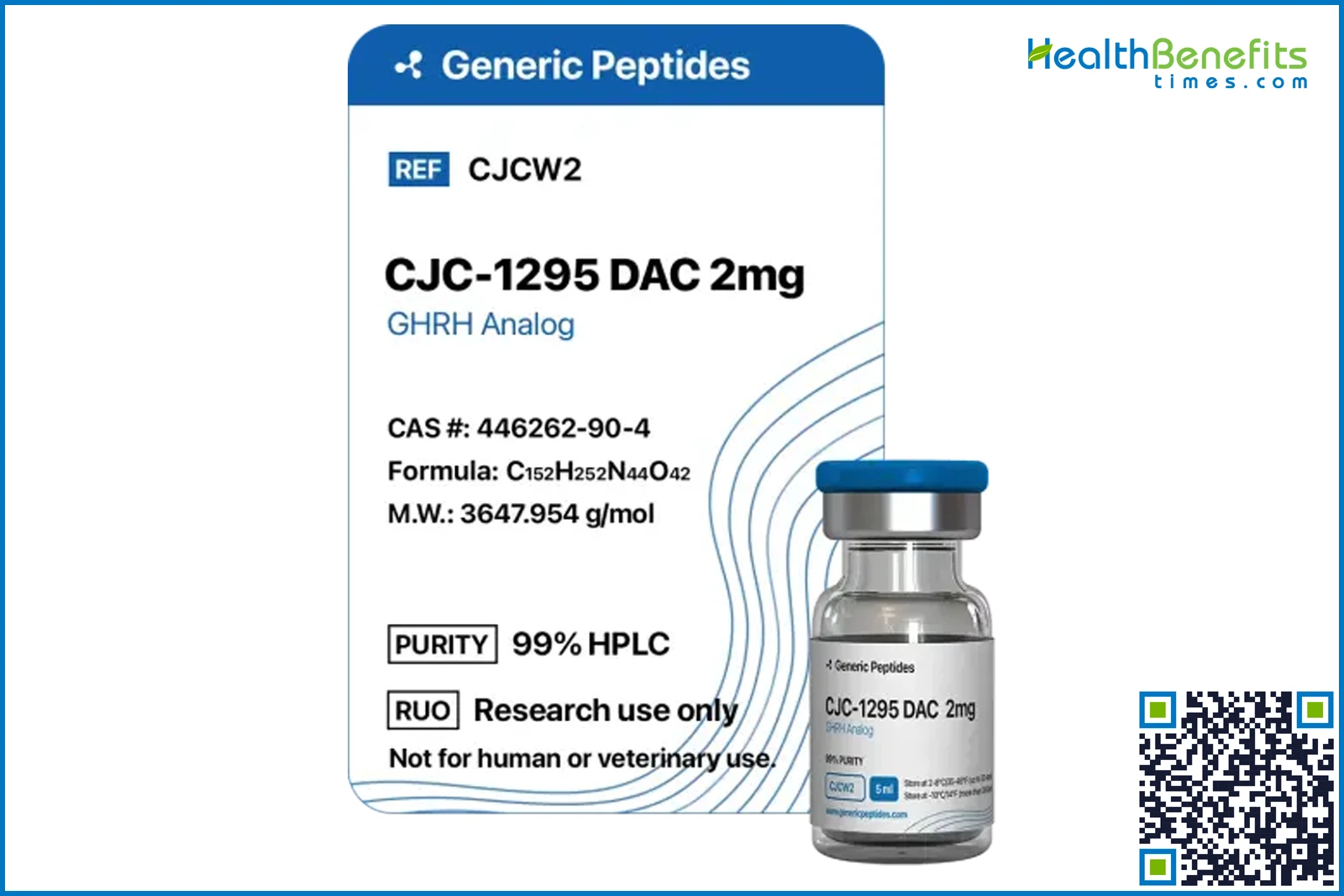
Due to both compounds having the same name there is a chance of mislabelling. If a vial is labelled as CJC-1295 it could be either version. This will impact the expected molecular weight of the compound. Researchers will usually confirm the identity by looking at a certificate of analysis for the batch. This will include HPLC purity and mass spectrometry. Suppliers such as Generic Peptides publish batch-level certificates of analysis for this reason. When comparing MOD GRF 1-29 with CJC-1295 with DAC from any supplier, always make sure that the molecular weight matches the version named on the label: the tetrasubstituted peptide alone, or the same sequence with the DAC linker attached.
Summary
- MOD GRF 1-29 and CJC-1295 with DAC both have the same modified 29 amino acid sequence.
- MOD GRF 1-29 has 4 substitutions to improve stability but remains short acting.
- CJC-1295 with DAC has the DAC link to bind to albumin, increasing duration from minutes to days.
- Most data from human studies refers to the DAC version.
- Both are research compounds and have not been approved for use in humans.
References
- Frohman LA, Downs TR, Williams TC, et al. Rapid enzymatic degradation of growth hormone-releasing hormone by plasma in vitro and in vivo to a biologically inactive product cleaved at the NH2 terminus. J Clin Invest. 1986;78(4):906–913.
- Jetté L, Léger R, Thibaudeau K, et al. Human growth hormone-releasing factor (hGRF)1-29-albumin bioconjugates activate the GRF receptor on the anterior pituitary in rats: identification of CJC-1295 as a long-lasting GRF analog. 2005;146(7):3052–3058.
- Teichman SL, Neale A, Lawrence B, et al. Prolonged stimulation of growth hormone (GH) and insulin-like growth factor I secretion by CJC-1295, a long-acting analog of GH-releasing hormone, in healthy adults. J Clin Endocrinol Metab. 2006;91(3):799–805.
- Ionescu M, Frohman LA. Pulsatile secretion of growth hormone (GH) persists during continuous stimulation by CJC-1295, a long-acting GH-releasing hormone analog. J Clin Endocrinol Metab. 2006;91(12):4792–4797.
- Bowers CY, Reynolds GA, Durham D, et al. Growth hormone (GH)-releasing peptide stimulates GH release in normal men and acts synergistically with GH-releasing hormone. J Clin Endocrinol Metab. 1990;70(4):975–982.
- World Anti-Doping Agency. The Prohibited List, class S2. https://www.wada-ama.org/en/prohibited-list
This article is for educational purposes only. The compounds discussed are research chemicals and are not intended for human use.
Comments
comments