

This guide synthesizes the strongest available evidence from NIH, NIDA, PubMed, and leading medical institutions to outline what Cannabis Use Disorder is, how it develops, and the most effective natural strategies to overcome it.
What Cannabis Use Disorder Actually Is — and How Common It’s Become
Cannabis Use Disorder is a psychiatric condition defined in the DSM-5 as a problematic pattern of cannabis use leading to clinically significant impairment or distress. 2 The Cleveland Clinic describes it as existing on a spectrum mild, moderate, or severe typically involving an overpowering desire to use, increased tolerance, and withdrawal symptoms upon cessation. 4 The World Health Organization notes that cannabis dependence syndrome, characterized by loss of control over use, is likely in chronic users. 5
The numbers are striking. In the United States, 61.8 million people aged 12 and older used marijuana in the past year according to 2023 NSDUH data, with young adults aged 18–25 showing the highest CUD prevalence at 16.6%. 2 NIDA estimates that about 9% of all cannabis users develop addiction, a rate that nearly doubles to 17% when use begins during the teen years. 3 Those who start before age 18 are 4 to 7 times more likely to develop CUD than those who begin as adults. 6 7
Diagnosis follows 11 DSM-5 criteria assessed over a 12-month period, including taking cannabis in larger amounts than intended, persistent unsuccessful efforts to cut down, craving, tolerance, and withdrawal. 8 9 Meeting 2–3 criteria indicates mild CUD, 4–5 moderate, and 6 or more severe. 10 11 The DSM-5 also formally recognized cannabis withdrawal for the first time, validating what clinicians had long observed. 12
Marijuana (Cannabis) Addiction Facts
| Category | Details |
| Symptoms 13 10
|
|
| Causes 2 14 9 15 16
|
|
| Types (Severity) 11
|
|
| How It Develops 17 18 19 2
|
|
| Most Affected Age Groups 2 7
|
|
| Higher Risk If You 2 20
|
|
| How Doctors Diagnose 11 12
|
|
| Treatment & Medications 3 21 22 23
|
|
| Methods of Prevention 3
|
|
| Withdrawal Timeline 24 10
|
|
| Long-Term Health Risks 20 25 26
|
|
How Marijuana Rewires the Brain and Why Quitting Is Hard
Understanding why cannabis addiction develops helps explain why targeted natural methods work. THC binds to CB1 receptors dense in the brain’s cortical, limbic, and striatal regions, disrupting the endocannabinoid system that normally regulates mood, memory, and reward. 27 2 Cannabinoids increase tonic dopamine levels in the ventral tegmental area the brain’s reward hub by suppressing GABA release, which disinhibits dopamine neurons and floods the nucleus accumbens with dopamine at levels exceeding natural rewards. 15 16 28
Repeated exposure triggers neuroadaptation: CB1 receptors downregulate, tolerance builds, and the brain requires more cannabis to achieve the same effect. 19 CUD shows substantial heritability of 30–80%, with genes like CNR1, FAAH, and DRD2 implicated in vulnerability. 2 Meanwhile, THC potency has risen dramatically from roughly 4% in 1995 to 17% by 2017, with concentrates reaching 90%. 14 29 This potency escalation accelerates the path from casual use to dependence.
Cannabis withdrawal affecting approximately 50% of regular users typically begins 24–48 hours after cessation and peaks at days 2–6. Symptoms include irritability, anxiety, insomnia, decreased appetite, depressed mood, and restlessness, with sleep disturbances persisting up to a month. 10 24 25 10 An estimated 65% of cannabis users cite poor sleep as a barrier to sustained abstinence, creating a vicious cycle of withdrawal insomnia and relapse. 6 30
Natural Methods to Quit Marijuana (Cannabis) Addiction
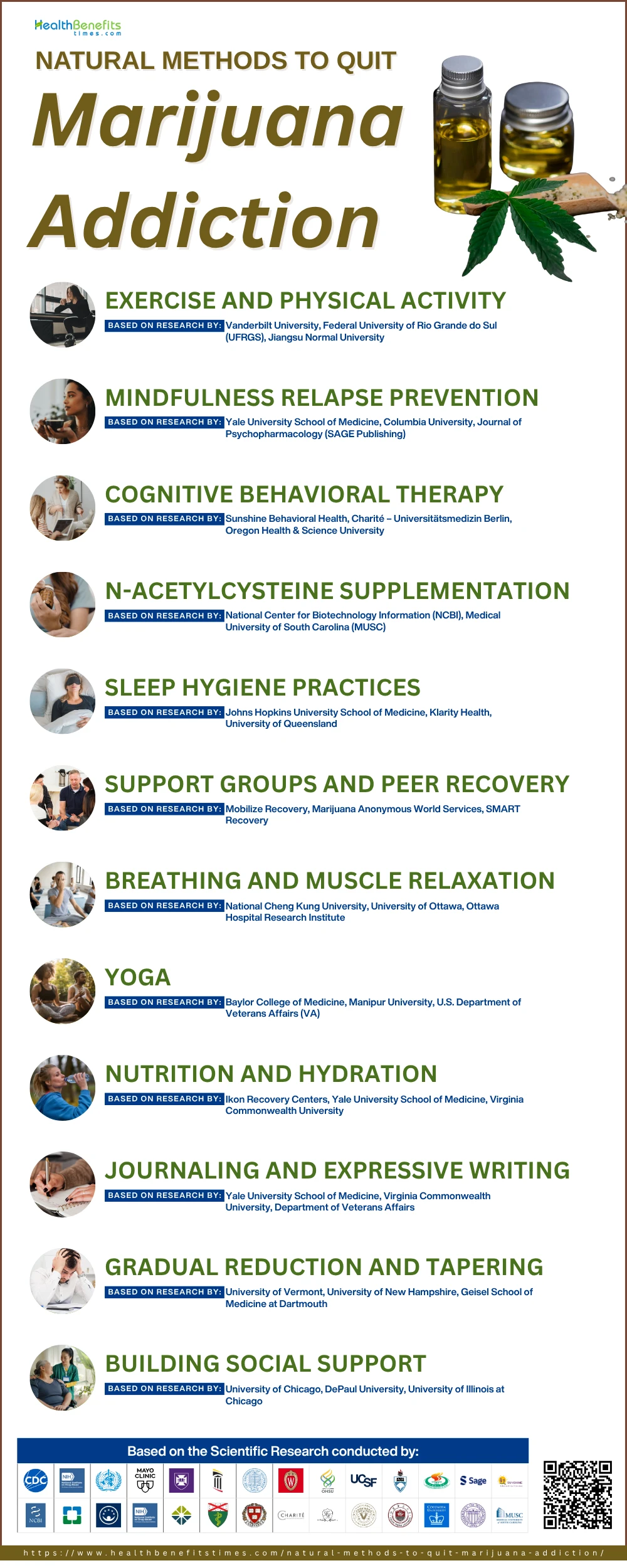
The most authoritative clinical review on cannabis withdrawal management states that standard clinical practice includes psychoeducation, coping with craving exercises, nutrition, hydration, physical exercise, sleep hygiene, motivational approaches, and CBT skills training. 24 10 Below are the methods with the strongest evidence.
1. Exercise and Physical Activity
A landmark Vanderbilt University study found that just ten 30-minute treadmill sessions over two weeks cut cannabis craving and use by more than 50% in dependent adults even those not initially planning to quit. 31 The mechanism is compelling: aerobic exercise stimulates the same endocannabinoid system that cannabis hijacks, increasing natural anandamide levels and providing a biological substitute for the high. 32 19 Chronic exercise upregulates CB1 receptors, particularly in the hippocampus, effectively helping the brain heal from cannabis-induced dysregulation. 19 A 2023 meta-analysis of 22 randomized controlled trials found exercise effectively attenuated withdrawal symptoms including craving, depression, and anxiety across substance use disorders. 33 34 Aim for 30 minutes of moderate aerobic exercise, five days per week.
MBRP integrates cognitive-behavioral relapse prevention with meditation practices. In a pivotal RCT, 168 adults completing an 8-week MBRP program showed significantly lower substance use rates and greater decreases in craving compared to treatment as usual. 35 Even more striking, 57% of cannabis-dependent participants achieved abstinence after 10 weeks of individual mindfulness therapy in another trial. 36 The technique of “urge surfing” observing cravings non-judgmentally as they rise and fall provides a practical tool for managing the intense cravings characteristic of early withdrawal. 36 Meta-analyses have found mindfulness-based interventions comparable to standard treatments for reducing substance use. 37 38
3. Cognitive Behavioral Therapy (CBT) Techniques
CBT is the most well-evaluated psychotherapeutic treatment for CUD. 21 The Marijuana Treatment Project, a multisite RCT with 450 adults, demonstrated strong effects on abstinence. 22 While formal CBT requires a therapist, self-applied techniques draw from the same framework: identifying triggers through functional analysis, challenging automatic thoughts that justify use, scheduling pleasant alternative activities, and practicing refusal skills. 39 The VA/Department of Defense recommends 1–14 weekly sessions involving trigger identification, coping with urges, problem-solving, and relapse prevention planning.
4. N-Acetylcysteine (NAC) Supplementation
This over-the-counter antioxidant supplement works by modulating glutamate in the nucleus accumbens normalizing the neurochemical pathways disrupted by chronic cannabis use. In the landmark 2012 trial, 116 cannabis-dependent adolescents receiving NAC (1,200 mg twice daily) had more than double the odds of negative urine tests compared to placebo. 23 However, a subsequent adult trial did not replicate these results, suggesting NAC may be most effective for younger users and when combined with behavioral incentives. 40 A systematic review of 8 RCTs confirmed mixed but promising results overall. 41 NAC remains investigational but is generally well-tolerated and available without prescription.
5. Sleep Hygiene Practices
Because insomnia is among the most debilitating withdrawal symptoms, addressing sleep is critical for preventing relapse. A Johns Hopkins study found that 48–77% of cannabis users who experienced sleep difficulty during abstinence resumed cannabis or used other substances to cope. 42 Clinical management guidelines recommend CBT for Insomnia (CBT-I) as first-line treatment, along with maintaining a consistent sleep-wake schedule, keeping the bedroom at 65–68°F, avoiding screens before bed, and using the “15-minute rule” if unable to sleep within 15 minutes, get up and do a calming activity before returning. 24 13 43
6. Support Groups and Peer Recovery
SAMHSA recognizes peer support as an evidence-based practice for addiction recovery, with systematic reviews finding improved substance use outcomes and increased treatment engagement. 44 Marijuana Anonymous offers weekly meetings worldwide using a 12-step model adapted specifically for cannabis. 45 12 SMART Recovery provides a non-spiritual, CBT-based alternative with four core tools: building motivation, coping with urges, managing thoughts and feelings, and living a balanced life. 46 A PMC literature review found peer support groups reduced relapse rates and increased treatment retention across addiction types. 47
7. Deep Breathing and Progressive Muscle Relaxation
These techniques activate the parasympathetic nervous system, directly countering the heightened anxiety and restlessness of withdrawal. Research shows that 20 minutes of progressive muscle relaxation immediately reduced craving and withdrawal symptoms in abstinent substance users. 48 The 4-7-8 breathing technique inhale for 4 counts, hold for 7, exhale for 8 offers a portable tool for acute craving episodes. Clinical guidelines include relaxation approaches in standard withdrawal management recommendations. 10 49
8. Yoga
A systematic review of 8 RCTs found that 7 of 8 studies demonstrated significant positive outcomes on anxiety, pain, or substance use from yoga interventions. 50 A neurobiological review explains that yoga addresses all three stages of the addiction cycle binge/intoxication, withdrawal/negative affect, and preoccupation/anticipation through dopamine homeostasis, increased parasympathetic tone, and improved grey matter volume in addiction-affected brain regions. 51 The VA’s Whole Health Library recommends yoga-based approaches as complementary treatments for substance use disorders. 52
9. Nutrition and Hydration
Clinical management guidelines include nutrition and hydration as first-line approaches for cannabis withdrawal management. 10 Omega-3 fatty acids serve as precursors for endocannabinoid synthesis, supporting the ECS recovery that is essential during cessation. 53 54 B-complex vitamins support serotonin and dopamine production neurotransmitters depleted by chronic use. 55 54 Magnesium helps regulate the brain’s reward system and supports sleep. Focus on complex carbohydrates for stable energy, lean proteins for tissue repair, healthy fats for brain health, and regular balanced meals to stabilize blood sugar and reduce mood swings.
10. Journaling and Expressive Writing
In a NIDA-funded RCT, 149 women in residential substance use treatment who practiced expressive writing showed greater reductions in depression, anxiety, and post-traumatic symptoms than controls. 56 Journaling serves multiple recovery functions: tracking triggers and cravings, processing difficult emotions, clarifying personal values, and monitoring progress. 57 Research in neuroscience shows that emotion labeling the core mechanism of journaling reduces amygdala reactivity, providing a neurological pause before acting on urges. A positive psychology journaling intervention demonstrated improvements in well-being and recovery outcomes for women in residential SUD treatment. 58
11. Gradual Reduction and Tapering
For heavy daily users, gradual reduction may be preferable to abrupt cessation. An intensive natural history study found that greater number of days of intentional reduction predicted significant declines in cannabis dependence (p=.006) and cannabis-related problems (p=.01). 59 Practical strategies include portioning into pre-measured daily amounts, switching to lower-potency products, starting use later in the day, and reducing sessions incrementally over 2–4 weeks. 12 60 61 Tapering is especially recommended for heavy users or those who’ve experienced intense withdrawal previously. 62
12. Building Social Support and Changing Your Environment
Among the strongest predictors of recovery success, social support has robust evidence behind it. A 2023 multilevel study of 229 individuals in recovery homes found that the house environment had more substantial impact on residents’ recovery than individual-level factors. 63 A qualitative study using the Recovery Capital model found that shifting from social isolation to social connectedness was the principal factor in transitioning from addiction to recovery. 64 Removing cannabis paraphernalia, avoiding environments associated with use, and building an abstinent social network are practical environmental changes that reduce exposure to cues triggering relapse. 65
Critical Precautions Before Relying on Natural Methods Alone
Natural methods should complement not replace professional guidance, particularly for moderate-to-severe CUD. The FDA does not regulate dietary supplements with the same rigor as prescription medications, and herbal supplements can interact dangerously with other medications. 66 67 The NCCIH warns that herb-drug interactions can range from negligible to life-threatening. 68
CUD commonly co-occurs with mood disorders, anxiety, PTSD, and psychotic disorders. 2 69 20 Cannabis use is associated with 2–4 times the likelihood of developing psychosis according to the CDC. These comorbidities require professional psychiatric attention, not self-treatment alone. Individuals with significant mental health conditions, polysubstance use, or severe CUD (6+ DSM-5 criteria) should seek clinical intervention, as natural methods alone may be insufficient for their level of need. 13 6 52
When to Seek Professional Help
Even with the most effective evidence-based psychosocial treatment, abstinence rates remain approximately 20–26%, and the average adult seeking treatment has used cannabis almost daily for over 10 years with 6+ prior quit attempts. 21 If you experience persistent withdrawal symptoms beyond three weeks, worsening mental health, inability to reduce use despite repeated attempts, or if cannabis use is causing significant impairment in work, relationships, or health, professional treatment should be pursued.
SAMHSA’s National Helpline (1-800-662-HELP) provides free, confidential, 24/7 referrals to local treatment facilities and support groups. The National Institute on Drug Abuse offers comprehensive resources on cannabis addiction and treatment options. 3 70 FindTreatment.gov offers a searchable directory of treatment providers. For crisis situations, the 988 Suicide & Crisis Lifeline is available 24/7 by calling or texting 988.
The Path Forward Combines Multiple Strategies
No single natural method is a silver bullet for Cannabis Use Disorder. The strongest evidence supports combining several approaches particularly exercise, CBT-based techniques, mindfulness, and social support into a comprehensive personal recovery plan. 19 The combination of CBT + Motivational Enhancement Therapy produces the best documented outcomes for CUD, and natural methods like exercise and sleep hygiene amplify these effects by addressing the neurobiological disruption that drives relapse. 21 22
What makes the current moment both challenging and hopeful is that THC potency has increased 3- to 5-fold over the past two decades making today’s cannabis more addictive but scientific understanding of recovery has advanced in parallel. Recovery is not about willpower alone; it is about systematically providing the brain with alternative pathways to the reward, stress relief, and regulation that cannabis once supplied. 2 26
Comments
comments
This article is based on Scientific Research Conducted by following Research Organization:
- Cannabis Facts and Stats–Centers for Disease Control and Prevention, United States
- Cannabis Use Disorder–National Center for Biotechnology Information, United States
- Cannabis (Marijuana)–National Institute on Drug Abuse, United States
- Substance Use Disorder (SUD)–Cleveland Clinic, United States
- Cannabis–World Health Organization, International
- Marijuana Withdrawal Symptoms, Timeline, and Treatment–American Addiction Centers, United States
- The problem with kids and cannabis–Mayo Clinic Health System, United States
- Marijuana Use Disorder: Signs of Marijuana Use, Abuse & Addiction–American Addiction Centers, United States
- Treatment–National Institute on Drug Abuse, United States
- Clinical management of cannabis withdrawal–University of Queensland, Australia
- DSM-5 Criteria for Substance Use Disorders: Recommendations and Rationale–National Institute on Alcohol Abuse and Alcoholism (National Institutes of Health), United States
- Cannabis Use Disorder–Virginia Cannabis Control Authority, United States
- Marijuana (Weed) Withdrawal–Cleveland Clinic, United States
- Cannabinoids and the endocannabinoid system in reward processing and addiction: from mechanisms to interventions –University of Queensland, Australia
- A Brain on Cannabinoids: The Role of Dopamine Release in Reward Seeking–University of Maryland School of Medicine, United States
- Marijuana: Rising THC Concentrations in Cannabis Can Pose Health Risks–Yale School of Medicine (Yale University), United States
- Cannabis effects on brain structure, function, and cognition: considerations for medical uses of cannabis and its derivatives–University of California, Los Angeles (UCLA), United States
- Tetrahydrocannabinol and dopamine D1 receptor–Harvard University (Department of Psychology), United States
- Exercise as an Adjunctive Treatment for Cannabis Use Disorder–University of Wisconsin–Madison, United States
- Cannabis and Mental Health–National Center for Injury Prevention and Control, United States
- Evidence-based Treatment Options in Cannabis Dependency–Charité – Universitätsmedizin Berlin, Germany
- A double-blind randomized controlled trial of N-acetylcysteine in cannabis-dependent adolescents–National Center for Biotechnology Information (NCBI), United States
- Treatments for Cannabis Use Disorder–Oregon Health & Science University (OHSU), United States
- Clinical management of cannabis withdrawal–University of Queensland, Australia
- Cognitive effects in midlife of long-term cannabis use–Harvard Health Publishing (Harvard Medical School), United States
- Marijuana–Mayo Clinic, United States
- What Is THC and How Does It Affect the Brain?–Hollywood Hills Recovery, United States
- Endocannabinoid release from midbrain dopamine neurons: a potential substrate for cannabinoid receptor antagonist treatment of addiction–University of California, San Francisco (UCSF), United States
- Cannabis—A Valuable Drug That Deserves Better Treatment–Mayo Clinic, United States
- Cannabis and Sleep–Oregon Health & Science University, United States
- Exercise can curb marijuana use and cravings, study finds–Vanderbilt University, United States
- Randomised controlled trial (RCT) of daily aerobic exercise for inpatient cannabis withdrawal: A study protocol–Federal University of Rio Grande do Sul (UFRGS), Brazil
- Effects of exercise of different intensities on withdrawal symptoms among people with substance use disorder: a systematic review and meta-analysis–Jiangsu Normal University, China
- Impact of Physical Exercise on Substance Use Disorders: A Meta-Analysis–Shanghai University of Sport, China
- Mindfulness-Based Relapse Prevention for Substance Use Disorders: A Pilot Efficacy Trial–Yale University School of Medicine, United States
- Individual Mindfulness-Based Psychotherapy for Cannabis or Cocaine Dependence: A Pilot Feasibility Trial–Columbia University, United States
- Efficacy of mindfulness-based relapse prevention in a sample of veterans in a substance use disorder aftercare program: A randomized controlled trial☆–Journal of Psychopharmacology (SAGE Publishing), United Kingdom
- Mindfulness-based Relapse Prevention for Substance Use Disorders: A Systematic Review and Meta-analysis–University of Washington, United States
- Natural Remedies For Drug Addiction–Sunshine Behavioral Health, United States
- A randomized placebo-controlled trial of N-acetylcysteine for cannabis use disorder in adults–Medical University of South Carolina (MUSC), United States
- N-acetyl cysteine in the treatment of cannabis use disorder: A systematic review of clinical trials–University of Newcastle, Australia
- Sleep disturbance and the effects of extended-release zolpidem during cannabis withdrawal–Johns Hopkins University School of Medicine, United States
- Breaking the Cycle: How to Reset Your Sleep Schedule After Cannabis Withdrawal–Klarity Health, United States
- The Power of Connection: Peer Support and Mutual Support Groups in Addiction Recovery–Mobilize Recovery, United States
- Do you have a problem with marijuana addiction? Are you struggling to quit using cannabis? Is it hard to imagine life without being high?–Marijuana Anonymous World Services, United States
- Marijuana Addiction–SMART Recovery, United States
- Benefits of peer support groups in the treatment of addiction–University of Washington, United States
- Effects of arousal modulation via resonance breathing on craving and affect in women with substance use disorder–National Cheng Kung University, Taiwan, University of Ottawa, Canada, Ottawa Hospital Research Institute, Canada, Jonköping University, Sweden
- Clinical management of cannabis withdrawal–Dartmouth College, USA, University of Toronto, Canada, Centre for Addiction and Mental Health, Canada
- Yoga for Substance Use: A Systematic Review–Baylor College of Medicine, United States
- Neurobiological basis for the application of yoga in drug addiction–Manipur University, India
- Substance Use Disorder Treatment: Complementary Approaches–U.S. Department of Veterans Affairs (VA), United States
- Omega-3 Fatty Acids: The Key Nutrient For Addiction Recovery
- Nutritional Supplements That Can Boost Mental Health And Help During Recovery
- Top 5 Vitamins Supporting Addiction Recovery–Ikon Recovery Centers, United States
- Expressive Writing as a Therapeutic Process for Drug Dependent Women–Yale University School of Medicine, United States, Virginia Commonwealth University, United States, Department of Veterans Affairs, United States
- Daily Prompts to Support Addiction Recovery–High Desert Counseling, United States
- Development, Feasibility, Acceptability, and Impact of a Positive Psychology Journaling Intervention to Support Addiction Recovery–University of Minnesota, United States, Massachusetts General Hospital, United States, Harvard Medical School, United States, Brown University, United States
- Attempts to Stop or Reduce Daily Cannabis Use: An Intensive Natural History Study–University of Vermont, United States, University of New Hampshire, United States, Geisel School of Medicine at Dartmouth, United States
- Tapering Marijuana to Reduce Withdrawal Symptoms Comments (2)–ChooseHelp (ChooseHelp.com), United States
- Tapering Off Weed vs. Quitting Cold Turkey–Clear30 (Clear30 / Clear30.org), United States
- What to Expect from Marijuana Withdrawal–Healthline Media (Healthline.com), United States
- The Importance of Social Support in Recovery Populations: Toward a Multilevel Understanding–University of Chicago, United States, DePaul University, United States, University of Illinois at Chicago, United States, Arizona State University, United States, University of Maryland, United States
- How Social Relationships Influence Substance Use Disorder Recovery: A Collaborative Narrative Study–SAGE Publications, United Kingdom
- What Happens to Your Body When You Stop Smoking Weed and How to Recover Completely?–Pathways Recovery, United States
- The Dangers of “Natural” Supplements in Addiction Recovery–Florida Springs Wellness & Recovery Center, United States
- What are the dangers of drug interactions with herbal medicines?–Taylor & Francis Group, United Kingdom
- Herb-Drug Interactions–National Center for Complementary and Integrative Health (NCCIH), United States
- Cannabis—A Valuable Drug That Deserves Better Treatment–Yale University School of Medicine, United States
- Principles of Drug Addiction Treatment: A Research-Based Guide (Third Edition)–National Institute on Drug Abuse (NIDA), United States