


Causes of Abdominal Muscle strain
Understanding the precise biomechanical triggers behind core injuries requires a deep dive into how physical demands interact with human anatomy. The musculature of the torso is constantly engaged in stabilizing the spine and transferring power between the upper and lower body, making it uniquely vulnerable to a wide array of physical and environmental stressors.
1. Inadequate Pre-Activity Warm-Up: Plunging directly into intense physical exertion without properly preparing the body significantly reduces the natural viscoelasticity of muscle tissues. When cold, stiff abdominal muscles are suddenly forced to contract or stretch, they lack the necessary pliability to absorb kinetic energy, resulting in microscopic tearing of the muscle fibers during rapid movement 2.
2. Strenuous Exertion Following Heavy Meals: Engaging in vigorous activities, such as long-distance running or heavy lifting, shortly after consuming a large volume of food places competing demands on the body. Blood supply is naturally shunted toward the gastrointestinal tract for digestion, which creates a temporary blood supply shortage in the skeletal muscles during exercise, rendering the abdominal wall highly susceptible to fatigue and subsequent structural failure.
3. High-Velocity Rotational Torque: Sports and dynamic activities that demand repetitive twisting, rapid acceleration, and sudden deceleration such as tennis, baseball, or ice hockey create immense rotational shear forces. The internal and external oblique muscles bear the brunt of these forces, and the rapid transition from yielding (eccentric) work to overcoming (concentric) work frequently overwhelms the tissue’s tensile capacity, leading to painful side strains 3.
4. Sudden Postural Transformations: Unexpected shifts in body position, such as slipping on a wet surface and reflexively tensing the core to regain balance, force the abdominal muscles into a severe, uncoordinated eccentric contraction. This sudden, high-load lengthening of the muscle fibers can instantly rip the tissue, particularly in the rectus abdominis.
5. Progressive Neuromuscular Fatigue: Continuous athletic training or demanding manual labor without adequate recovery intervals leads to profound muscle fatigue. As the primary muscles tire out, the neuromuscular system loses its ability to efficiently absorb mechanical loads, transferring dangerous levels of stress directly onto the supporting connective tissues and weaker muscle segments, inevitably resulting in overuse strains.
6. Direct External Trauma: Blunt force impacts to the midsection, whether stemming from a collision on an athletic field, a workplace accident, or a simple fall, can physically crush or forcefully separate the muscle fibers. These direct impact injuries bypass the normal stretch-reflex mechanisms, causing immediate structural damage and highly localized internal bleeding within the abdominal wall.
Symptoms of Abdominal Muscle strain
Recognizing the exact clinical presentation of this injury is a crucial step in differentiating it from potentially dangerous intra-abdominal organ issues. The physical manifestations of a muscle tear are generally mechanical in nature and strictly localized to the abdominal wall itself.
- Sudden, sharp, and highly localized pain occurring directly over the injured muscle belly, which often presents immediately following a forceful movement or heavy lift.
- A profound exacerbation of discomfort when executing a concentric contraction, such as attempting a trunk “sit-up” motion or simply trying to rise from a flat, lying position in bed 3.
- A noticeable sensation of muscular stiffness, rigidity, and persistent soreness across the midsection that severely restricts the natural range of motion during routine activities like bending over or reaching overhead.
- Visible skin discoloration, redness, or dark bruising developing slowly over the site of the injury, representing a subcutaneous hematoma caused by the rupture of microscopic blood vessels within the torn muscle tissue 2.
- Painful, involuntary muscle spasms, cramping, or guarding behavior within the abdominal wall, which are frequently triggered by increases in intra-abdominal pressure from deep breathing, coughing, laughing, or sneezing.
- Exquisite tenderness to light manual touch over a very specific, circumscribed area of the abdomen, a key diagnostic indicator that medical professionals evaluate to rule out deeper visceral pain 4.
- General core weakness and an inability to stabilize the trunk, manifesting as a sudden failure to lift moderate weights, maintain proper upright posture, or walk without experiencing sharp, debilitating twinges of pain.
Abdominal Muscle strain Facts
| Category | Details |
| Symptoms |
|
| Causes |
|
| Types of Abdominal Muscle strain |
|
| How does spread |
|
| Age Group |
|
| You might be at a higher risk for exposure of this disease if you: |
|
| How doctors diagnose |
|
| Other facts |
|
Natural Remedies for Abdominal Muscle strain
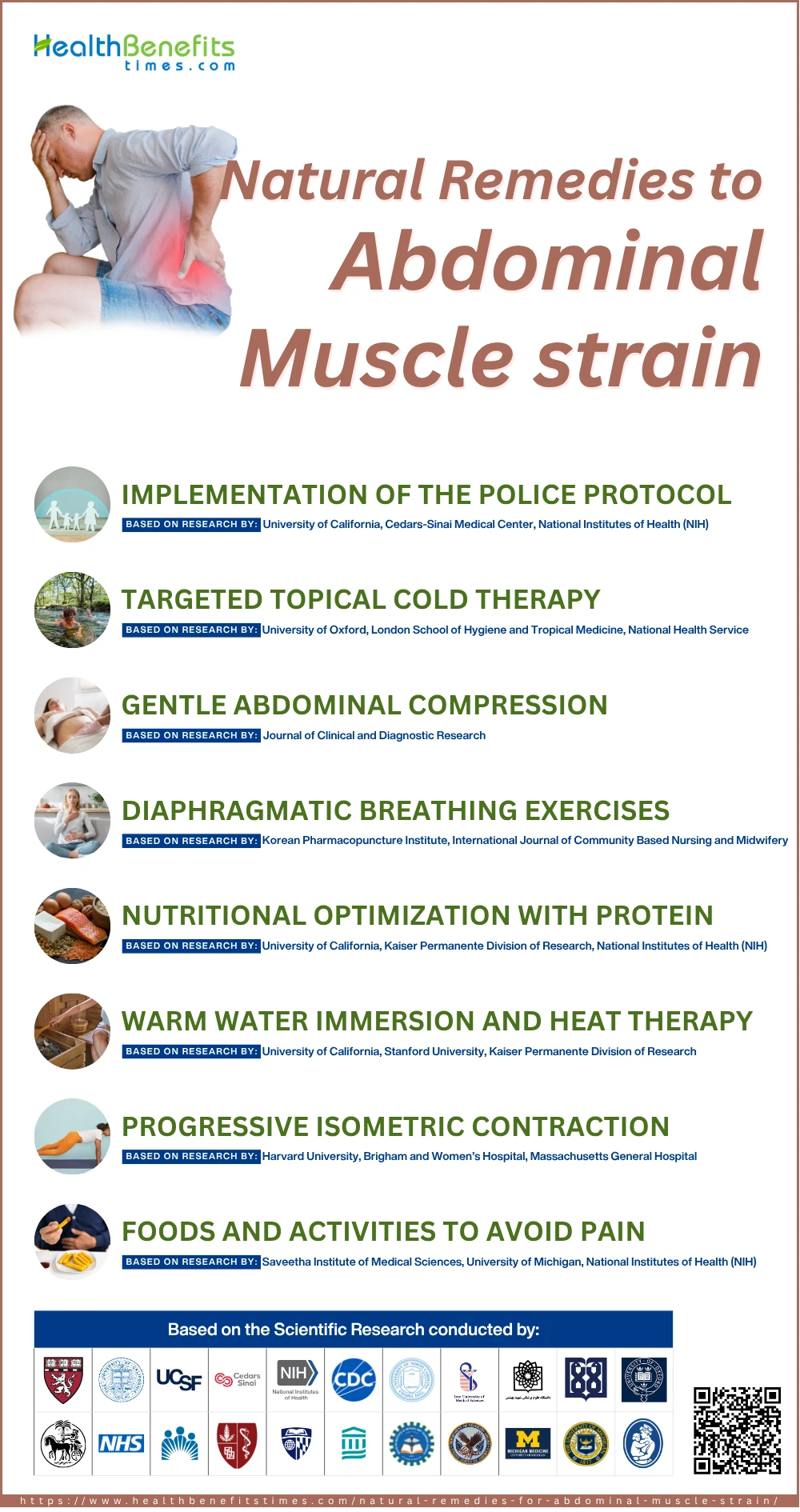
When dealing with a compromised core, the recovery process requires immense patience and a highly strategic approach to cellular healing. Because the abdominal muscles are inherently involved in almost every bodily movement from sitting upright to simply drawing a breath completely resting them is a unique mechanical challenge. As a result, conservative management and targeted natural interventions form the absolute cornerstone of tissue rehabilitation. Here is a detailed guide on what you need to know to safely manage your recovery.
1. Implementation of the POLICE Protocol
Navigating the earliest days following your injury sets the physiological stage for your entire healing timeline. While traditional medical advice often highlighted absolute, prolonged bed rest, modern sports medicine guidelines emphasize the POLICE protocol, which stands for Protection, Optimal Load, Ice, Compression, and Elevation. You should initially protect the abdominal wall by strictly avoiding any strenuous athletic activity or heavy lifting that elicits sharp pain. However, rather than remaining completely immobile which can lead to muscle atrophy and the formation of stiff, dysfunctional scar tissue you must gently introduce “optimal loading.” This means you engage in safe, highly controlled, low-impact movements like slow, upright walking that do not aggressively stress the specific injured fibers. This careful balance prevents the muscle from healing in a shortened state while still shielding the fragile, newly forming tissues from catastrophic re-rupture 2.
Note: Used as a comprehensive daily behavioral framework to control early mechanical stress, prevent severe muscle atrophy, and encourage proper muscle fiber alignment during the crucial initial healing window.
Managing the body’s acute inflammatory response is one of the most effective, non-invasive ways to naturally soothe abdominal discomfort. You should apply cold therapy, such as an ice pack securely wrapped in a soft cloth, directly to the tender area for 15 to 20 minutes every few hours during the first 48 hours following the injury. The cold temperature triggers immediate local vasoconstriction, narrowing the peripheral blood vessels and significantly reducing the pooling of blood and interstitial fluid within the torn muscle fibers. Furthermore, cryotherapy drastically lowers the metabolic demand of the surrounding healthy tissues, protecting them from secondary hypoxic damage caused by swelling and oxygen deprivation, while simultaneously numbing superficial nerve endings to provide rapid pain relief 5.
Note: Applied topically to the skin over the injury site strictly during the acute phase to organically mitigate hematoma expansion, reduce nerve conduction velocity for pain relief, and decrease localized tissue edema.
3. Gentle Abdominal Compression
Providing external physical support to your midsection can profoundly reduce the everyday biomechanical strain placed on your healing core. You can utilize a flexible, moderately snug abdominal binder or an elastic compression bandage wrapped carefully around the torso. By lightly compressing the abdominal cavity, you artificially support the intra-abdominal pressure, which means your injured rectus abdominis or oblique muscles do not have to contract as forcefully to keep your spine stabilized and your torso upright. Furthermore, this gentle mechanical squeezing effect aids the lymphatic system in clearing away excess interstitial fluid and cellular debris resulting from the tissue injury, visibly reducing regional swelling and easing localized stiffness 6.
Note: Applied physically around the waist as a wearable support garment to mechanically stabilize the damaged musculature, relieve interstitial fluid pressure, and prevent painful involuntary muscle spasms during essential daily movements.
4. Diaphragmatic Breathing Exercises
Breathing mechanics are intimately connected to the health of your abdominal wall, and poor respiratory habits can inadvertently worsen your pain by engaging injured tissues. You should practice focused diaphragmatic breathing often referred to clinically as “belly breathing.” To do this safely, lie comfortably on your back with your knees slightly bent to take tension off the lower abdomen, place a hand over your upper stomach, and inhale deeply so that your stomach gently rises while your chest remains relatively still. This specific technique recruits the large internal diaphragm muscle for respiration rather than relying on the accessory muscles of the superficial abdominal wall. By doing so, you effectively bypass the injured oblique and transverse muscles, preventing painful involuntary spasms and releasing functional tension in the core musculature 7.
Note: Practiced routinely in a quiet, relaxed environment to mentally regulate the autonomic nervous system, reduce involuntary visceral tension, and efficiently oxygenate the blood without mechanically straining core muscles.
5. Nutritional Optimization with Dietary Protein
Fueling your body with the correct biological building blocks is a non-negotiable aspect of natural muscle repair. You must prioritize a high-protein diet rich in essential amino acids, as wound healing and muscle regeneration demand a massive, localized increase in cellular protein synthesis. Incorporating complete protein sources like lean meats, eggs, dairy, or high-quality plant-based equivalents supplies the raw materials that your body’s fibroblasts desperately need to weave new collagen fibers across the muscular tear 8. Additionally, consuming foods naturally containing specific collagen dipeptides can actively accelerate the migration of myoblasts to the injury site, effectively fast-tracking the maturation of new, healthy muscle tissue while actively minimizing the formation of rigid, inflexible scar tissue 9.
Note: Eaten daily as a foundational part of your recovery diet to furnish the structural amino acids required for repairing torn tissue, mitigating muscle atrophy, and significantly advancing functional muscular regeneration.
6. Warm Water Immersion and Heat Therapy
Once the initial acute inflammatory phase has fully passed typically after 48 to 72 hours your physical strategy must shift from restricting blood flow to actively encouraging it. You should apply a warm compress, utilize a heating pad on a low setting, or soak in a warm bath to safely heat the abdominal region. The gentle elevation in tissue temperature causes localized vasodilation, naturally widening the blood vessels and allowing a rich supply of oxygen, nutrients, and immune macrophages to flood the damaged area to clean out cellular debris. Heat therapy also dramatically improves the viscoelasticity of the healing muscle fibers, softening tight, guarding spasms and making it far easier to achieve a pain-free range of motion during your daily recovery exercises.
Note: Applied externally after the acute phase has ended to thermally induce vasodilation, relax tightened muscle guarding, and wash away metabolic waste products from the regenerating cellular zone.
7. Progressive Isometric Contraction and Stretching
Restoring the functional strength and flexibility of your core is the final frontier of a complete natural recovery. You should begin very gentle, pain-free isometric stretches where you purposefully contract the abdominal muscles without actually moving your spine or joints to safely stimulate the healing fibers. As your comfort improves over several weeks, you can slowly introduce dynamic stretches that gently elongate the rectus abdominis, such as the modified yoga cobra pose (lifting only the chest slightly while lying face down). This careful mechanical tension acts as a physical signaling mechanism to the repairing cells, ensuring that the new collagen fibers align properly along the lines of functional stress rather than clumping haphazardly, which fortifies the area and guards against frustrating future reinjuries 10.
Note: Practiced meticulously and slowly during the functional rehabilitation period to appropriately align repairing collagen structures, restore normal tissue length, and sustainably rebuild pre-injury muscle strength.
8. Foods and Activities to Avoid When You suffer from Abdominal Muscle strain
Protecting your vulnerable abdominal tissues goes far beyond knowing what you should do; it relies heavily on understanding exactly what you must avoid. Certain daily habits, unconscious movements, and dietary choices can inadvertently sabotage your body’s natural healing timeline and cause severe setbacks.
- Avoid consuming heavy, highly voluminous meals: Eating exceptionally large portions of food significantly expands the physical volume of the stomach and intestines. This outward gastrointestinal distension pushes directly against the injured interior wall of your abdomen, needlessly stretching the fragile, healing muscle fibers from the inside out and triggering acute pain flare-ups 11.
- Avoid highly acidic, exceptionally spicy, or extreme gas-producing foods: Dietary items that severely irritate the gastrointestinal tract or cause extensive bloating can induce cramping, nausea, or violent vomiting. The sudden, convulsive muscle contractions required by the body to vomit or pass excessive gas will forcefully tear newly forming tissue structures and exacerbate postoperative-like pain 12.
- Avoid premature, aggressive deep stretching: While gentle mobility is helpful much later in the recovery process, aggressively stretching the torso backwards (lumbar hyper-extension) in the early days of recovery will actively rip apart the delicate collagen matrix your body is painstakingly attempting to construct across the muscular gap.
- Avoid activities requiring explosive rotational torque: Swinging a heavy golf club, tossing an object sideways, or playing racket sports places immense, unmanageable sheer force on the oblique muscles. You must absolutely abstain from these twisting mechanics until your physician or physical therapist clears you for dynamic loading.
- Avoid heavy lifting and the Valsalva maneuver: Lifting heavy boxes, weights, or even struggling against heavy doors often causes people to unconsciously hold their breath and bear down. This physiological action causes a severe spike in intra-abdominal pressure that presses forcefully against the weakened abdominal wall, risking further rupture or the development of a traumatic sports hernia.
- Avoid prolonged periods of slouched, unsupported sitting: Slumping forward in a deep chair or couch for hours causes the abdominal muscles to remain in a shortened, entirely relaxed position. When you finally attempt to stand up, the sudden tension placed on the stiffened, injured muscle can cause secondary micro-tears and intense, breathtaking spasms.
Myths and Misconceptions
| Myth | Reality |
| You should push through the pain to strengthen the core and speed up healing. | Continuing to exercise or strain a torn abdominal muscle actively worsens the injury on a cellular level, increasing the size of the micro-tears, promoting extensive internal bleeding, and dramatically prolonging the total recovery time. |
| Applying a hot heating pad immediately after the injury will relax the muscle and speed up healing. | Heat applied during the first 48 hours dramatically increases local bleeding and swelling by dilating ruptured blood vessels. Ice is strictly required initially to constrict blood vessels and control the expanding hematoma. |
| Complete, strict bed rest for weeks is the best way to heal any core injury. | While protecting the area is vital initially, absolute immobility leads to rapid muscle atrophy and the formation of stiff, dysfunctional scar tissue. Gentle, pain-free movement (optimal loading) is scientifically proven to yield much better functional outcomes. |
| Severe abdominal pain is almost always a definitive sign of internal organ distress or disease. | A highly significant percentage of acute abdominal discomfort actually originates in the abdominal wall musculature itself. This condition is frequently confirmed by physicians through physical assessments like Carnett’s test, rather than relying solely on internal imaging scans 13. |
| You can only strain your abdominal muscles if you are lifting incredibly heavy weights at the gym. | Even simple, rapid, and uncoordinated actions such as coughing violently, twisting suddenly to grab a falling object, or reaching awkwardly overhead to grab a high shelf can generate enough eccentric force to tear an abdominal muscle fiber. |
Special Considerations
Differentiating a straightforward muscle strain from more complex, nuanced clinical scenarios is vital when dealing with distinct patient populations. The inherent biomechanics and underlying baseline health profiles of different age groups and physical conditions drastically alter the entire landscape of abdominal wall injuries.
Children
The pediatric patient population presents highly unique anatomical challenges that complicate standard diagnoses. In younger athletes whose skeletal systems have not yet fully matured, the tendons attaching the abdominal muscles to the pelvic bones are sometimes physically stronger than the cartilage of the growth plates themselves. Consequently, incredibly forceful abdominal contractions can result in an apophyseal avulsion a serious condition where a fragment of bone is literally torn away from the pelvis rather than a simple muscle strain. Furthermore, children often struggle to accurately articulate and localize pain. What may appear to be a muscular strain could be functional gastrointestinal distress. Clinical evaluations in pediatrics must heavily factor in body motion artifacts during motility diagnoses to avoid misinterpreting normal growing pains or digestive issues as severe muscular tears 14.
Pregnancy
During gestation, the female body undergoes immense, rapid anatomical restructuring. As the uterus exponentially expands, the abdominal muscles specifically the rectus abdominis are naturally stretched, separated, and thinned, leading to a common condition known as diastasis recti. Pregnant women are highly susceptible to core strains because their muscles are already under significant baseline mechanical tension. Importantly, sharp, stabbing pain in the lower abdomen during pregnancy is frequently caused by the stretching and spasming of the round ligaments supporting the heavy uterus, an event which intricately mimics the exact sensation of an oblique muscle tear. Medical professionals must carefully and compassionately distinguish between benign musculoskeletal strain, round ligament pain, and potentially serious obstetric complications to ensure maternal and fetal safety 15.
Chronic Conditions
Individuals battling pre-existing chronic respiratory or gastrointestinal issues face a constant, unavoidable uphill battle when attempting to heal an abdominal strain. Conditions like Chronic Obstructive Pulmonary Disease (COPD), severe asthma, or chronic bronchitis cause frequent, violent coughing fits. Each intense cough creates a massive, involuntary spike in intra-abdominal pressure that aggressively strains and pulls at the healing muscle fibers, constantly resetting the recovery clock. Similarly, chronic constipation forces patients to bear down forcefully during routine bowel movements, essentially recreating the dangerous physiological mechanics of a heavy weightlifting attempt. Managing these underlying chronic triggers with medication and lifestyle adjustments is an absolute prerequisite to achieving full, lasting recovery from an abdominal wall injury 16.
Elderly
In older adults, accurately diagnosing an abdominal strain is notoriously complicated and fraught with diagnostic pitfalls. The geriatric population is at a naturally higher risk for developing abdominal wall hernias due to the age-related thinning and weakening of bodily connective tissues. What appears to be a chronic, nagging muscle strain may actually be Chronic Abdominal Wall Pain (CAWP) caused by Anterior Cutaneous Nerve Entrapment Syndrome (ACNES), a painful condition where small sensory nerve branches become pinched and starved of blood within the aging, fibrotic muscle layers. Elderly patients also frequently exhibit atypical signs of severe visceral illness, meaning life-threatening internal issues such as ischemic colitis or perforated ulcers may subtly masquerade as dull, aching muscle pain. Thorough differential diagnoses are absolutely paramount for safeguarding this vulnerable demographic 17.
Precaution before use of natural remedies when you have Abdominal Muscle strain
Taking your medical recovery into your own hands requires a firm foundation of absolute safety and situational awareness. Before you begin applying natural treatments or physical therapies to your core, you must actively rule out underlying conditions that could make conservative therapy ineffective or outright dangerous.
- Confirm the absolute absence of internal organ involvement: You must ensure beyond a doubt that your pain is definitively localized to the muscle wall and not radiating from inflamed internal organs like the appendix, gallbladder, or intestines. Natural remedies cannot treat visceral disease, and delaying medical care for an infected organ can be fatal.
- Check carefully for the presence of a palpable hernia: Carefully feel the area of greatest pain with your fingertips. If you detect a soft, squishy, bulging lump that pushes outward when you cough, stand, or strain, you may have an abdominal hernia rather than a simple muscle tear. Utilizing tight binders and compression garments can sometimes severely complicate hernias by cutting off blood supply to the trapped tissue.
- Monitor your skin’s physiological reaction to cryotherapy: When applying ice packs to the abdomen, you must always use a protective thermal barrier, such as a thick towel. Placing ice directly onto the delicate skin of the stomach can quickly cause severe frostbite or permanent thermal tissue damage, complicating your recovery with a serious skin injury.
- Ensure the proper, safe fit of all compression garments: If you choose to wear an abdominal binder for support, you must ensure it allows for normal, unrestricted breathing. Wrapping the torso too tightly can artificially raise your systemic blood pressure, restrict vital diaphragmatic respiration, and force stomach acid upward, causing painful acid reflux.
- Assess the severe risk of bleeding if you are a patient on anticoagulants: If you are currently taking prescription blood-thinning medications for a heart condition or blood clot, you must be extremely cautious. Even a seemingly minor abdominal muscle strain can result in a massive, life-threatening rectus sheath hematoma that natural remedies cannot safely manage, requiring immediate hospital supervision 18.
When to see Doctor
While natural remedies, modified activity, and conservative rest are highly effective for managing mild to moderate musculoskeletal injuries, certain physiological warning signs dictate the immediate need for professional medical evaluation. You should not attempt to manage your recovery independently if you experience any of the following clinical red flags.
- You experience localized pain that is disproportionately severe or entirely unmanageable: If the pain prevents you from standing upright entirely, causes you to feel faint or dizzy, or does not respond whatsoever to standard over-the-counter pain management protocols and rest.
- You notice profound, rapidly expanding swelling or dark skin discoloration: A sudden, visible ballooning of the abdomen or the rapid spread of deep purple or black bruising indicates ongoing, uncontrolled internal bleeding that may require urgent surgical intervention to evacuate the hematoma.
- You develop systemic, whole-body symptoms of acute illness: If your abdominal pain is accompanied by a sudden high fever, uncontrollable shivering, severe nausea, bloody vomiting, or an absolute inability to pass gas or stool, this points heavily toward a dangerous intra-abdominal organ emergency rather than a surface muscle tear 19.
- You fail a clinical self-assessment like Carnett’s sign: If pressing lightly on your abdomen hurts deeply, but deliberately tensing your stomach muscles actually relieves or completely masks the pain, the injury is highly likely located deep within your internal organs, necessitating an immediate clinical scan by a physician 20.
- You see zero functional improvement after two weeks of dedicated rest: Simple muscle strains should show a noticeable, steady trajectory of improvement within 14 days of dedicated rest and natural therapy. Persistent, stagnant, or worsening pain strongly warrants professional imaging, such as an ultrasound or MRI, to rule out full-thickness tendon ruptures or complex nerve entrapment syndromes
Comments
comments
This article is based on Scientific Research Conducted by following Research Organization:
- Muscle strain–Harvard Health Publishing, Harvard Medical School, United States
- Military training-related abdominal injuries and diseases: Common types, prevention and treatment–University of California, Los Angeles (UCLA), United States, University of California, San Francisco (UCSF), United States, Cedars-Sinai Medical Center, United States, National Institutes of Health (NIH), United States
- Rectus abdominis muscle strains in tennis players–University of North Carolina at Chapel Hill, United States, Centers for Disease Control and Prevention (CDC), United States, National Institutes of Health (NIH), United States
- Don't Forget the Abdominal Wall: Imaging Spectrum of Abdominal Wall Injuries after Nonpenetrating Trauma–Tehran University of Medical Sciences, Iran, Shahid Beheshti University of Medical Sciences, Iran, Iran University of Medical Sciences, Iran
- REHABILITATION OF SOFT TISSUE INJURIES OF THE HIP AND PELVIS–University of Oxford, United Kingdom, London School of Hygiene and Tropical Medicine, United Kingdom, National Health Service (NHS), United Kingdom
- Rectus sheath haematoma: a rare masquerader for abdominal pain
- Common Functional Gastroenterologic Disorders Associated With Abdominal Pain–University of California, San Francisco, United States, Kaiser Permanente Division of Research, United States, National Institutes of Health (NIH), United States
- The effect of protein malnutrition on the capacity for protein synthesis during wound healing–University of California, San Francisco, United States, Kaiser Permanente Division of Research, United States, Stanford University School of Medicine, United States
- Collagen-derived dipeptide Pro-Hyp administration accelerates muscle regenerative healing accompanied by less scarring after wounding on the abdominal wall in mice–Johns Hopkins University, United States, National Institutes of Health (NIH), United States, Centers for Disease Control and Prevention (CDC), United States
- Sports Hernias: A Comprehensive Review for Clinicians–Harvard University, United States, Brigham and Women’s Hospital, United States, Massachusetts General Hospital, United States, National Institutes of Health (NIH), United States
- Prevalence and risk factors of training-related abdominal injuries: A multicenter survey study
- Erector spinae plane block reduces postoperative nausea and vomiting: a systematic review and meta-analysis of 44 randomized trials–Saveetha Institute of Medical and Technical Sciences, India
- Adhesion-induced chronic abdominal pain: a case report on the diagnostic value of Carnett’s test–University of Michigan, United States, Michigan Medicine, United States, Veterans Affairs (VA) Ann Arbor Healthcare System, United States, National Institutes of Health (NIH), United States
- Simultaneous Colonic Pressure Waves in Children and Young Adults with Gastrointestinal Motility Disorders: Artefact or Colonic Physiology?–Flinders University, Australia, Boston Children’s Hospital, United States, Queen Mary University of London, United Kingdom, Flinders Medical Centre, Australia
- Omental torsion diagnosed by abdominal contrast-enhanced computed tomography: A case report–Saveetha Institute of Medical and Technical Sciences, India
- Bochdalek hernia masquerading as severe acute pancreatitis during the third trimester of pregnancy: A case report–University of Birmingham, United Kingdom, National Institute for Health Research (NIHR), United Kingdom, University Hospitals Birmingham NHS Foundation Trust, United Kingdom
- Anterior Cutaneous Nerve Entrapment Syndrome: An Underestimated Diagnosis–Saveetha Institute of Medical and Technical Sciences, India
- Rectus Sheath Hematoma–StatPearls Publishing, United States
- A primary care approach to abdominal pain in adults–University of California, San Diego, United States, VA San Diego Healthcare System, United States, National Institutes of Health (NIH), United States
- Anterior cutaneous nerve entrapment syndrome with pain present only during Carnett’s sign testing: a case report–University of Pittsburgh, United States, Magee-Womens Research Institute, United States, National Institutes of Health (NIH), United States