

What is prescription drug addiction
NIDA defines prescription drug misuse as “taking a medication in a manner or dose other than prescribed; taking someone else’s prescription, even if for a legitimate medical complaint such as pain; or taking a medication to feel euphoria.” Addiction itself is “a chronic, relapsing disorder characterized by compulsive drug seeking, continued use despite harmful consequences, and long-lasting changes in the brain”. 1 2 3
Mayo Clinic defines drug addiction (substance use disorder) as “a disease that affects a person’s brain and behavior and leads to an inability to control the use of a legal or illegal drug or medicine”. 4 5 The DSM-5 replaced prior categories of “substance abuse” and “substance dependence” with a single diagnostic category substance use disorder (SUD) with three severity levels: mild, moderate, and severe. Addiction corresponds to severe SUD. 6 7 8 7 9
How prescription drug addiction develops
Most addictive drugs affect the brain’s reward circuit by flooding it with dopamine, powerfully reinforcing drug-taking behavior. Three brain areas are central to addiction: (1) the basal ganglia (reward circuit), where repeated exposure diminishes sensitivity to pleasure; (2) the extended amygdala, which drives stressful feelings like anxiety during withdrawal; and (3) the prefrontal cortex, which governs decision-making and self-control and becomes impaired in addiction. 6 10
The pathway follows a progression: tolerance (needing higher doses for the same effect) National Institute on Drug Abuse → dependence (neurons adapt so they function normally only in the presence of the drug) → addiction (compulsive, uncontrollable drug seeking despite harmful consequences). 11 11 7 1
Mayo Clinic explains the opioid-specific pathway: “Opioids trigger the release of endorphins… This creates a sense of well-being that is powerful but lasts only a short time. When an opioid dose wears off, you may find yourself wanting those good feelings back as soon as possible.” With repeated use, the body stops producing as many endorphins naturally. 12 12 After only 5 days of taking an opioid, the chance of still taking opioids a year later increases significantly. 12
Scope of the problem — United States
- 14.4 million people aged 12+ misused prescription psychotherapeutic drugs in the past year (2023), including 8.6 million who misused pain relievers, 4.7 million who misused tranquilizers/sedatives, and 3.9 million who misused stimulants.
- 48.5 million people aged 12+ (17.1% of the population) had a substance use disorder in 2023.
- Only 15.6% (7.1 million) of those with SUD received treatment; 84.4% did not. 13
- 105,007 drug overdose deaths in 2023; CDCNIDA approximately 80,391 in 2024 CDC a 26.9% decline, CDC the largest drop in a decade 14
- 13,026 prescription opioid overdose deaths in 2023, down from peak of 17,029 in 2017. 15
- From 1999–2023, approximately 806,000 people died from opioid overdose. 16
- Economic cost of the opioid epidemic: estimated $1.5 trillion in 2020. 17
- The CDC identifies three waves of the opioid crisis: Wave 1 (~1999, prescription opioids), Wave 2 (~2010, heroin), Wave 3 (~2013, synthetic opioids like fentanyl). 16
Scope of the problem — Global
- 292 million people used drugs worldwide in 2022, a 20% increase over the past decade, UNODC including 60 million opioid users. 18
- 0.6 million deaths annually are attributable to psychoactive drug use globally PAHO/WHO . 19
- Only 1 in 11 people with drug use disorders globally receive treatment; Legacy IAS Academy treatment coverage ranges from less than 1% to 35% across countries. 18 19 20
Prescription drug addiction facts
| Symptoms by drug class 5 21 |
|
| Causes 4 5 3 22 |
|
| Types of commonly abused prescription drugs 4 5 |
|
| Age groups most affected 12 5 13 |
|
| Risk factors 5 4 |
|
| Diagnosis — DSM-5 criteria 23 24 25 9 |
|
| Treatment and medications 26 27 28 29 30 31 |
|
| Relapse rates and other facts 32 33 27 1 |
|
| Prevention 34 5 |
|
Natural remedies for prescription drug addiction
1. Acupuncture
NCCIH’s position: “There aren’t enough consistent data to support the use of acupuncture for substance use disorder treatment. However, some research suggests that acupuncture may be helpful in reducing withdrawal/craving and anxiety symptoms”. 35 A 2016 systematic review of 41 studies (5,227 participants) found significant differences favoring acupuncture for craving and anxiety. Liebert Pub A 2023 meta-analysis of 16 RCTs found acupuncture as adjunct therapy helped alleviate alcohol cravings and withdrawal severity 36 The NADA protocol (5 ear acupoints) is used in over 700 addiction treatment centers 37 38 39 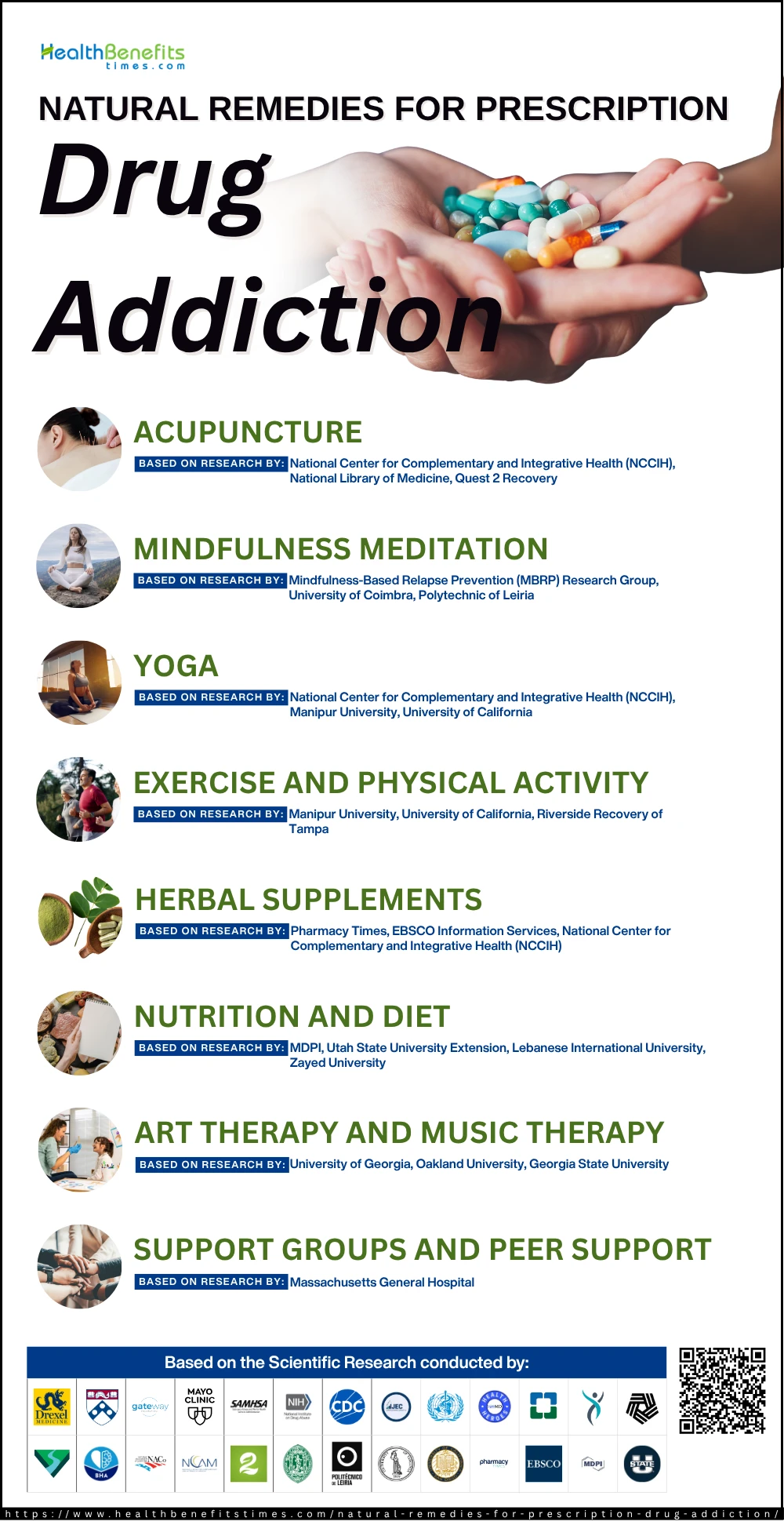
NCCIH states: “Mindfulness-based interventions may help people reduce their use of substances such as alcohol, cigarettes, and opioids” 35 Mindfulness-Based Relapse Prevention (MBRP) is an 8-session aftercare program developed at the University of Washington. Home A major RCT published in JAMA Psychiatry (N=286) found MBRP showed benefits at 12-month follow-up for reducing heavy drinking and drug use. 40 A 2021 systematic review of 13 studies confirmed MBRP has “a significant positive impact on various substance use and clinical variables”. 41 42 MBRP works by decoupling habitual behavioral patterns from emotional/physiological triggers. 43 44
3. Yoga
NCCIH position: “Preliminary results of studies on yoga for substance use disorders have been positive, but larger, high-quality studies are needed”. 45 A 2021 systematic review of 8 RCTs found 7 of 8 studies showed significant positive outcomes when yoga was combined with pharmacologic treatment. 46 During yoga nidra meditation, a 65% increase in endogenous dopamine release was observed in the ventral striatum 47 NCCIH is currently sponsoring research on yoga for chronic pain in people treated for opioid use disorder. 45
4. Exercise and physical activity
Epidemiological studies show individuals meeting physical activity guidelines are less likely to use illicit drugs. Exercise stimulates natural release of dopamine, endorphins, serotonin, and norepinephrine, activating brain reward circuitry without creating dependency. Riverside Recovery of Tampa Preclinical evidence strongly supports exercise for reducing drug self-administration during acquisition, maintenance, and relapse phases. 48 49 Exercise normalizes dopaminergic and glutamatergic transmissions and promotes neuroplasticity through BDNF-mediated epigenetic interactions. 50 Well-controlled clinical trials remain scarce but growing. 48
5. Herbal supplements
- Kudzu (Pueraria lobata): Studied for alcohol reduction; one study showed modest reductions in alcohol intake, but results have not been consistently replicated. No clear benefit established 51
- Passionflower (Passiflora incarnata): A 14-day double-blind trial found passionflower + clonidine was superior to clonidine alone for emotional symptoms (anxiety, irritability, depression) during opioid withdrawal. Evidence: preliminary but promising. 52 53
- Ashwagandha (Withania somnifera): NCCIH states some preparations “may be effective for insomnia and stress” but evidence is unclear for anxiety. NCCIH Stress-reduction properties may indirectly support recovery, but no high-quality direct evidence for addiction treatment exists 54 55
- Milk thistle (Silybum marianum): NCCIH: “There isn’t enough high-quality evidence to allow definite conclusions about effects on health conditions.” Results for alcohol-related liver diseases have been “conflicting or too limited.” NCCIH Two NCCIH-funded studies found no benefit 56
- N-Acetyl Cysteine (NAC): A 2017 meta-analysis (7 RCTs) found NAC significantly superior to placebo for craving symptoms. 57 A 2021 meta-analysis (16 trials) confirmed significant decreases in craving and depressive symptoms 58 However, a 2024 updated meta-analysis (9 trials, 623 participants) found NAC did NOT significantly outperform placebo, with very high heterogeneity59 Evidence is mixed; NAC may be most effective for cocaine users (adults) and cannabis users (adolescents) 60
6. Nutrition and diet
Substances substantially influence metabolism, appetite, and nutrient absorption. Common deficiencies in addiction include B vitamins, zinc, magnesium, omega-3 fatty acids, and amino acids. MDPI Less than 7% of treatment centers employ a nutritionist. 61 62 Key recovery nutrients include: tyrosine and tryptophan (dopamine and serotonin precursors), omega-3 fatty acids (which reduced anger and anxiety in detoxification patients), PubMed Central and NAC (which helps restore glutamate transporter levels). 63 64 63 64 The gut produces ~95% of the body’s serotonin World of Medical Saviours and substance abuse disrupts the gut microbiome, impairing mood regulation 61
7. Art therapy and music therapy
A 2022 Cochrane systematic review (21 trials, 1,984 participants) found music therapy as adjunct to standard care led to moderate reductions in substance craving and increased motivation for treatment/change. Greater craving reduction was associated with music therapy lasting longer than a single session. 46 A national survey found 36.8% of treatment programs offered art therapy and 14.7% offered music therapy. 65
8. Support groups and peer support
A 2020 Cochrane review found that when AA/12-step programs are subjected to the same scientific standards as other interventions, they perform at least equivalently and are “better at sustaining abstinence and remission over time” and “highly cost-effective”. 66 SMART Recovery uses cognitive-behavioral and motivational techniques with over 3,000 meetings in 20+ countries. Behave Health SAMHSA defines peer recovery support services as services designed and delivered by people in recovery, SAMHSA and all U.S. states now have peer certification standards.
Other complementary approaches
- Neurofeedback: A 2026 meta-analysis (17 RCTs, 662 participants) found EEG neurofeedback significantly alleviated addiction symptoms (Hedges’ g = 0.85, p<0.001) 67 68 68
- Tai Chi/Qigong: A 2022 systematic review found these practices reduce anxiety and depression in SUD populations 69
Precautions before using natural remedies
“Natural” does not mean “safe”
NCCIH explicitly warns: “‘Natural’ does not necessarily mean ‘safe.’ For example, the herbs comfrey and kava can cause serious harm to the liver”. 70 All complementary approaches should be used alongside conventional medical care, never as replacements. 71
FDA does not approve supplements before marketing
Under the Dietary Supplement Health and Education Act (DSHEA) of 1994, “FDA does not have the authority to approve dietary supplements before they are marketed.” FDA Manufacturers are responsible for evaluating safety and labeling; NCCIH FDA can only act after products reach market. 72 72 FDA has found over 1,060 tainted products marketed as dietary supplements containing hidden prescription drugs. 73 All structure/function claims must carry a disclaimer: “This statement has not been evaluated by the FDA. This product is not intended to diagnose, treat, cure, or prevent any disease”. 72
Dangerous drug interactions
St. John’s Wort has an “overall high risk of drug interaction” as a potent inducer of cytochrome P-450 enzymes 74 It can reduce methadone blood levels to 47% of original concentration, inducing withdrawal symptoms. 75 It can reduce buprenorphine levels, making treatment less effective and triggering withdrawal. 76 Mayo Clinic warns: “Don’t take St. John’s wort with methadone”. 77
Kava can interact with benzodiazepines, adding to CNS depressant effects. When combined with Xanax, kava has caused a “semicomatose state.” Kava components are hepatotoxic. 78 79
Risks of replacing medical treatment
NIDA states: “Detoxification alone without subsequent treatment generally leads to resumption of drug use” NIDA and medical detox is “only the first stage of treatment”. 27 Self-detox is “a leading cause of relapse and drug or alcohol-related overdose deaths.” Attempting to quit cold turkey is “unsafe, dangerous, and possibly life-threatening”. 80 NCCIH advises: “Tell your health care providers about any complementary health products or practices you use”. 70
When to seek professional help
Signs that natural remedies are insufficient
NIDA describes addiction as involving “intense and, at times, uncontrollable drug craving, along with compulsive drug seeking and use that persist even in the face of devastating consequences.” National Institute on Drug Abuse Warning signs include: continued use despite harmful consequences, inability to stop despite wanting to, escalating use/tolerance, spending excessive time obtaining or using the substance, failing to meet work/school/home obligations, and giving up important activities. 81 3
Emergency signs of overdose
Opioid overdose signs: Blue/purple fingernails and lips, unresponsiveness, pinpoint pupils, slow/shallow/stopped breathing, snoring or gurgling sounds, cold/clammy skin, very slow or stopped heartbeat. Call 911 immediately. 82 Naloxone (Narcan) “rapidly reverses an opioid overdose” and “can quickly restore normal breathing.” It works for 30–90 minutes, after which overdose symptoms may return medical care is essential. Naloxone only works on opioid overdoses and has no effect on someone without opioids in their system. 83
Medically supervised detox is essential for certain substances
Supervised medical detox is the standard of care for withdrawal from opioids, benzodiazepines, and alcohol. Alcohol withdrawal can progress to seizures and delirium tremens with a fatality rate of up to 15% if untreated. Benzodiazepine withdrawal can cause severe or life-threatening symptoms requiring gradual tapering. Opioid withdrawal, while typically not life-threatening, is “intensely painful and debilitating” and “often leads to immediate relapse”. 84 NIDA emphasizes: “No single addiction treatment is appropriate for all individuals” and effective treatment must attend to multiple needs. 81
Professional treatment resources
| Resource | Contact |
| SAMHSA National Helpline | 1-800-662-4357 (24/7, free, confidential) |
| SAMHSA Treatment Locator | findtreatment.gov |
| 988 Suicide & Crisis Lifeline | Call or text 988 |
| NIDA Drug Facts | nida.nih.gov |
| American Addiction Centers | 888-966-8152 |
Comments
comments
This article is based on Scientific Research Conducted by following Research Organization:
- DrugFacts Understanding Drug Use and Addiction DrugFacts–National Institute on Drug Abuse, United States
- Misuse of Prescription Drugs Research Report–Drugs, Brains, and Behavior: The Science of Addiction Drug Misuse and Addiction
- Drug addiction (substance use disorder)–Mayo Clinic, United States
- Drug addiction (substance use disorder)–Mayo Clinic, United States
- Prescription drug abuse–Mayo Clinic, United States
- Drugs, Brains, and Behavior: The Science of Addiction Drugs and the Brain–National Institute on Drug Abuse, United States
- Substance Use Disorder defined by NIDA and SAMHSA:–National Institute on Drug Abuse, United States
- SUBSTANCE-RELATED DISORDERS–National Institute on Drug Abuse, United States, Drexel University College of Medicine, United States, University of Pennsylvania School of Medicine, United States
- DSM-5 Criteria for Substance Use Disorders–Gateway Foundation, United States
- Drugs, Brains, and Behavior: The Science of Addiction Drugs and the Brain–National Institute on Drug Abuse, United States
- Prescription Opioids DrugFacts–National Institute on Drug Abuse, United States
- How opioid use disorder occurs–Mayo Clinic, United States
- SAMHSA releases new data on rates of mental illness and substance use disorder in the U.S.–Substance Abuse and Mental Health Services Administration, United States
- U.S. Overdose Deaths Decrease Almost 27% in 2024–National Center for Health Statistics, United States
- Drug Overdose Deaths: Facts and Figures–National Institute on Drug Abuse, United States
- Understanding the Opioid Overdose Epidemic–Centers for Disease Control and Prevention (CDC), United States
- Joint Economic Committee Democrats–Joint Economic Committee (JEC), United States Congress
- World Drug Report 2024–United Nations Office on Drugs and Crime (UNODC), United Nations
- Over 3 million annual deaths due to alcohol and drug use, majority among men–World Health Organization (WHO), United Nations
- UNODC Releases World Drug Report 2024–United Nations Office on Drugs and Crime (UNODC), United Nations
- Signs of Drug Addiction–WebMD, United States
- Is Addiction Hereditary?–Cleveland Clinic, United States
- Screening Tools and Prevention–National Institute on Drug Abuse (NIDA), United States
- Clinical Use Of The NIDA Drug Use Screening Tool: Process And Purpose–Valley Spring Recovery Center, United States
- DSM-5 Criteria for Addiction Simplified–Addiction Policy Forum, United States
- Prescription Drug addiction: Definition, Types, signs and symptoms, Effects, Treatment–Better Addiction Care, United States
- Drugs, Brains, and Behavior: The Science of Addiction Treatment and Recovery–National Institute on Drug Abuse (NIDA), United States
- Opioid treatment programs (OTPs)–Behavioral Health Administration, United States
- Medication-Assisted Treatment (“MAT”) for Opioid Use Disorder: A NACo Opioid Solutions Strategy Brief–National Association of Counties (NACo), United States
- National Institute on Drug Abuse (NIDA) Misuse of Prescription Drugs–National Institute on Drug Abuse (NIDA), United States
- Prescription Drug Abuse–WebMD, United States
- The Big Picture of Addiction Recovery in America–Addiction Help (AddictionHelp.com), United States
- Understanding Relapse: Key Statistics and What They Mean for Recovery–Clear Steps Recovery, United States
- Substance Use Disorder (SUD)–Cleveland Clinic, United States
- 6 Things To Know About Psychological and Physical Approaches for Substance Use Disorders–National Center for Complementary and Integrative Health (NCCIH), United States
- Acupuncture in Addiction Medicine: Its History, Evidence, and Possibilities
- Acupuncture therapy for drug addiction–National Library of Medicine (PubMed Central), United States
- Acupuncture in Addiction Medicine: Its History, Evidence, and Possibilities
- “Acupuncture In Addiction Treatment: Uses And Benefits”–Quest 2 Recovery, United States
- Mindfulness-Based Relapse Prevention–Mindfulness-Based Relapse Prevention (MBRP) Research Group / Mindful RP, United States
- Effectiveness of Mindfulness-Based Relapse Prevention in Individuals with Substance Use Disorders: A Systematic Review
- Effectiveness of Mindfulness-Based Relapse Prevention in Individuals with Substance Use Disorders: A Systematic Review–University of Coimbra, Portugal, Polytechnic of Leiria, Portugal, VillaRamadas International Treatment Centre, Portugal
- Mindfulness-Based Relapse Prevention: History, Mechanisms of Action, and Effects–University of Virginia, United States
- Mindfulness-based relapse prevention for substance craving
- Yoga: Effectiveness and Safety–National Center for Complementary and Integrative Health (NCCIH), United States
- Psychological and Physical Approaches for Substance Use Disorders: What the Science Says–National Center for Complementary and Integrative Health (NCCIH), United States
- Neurobiological basis for the application of yoga in drug addiction–Manipur University, India
- Exercise-based treatments for substance use disorders: evidence, theory, and practicality–University of California, San Diego (UC San Diego), United States
- Exercise and Addiction Recovery: Benefits, Withdrawal, and What the Science Says–Riverside Recovery of Tampa, United States
- Rewiring the Addicted Brain Through a Psychobiological Model of Physical Exercise–Federal University of Rio Grande do Norte (UFRN), Brazil
- Herbal Approaches to Alcohol Dependence: Evidence and Risks–Pharmacy Times, United States
- Passionflower's therapeutic uses–EBSCO Information Services, United States.
- Passionflower–National Center for Complementary and Integrative Health (NCCIH), United States (NIH).
- Ashwagandha–National Center for Complementary and Integrative Health (NCCIH), United States (NIH).
- Benefits of Ashwagandha and How Much To Take–Cleveland Clinic, United States
- Milk Thistle–National Center for Complementary and Integrative Health (NCCIH), United States
- N-acetylcysteine in the treatment of craving in substance use disorders: Systematic review and meta-analysis–National Library of Medicine (NLM), United States
- Effectiveness of N-acetylcysteine in Treating Clinical Symptoms of Substance Abuse and Dependence: A Meta-analysis of Randomized Controlled Trials–National Library of Medicine (NLM), USA
- N-acetylcysteine as a treatment for substance use cravings: A meta-analysis–Wiley (publisher of Addiction Biology), United States
- N-acetylcysteine: A potential treatment for substance use disorders–National Library of Medicine (NLM), United States
- Importance of Nutrition Care During the Addiction Recovery Process–MDPI (Multidisciplinary Digital Publishing Institute), Switzerland
- Diet, Nutrition, and Substance Use Disorder–Utah State University Extension (USU Extension), United States
- Nutritional status and eating habits of people who use drugs and/or are undergoing treatment for recovery: a narrative review–Lebanese International University, Lebanon, Zayed University, United Arab Emirates, Maastricht University, Netherlands
- Nutrition for Addiction Recovery: Best Foods, Diet Tips, & Healing Support–American Addiction Centers (AAC), United States
- The Use of Art and Music Therapy in Substance Abuse Treatment Programs–University of Georgia, United States, Oakland University, United States, Georgia State University, United States
- An investigation of SMART Recovery: protocol for a longitudinal cohort study of individuals making a new recovery attempt from alcohol use disorder–Massachusetts General Hospital, United States
- Effect of EEG neurofeedback therapy on addiction disorders: A systematic review and meta-analysis–Tribhuvan University (Institute of Medicine), Nepal
- Effect of EEG neurofeedback therapy on addiction disorders: A systematic review and meta-analysis–National Institute on Drug Abuse (NIDA), United States, University of North Carolina at Chapel Hill, United States
- The Impact of Qigong and Tai Chi Exercise on Drug Addiction: A Systematic Review and Meta-Analysis–Shenzhen University, China
- 5 Tips: What Consumers Need To Know About Dietary Supplements–National Center for Complementary and Integrative Health (NCCIH), United States
- Complementary, Alternative, or Integrative Health: What’s In a Name?–National Center for Complementary and Integrative Health (NCCIH), United States
- Questions and Answers on Dietary Supplements–U.S. Food and Drug Administration (FDA), United States
- Unapproved Pharmaceutical Ingredients Included in Dietary Supplements Associated With US Food and Drug Administration Warnings–University of California, Los Angeles
- NCCIH Clinical Digest–National Center for Complementary and Integrative Health (NCCIH), United States (NIH)
- Methadone maintenance treatment and St. John's Wort - a case report–Tribhuvan University, Institute of Medicine, Nepal, Nepal Health Research Council (NHRC), Nepal
- Can You Take Buprenorphine with St. john's wort?–Drugs.com (Drugsite Trust), United States
- St. John's wort–Mayo Clinic, United States
- Kava - Uses, Side Effects, and More–WebMD, United States
- When It Comes to Kava, ‘Natural’ Doesn’t Mean Safe–Cleveland Clinic, United States
- How to Get Sober: A Guide to Sobriety–American Addiction Centers (AAC), United States
- Principles of Drug Addiction Treatment: A Research-Based Guide (Third Edition)–National Institute on Drug Abuse (NIDA), United States (NIH)
- Opioid Overdose Prevention TOOLKIT–Substance Abuse and Mental Health Services Administration (SAMHSA), United States (HHS)
- What is naloxone?–National Institute on Drug Abuse (NIDA), United States (NIH)
- Types of Detox Programs and Addiction Treatment Options–American Addiction Centers (AAC), United States
- Millions of Americans have mental and substance use disorders. Find treatment here.–Substance Abuse and Mental Health Services Administration (SAMHSA), United States (HHS)
- Resources for Addiction Treatment: Freedom from Addiction Begins Here.–American Addiction Centers (AAC), United States