

Causes of Salivary gland infection (Sialadenitis)
Unraveling the mystery of what triggers these uncomfortable glandular flare-ups requires looking at the delicate balance of the mouth’s internal environment. When the natural flushing action of saliva slows down or stops, the door opens for a variety of biological and mechanical issues to take root.
1. Bacterial Invasion (Retrograde Infection): The most frequent pathway for a sudden glandular infection occurs when normal bacteria from the mouth travel backward up the salivary ducts and into the gland itself 6. Pathogens like Staphylococcus aureus easily colonize the tissue when saliva flow is too weak to push them out.
2. Viral Illnesses: Systemic viruses have a strong biological preference for glandular tissues, leading to widespread inflammation. The mumps virus is historically the most famous cause of severe, bilateral cheek swelling, though other viruses such as HIV can also trigger chronic glandular enlargement 7.
3. Salivary Stones (Sialolithiasis): Hardened mineral deposits, formed from crystallized calcium and phosphate, frequently develop in the thicker saliva of the submandibular glands 8. When a stone becomes wedged in the ductal pathway, it acts like a physical dam that stops saliva from escaping, inevitably leading to stagnation and secondary infection.
4. Autoimmune Disorders: In some individuals, the immune system becomes confused and mistakenly launches an attack on the body’s own moisture-producing glands. Conditions like Sjögren’s syndrome cause white blood cells to infiltrate and damage the salivary glands, drastically lowering saliva volume and leaving the mouth constantly dry and vulnerable to germs 9.
5. Severe Dehydration: The fundamental building block of healthy saliva is water, and without enough of it, salivary secretions become thick, sticky, and slow-moving. Insufficient fluid intake is a major modifiable risk factor that severely diminishes the mouth’s ability to wash away debris and bacteria 10.
6. Medication Side Effects: Many common prescription drugs, ranging from blood pressure diuretics to allergy antihistamines and psychiatric medications, chemically induce dry mouth as an unintended side effect 11. This chemically induced hyposalivation creates the exact same stagnant conditions as physical dehydration.
7. Postoperative Stasis: Patients recovering from surgeries, especially those requiring intubation or long periods without food or water, often experience a temporary shutdown of salivary function. This sudden stasis can lead to a condition historically referred to as “anesthesia mumps,” where the parotid gland painfully swells shortly after a major medical procedure 12.
Symptoms of Salivary gland infection (Sialadenitis)
Noticing the physical changes that accompany a compromised salivary gland is the first step toward finding relief. Because the glands are nestled intimately within the face and neck, inflammation here produces highly noticeable and uncomfortable localized reactions.
- Sudden, highly tender swelling that visibly alters the symmetry of the face, usually appearing distinctly on one side of the cheek or directly under the curve of the jawline 1.
- Sharp, cramping pain in the affected area that noticeably worsens just before or during a meal, as the gland tries to forcefully pump saliva against a blocked or narrowed duct 3.
- The skin lying directly over the swollen gland may appear visibly red (erythematous) and feel unusually warm to the touch, signaling a strong immune response 13.
- A foul, bitter taste that persistently coats the tongue, accompanied by severely bad breath, which happens when thick, bacteria-laden pus drains from the infected duct into the mouth 14.
- Systemic signs of illness, including a spiking fever, unprovoked chills, extreme fatigue, and general body aches, which indicate that the body is fighting a broader infection 15.
- A profound, unrelenting feeling of dry mouth that makes chewing, swallowing dry foods, and speaking continuously uncomfortable due to the total lack of natural lubrication 16.
Salivary gland infection (Sialadenitis) Facts table
| Symptoms |
|
| Causes |
|
| Types of Salivary gland infection (Sialadenitis) |
|
| How it spreads |
|
| Age Group |
|
| You might be at a higher risk for exposure of this disease if you: |
|
| How doctors diagnose |
|
| Other facts |
|
Natural Remedies for Salivary gland infection (Sialadenitis)
Shifting focus to gentle, supportive care, the primary goal of managing a glandular infection is to break the cycle of salivary stagnation. The most effective conservative medical treatments rely on natural principles to stimulate the body’s own physiological processes, commonly remembered in clinical settings by the acronym MASHH: Massage, Antibiotics, Sialagogues, Heat, and Hydration 3. While the antibiotic component requires a doctor’s prescription for bacterial cases, the remaining natural strategies form the cornerstone of healing.
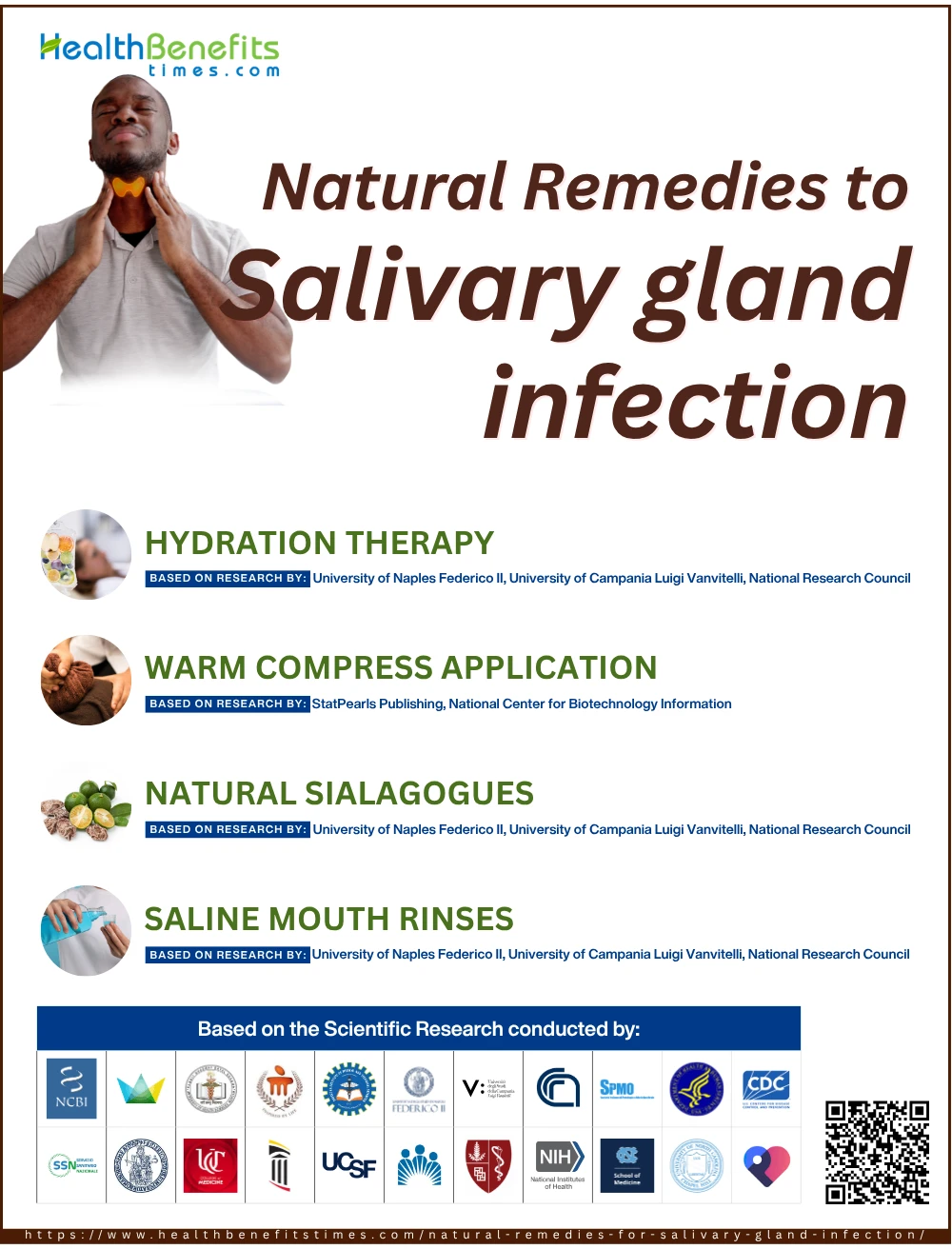
Water acts as the absolute baseline requirement for healthy glandular function. When the body detects a state of dehydration, it immediately conserves water, causing the remaining salivary secretions to become thick, highly concentrated, and slow-moving 10. By aggressively rehydrating the body, the blood volume expands and provides the glandular cells with the necessary fluid to manufacture a thin, watery, and fast-flowing stream of saliva. This constant, pressurized liquid irrigation is the body’s natural mechanism for flushing microscopic debris and invading bacteria out of the ductal pathways before they can establish an infection.
Note: You should aim to drink at least eight to ten large glasses of plain water steadily throughout the day to keep your saliva thin and flowing smoothly.
2. Warm Compress Application
Applying targeted thermal therapy harnesses the body’s natural circulatory response to heat. When a warm cloth is placed over the swollen jaw or cheek, the gentle heat causes the local blood vessels to dilate, drawing oxygen-rich blood and healing immune cells directly to the site of the infection 5. Furthermore, the deep warmth gently relaxes the smooth muscle tissue that lines the walls of the salivary ducts. This tissue relaxation can ease the agonizing spasms caused by a blockage and may subtly widen the duct enough to allow a trapped salivary stone to finally pass into the mouth.
Note: You should soak a clean washcloth in comfortably warm water, wring out the excess, and hold it firmly against your swollen skin for 10 to 15 minutes, repeating this soothing process several times a day.
3. Natural Sialagogues (Citrus and Sour Foods)
The nervous system closely controls the release of saliva, and it can be chemically tricked into maximum production through specific dietary triggers. Acidic and intensely sour flavors, medically categorized as sialagogues, send immediate signals to the parasympathetic nerves to aggressively contract the salivary glands 17. Natural elements containing high amounts of citric acid like lemon juice or sour hard candies provoke a massive, immediate surge in saliva volume. This sudden buildup of hydrostatic pressure behind a blockage acts like a pressure washer, helping to forcefully dislodge thick mucus plugs or tiny calcified stones that are trapped near the duct opening 4.
Note: You should suck on sugar-free lemon drops, drink highly diluted lemon water, or chew on sugar-free gum shortly before and after your meals to force your glands to produce a cleansing wave of saliva.
4. Saline Mouth Rinses
The environment inside the mouth must be carefully managed to prevent opportunistic bacteria from migrating into the vulnerable salivary ducts. A basic solution of warm water and table salt creates a slightly hypertonic environment, meaning it contains a higher concentration of salt than the swollen tissues of the mouth 18. Through the simple science of osmosis, this salty rinse draws excess fluid out of the inflamed duct openings, reducing localized puffiness. Simultaneously, the saline environment naturally disrupts the delicate cell membranes of harmful oral bacteria, acting as a mild, non-irritating antiseptic that halts further retrograde infection 19.
Note: You should dissolve one level teaspoon of salt into a warm cup of water and vigorously swish it around your mouth for thirty seconds, spitting it out afterward, to help keep your mouth clean and reduce swelling.
Is there any exercise or physical activities for Salivary gland infection (Sialadenitis)
Engaging the facial muscles and manually manipulating the soft tissues of the jaw can physically assist a struggling gland. Because the salivary networks rely on pressure to move fluid, targeted kinetic movements can break up stagnation and encourage natural drainage.
1. Glandular Massage
Applying direct kinetic pressure is one of the most effective mechanical methods to combat obstructive stasis. The sweeping motion of a massage physically increases the pressure inside the gland, gently milking the trapped saliva, pus, and tiny crystalline fragments forward along the anatomical routing of the duct 20. This technique must strictly follow the natural path of drainage, pushing from the back of the cheek forward toward the mouth for the parotid gland, or from under the jawline upward toward the tongue for the submandibular gland.
Note: You should use two fingers to apply firm but gentle pressure over the swollen area, slowly stroking the skin forward in the direction of your mouth to help push out trapped fluids.
2. Facial Muscle Stretches
The salivary glands do not exist in isolation; they are tightly packed against the strong muscles responsible for chewing and facial expressions. By intentionally exaggerating facial movements, the major chewing muscles (like the masseter) alternately squeeze and release the parotid glands resting on top of them 21. This rhythmic compression acts as an internal biological pump, stimulating local blood flow while coaxing stagnant saliva out of the deepest pockets of the glandular tissue.
Note: You should regularly stretch your face by smiling as wide as you can, then closing your lips tightly and puffing your cheeks out with air, moving the air back and forth to massage the cheek muscles.
3. Tongue Movement Exercises
The sublingual glands and the exit points for the submandibular glands are located directly in the floor of the mouth, intricately interwoven with the base of the tongue 22. By moving the tongue vigorously, you pull and stretch the mucous membranes and underlying tissues of the mouth’s floor. This internal tension acts as a natural massage from the inside out, helping to dislodge the thick, stringy saliva that tends to pool under the tongue when a gland is infected or dehydrated.
Note: You should stick your tongue out as far as it will comfortably go, point it side to side, try to touch your nose with it, and firmly press it against the inside of your cheeks to stretch the floor of your mouth.
Foods and Activities to Avoid
Navigating the recovery process means actively protecting your compromised tissues from further harm. Eliminating dietary choices and habits that aggressively dry out the mouth or feed bad bacteria is just as important as implementing healthy remedies.
(i) Foods to Avoid When You Suffer from Salivary Gland Infection
- High-Sugar and Sticky Foods: Without a strong flow of healthy saliva to wash your teeth, your mouth loses its primary defense against sugar. Sugary treats feed acid-producing oral bacteria, rapidly leading to dental decay and increasing the population of germs that can invade your weakened salivary ducts 23.
- Caffeinated Beverages: Drinks heavily loaded with caffeine, such as coffee, strong teas, and energy drinks, act as mild diuretics that encourage your body to lose water. This chemical drying effect creates a sticky, uncomfortable sensation in the mouth and causes your remaining saliva to become dangerously thick 11.
- Salty and Processed Snacks: Consuming heavy amounts of dry, salt-cured meats or excessively salty chips pulls vital moisture directly out of your mouth’s delicate tissues. This rapid moisture loss directly counteracts all your efforts to keep your glands hydrated and flushed.
- Extremely Spicy or Sharp Foods: While a tiny bit of spice might make your mouth water, excessively hot peppers or physically sharp foods like hard taco shells can easily scratch the inflamed, sensitive duct openings inside your cheeks, creating tiny cuts that invite secondary bacterial infections.
Note: You should stick to a soft, mild, and highly hydrating diet like broths and smooth soups until the swelling and pain in your glands have completely subsided.
(ii) Activities to Avoid When You Suffer from Salivary Gland Infection
- Smoking and Tobacco Use: Inhaling hot, toxic smoke is one of the fastest ways to destroy the protective lining of your mouth. Tobacco heavily dries out the oral tissues, introduces harsh chemical irritants, and suppresses your local immune response, making it incredibly difficult for an infected gland to heal 24.
- Consuming Alcohol: Alcoholic beverages are potent dehydrators that strip the mouth of its natural, protective mucus layer. Regular drinking during a glandular infection will severely dry out your body and increase the burning pain associated with a blocked duct 13.
- Skipping Oral Hygiene: Failing to brush and floss allows dental plaque a thick, sticky biofilm of germs to build up near the openings of your salivary ducts. This plaque serves as a massive bacterial reservoir, practically guaranteeing that the germs will travel back up into your glands and cause a flare-up.
- Heavy Sweating Without Fluid Replacement: Engaging in intense workouts or spending time in saunas without meticulously drinking water causes rapid systemic dehydration. Losing fluids through sweat instantly thickens your salivary output, creating the perfect condition for a salivary stone to form and block your ducts 10.
Note: You should pause any intense physical exertion, avoid all tobacco and alcohol, and maintain a rigorous but gentle daily brushing routine to give your body the best environment to heal.
Myths and Misconceptions
Sorting fact from fiction can prevent unnecessary anxiety and help you make better, evidence-based decisions regarding glandular health.
| Myth | Reality |
| All salivary stones are massive and require immediate, invasive surgical removal. | The overwhelming majority of small salivary stones (those under 5 millimeters) can actually be managed and passed naturally at home using conservative treatments like intense hydration, warm compresses, and natural sialagogues 25. |
| A chronically dry mouth is just a normal, completely harmless part of getting older. | While salivary flow can decrease slightly with advanced age, a persistently dry mouth is abnormal and often points to medication side effects, a hidden autoimmune disease, or a chronic, low-grade salivary infection that requires medical attention 26. |
| Only the parotid glands in the cheeks can get painful stones and infections. | Surprisingly, the submandibular glands underneath the jawline account for 80% to 90% of all salivary stone formations, largely because their saliva is naturally thicker and must travel upward against the pull of gravity 27. |
| Drinking a glass of milk will effectively stimulate saliva production and cure a dry mouth. | Dairy products lack the acidic or sour properties necessary to trigger the nervous system’s salivary response; instead, milk tends to leave a thick protein coating in the mouth that can make a dry mouth feel much more congested and uncomfortable. |
| Once an acute salivary gland infection clears up, it will never happen again. | While acute episodes do resolve, patients who have suffered from a salivary stone or who have structural narrowing in their ducts face a significantly higher risk of experiencing recurrent flare-ups throughout their lifetime 28. |
Special Considerations
Looking at unique populations reveals that the physiological impact of an infected salivary gland changes drastically depending on a patient’s age and underlying health status.
1. Children
The pediatric presentation of glandular swelling differs wildly from the adult experience. Juvenile recurrent parotitis (JRP) is a rare, puzzling inflammatory condition that primarily affects young boys between the ages of three and six 29. Unlike adult infections, which are almost always tied to calcified stones or severe dehydration, JRP manifests as spontaneous, repeated swellings of the cheek accompanied by fever, possibly linked to temporary immune disruptions or immature ductal anatomy 30. Thankfully, the vast majority of JRP cases respond beautifully to simple home hydration and massage, naturally fading away entirely without permanent damage as the child reaches puberty and their salivary network fully matures.
2. Pregnancy
The massive hormonal shifts that characterize pregnancy introduce unexpected vulnerabilities for oral and glandular health. Spikes in estrogen and progesterone subtly alter the chemical makeup of maternal saliva, sometimes rendering it more prone to thickening and crystallization 31. Furthermore, pregnant individuals suffering from severe morning sickness (hyperemesis gravidarum) face prolonged periods of intense dehydration and poor fluid intake, laying the perfect foundation for a sudden ductal blockage. Because doctors wish to avoid unnecessary antibiotics or surgeries during gestation, managing these painful flare-ups relies heavily on diligent natural therapies like saline rinses and thermal compresses.
3. Chronic Conditions
Individuals battling lifelong systemic diseases must manage compounding risks that constantly threaten their salivary function. Autoimmune diseases, particularly Sjögren’s syndrome, feature a devastating biological error where the body’s white blood cells directly attack and destroy the salivary glands 9. This chronic destruction creates a permanent state of dry mouth, leaving the patient at an exceptionally high risk for recurrent retrograde bacterial infections. Similarly, patients with poorly controlled diabetes suffer from high blood sugar levels that can damage the delicate nerves controlling saliva production, while simultaneously creating a sugar-rich environment in the mouth that perfectly supports aggressive bacterial growth 32.
4. Elderly
The geriatric population faces the most complex web of oral health challenges. Natural age-related thinning of the glandular tissues is almost always made worse by polypharmacy; older adults frequently take a cocktail of blood pressure medications and antidepressants that synergistically shut down saliva production 33. Moreover, elderly patients who are bedbound or rely on feeding tubes completely lose the natural mechanical action of chewing. Without this daily physical stimulation, the salivary glands enter a dormant state, causing profound stasis that frequently erupts into acute, painful submandibular infections.
Precaution before use of natural remedies when you have Salivary gland infection (Sialadenitis)
Taking a cautious approach ensures that your attempts to heal at home do not accidentally make the inflammation worse. You must listen to your body and adjust your care based on the severity of the symptoms.
- Avoid Forceful Massage on an Active Abscess: If your swollen gland feels highly pressurized, the skin is burning hot, and the pain is agonizing, you may have developed an encapsulated bacterial abscess. Vigorously massaging this kind of severe infection can rupture the tissue boundary, pushing dangerous bacteria deeper into the sensitive tissues of your neck 3.
- Test the Temperature of Warm Compresses: The skin on your face and neck is exceptionally delicate. Always test a warm washcloth on your wrist first to ensure it is comfortably warm, not scalding hot, to avoid accidentally burning skin that is already stretched and inflamed from the underlying swelling.
- Match Sour Candies with Copious Water: Consuming highly sour, saliva-stimulating foods without drinking any water forces an already dehydrated gland to work in overdrive. Trying to squeeze saliva out of an empty, dry gland can trigger intense cramping spasms in your jaw.
- Be Extremely Gentle with Your Toothbrush: While keeping your mouth clean is vital, aggressively scrubbing the delicate tissues under your tongue or inside your cheeks can easily scratch the inflamed openings of your salivary ducts, creating tiny wounds that invite further bacterial invasion 34.
- Understand That Salt Water is Not a Cure-All: Gargling with warm saline is fantastic for reducing topical swelling and keeping the surface of your mouth clean, but it cannot penetrate deep inside a blocked duct to dissolve a hard stone or cure a severe internal bacterial infection 35.
Note: You should always start with the gentlest remedies first, slowly increasing the pressure of your massages and the intensity of your sour foods as your pain begins to tolerate it.
When to see Doctor
Recognizing the limits of natural home care is vital for your safety. While hydration and massage work wonders for minor blockages, certain dangerous symptoms demand immediate professional medical intervention to prevent life-threatening complications.
- You Experience Any Difficulty Breathing: If the swelling in your jaw or neck rapidly expands downward toward your throat, causing a change in your voice, difficulty swallowing your own spit, or a feeling that your airway is closing, you must seek emergency medical care immediately 36.
- You Develop a Spiking, Uncontrollable Fever: A body temperature that suddenly spikes dangerously high, accompanied by severe shaking chills, strongly suggests that the localized glandular infection has escaped into your bloodstream, raising the terrifying risk of systemic sepsis.
- You Notice Sudden Facial Paralysis: The major nerve controlling your facial expressions runs directly through the center of your parotid gland. If your cheek swelling is suddenly accompanied by a drooping face or an inability to blink or smile on one side, it could indicate a massive abscess or a tumor compressing the nerve, requiring urgent specialist imaging 37.
- Your Symptoms Worsen After Several Days: If you have diligently applied warm compresses, stayed hydrated, and massaged the gland for three to four days, but the pain and swelling are actively getting worse, the infection is likely too severe for home care. You will likely need prescription antibiotics or a minor endoscopic procedure to physically extract a stubborn stone 38.
- You Find a Hard, Painless Lump: Unlike the fluctuating, painful swelling of a standard infection or stone, a lump in your jaw or cheek that feels rock-hard, does not move, and does not hurt when you press on it is highly suspicious. This type of painless mass requires a prompt medical biopsy to rule out a benign or malignant salivary gland tumor.
Note: You should never hesitate to consult a healthcare professional if your intuition tells you that the pain is abnormal or if your symptoms frighten you; swift medical action can quickly resolve a condition before it becomes severe
Comments
comments
This article is based on Scientific Research Conducted by following Research Organization:
- Submandibular Sialadenitis and Sialadenosis–StatPearls Publishing, United States, National Center for Biotechnology Information (NCBI), United States
- Submandibular Sialadenitis and Sialadenosis–Manipal College of Medical Sciences, Nepal, Pandit Bhagwat Dayal Sharma University of Health Sciences (UHSR), India
- Approach to sialadenitis–Saveetha Institute of Medical and Technical Sciences, India
- A conservative treatment for chronic obstructive sialoadenitis by intraductal instillation of mucolytic, steroids and antibiotic solution–University of Naples Federico II, Italy, University of Campania Luigi Vanvitelli, Italy, National Research Council (CNR), Italy, Italian Society of Oral Pathology and Medicine (SIPMO), Italy
- Sialolithiasis–StatPearls Publishing, United States, National Center for Biotechnology Information (NCBI), United States
- Parotitis–StatPearls Publishing, United States, National Center for Biotechnology Information (NCBI), United States
- Clinical Overview of Mumps–Centers for Disease Control and Prevention (CDC), United States, U.S. Department of Health and Human Services (HHS), United States
- Noninvasive treatment for chronic sialadenitis: Case report–University of Naples Federico II, Italy, University of Campania Luigi Vanvitelli, Italy, Italian Society of Oral Pathology and Medicine (SIPMO), Italy, National Health Service (SSN), Italy, National Research Council (CNR), Italy
- The Role of Salivary Diagnostics in Early Detection of Systemic and Oral Diseases: A Comprehensive Review–Saveetha Institute of Medical and Technical Sciences, India
- Review of the Major and Minor Salivary Glands, Part 1: Anatomy, Infectious, and Inflammatory Processes–University of Naples Federico II, Italy, University of Campania Luigi Vanvitelli, Italy, Italian Society of Oral Pathology and Medicine (SIPMO), Italy, National Research Council (CNR), Italy
- Dry Mouth Dilemma: A Comprehensive Review of Xerostomia in Complete Denture Wearers–Saveetha Institute of Medical and Technical Sciences, India
- Anesthesia mumps with airway obstruction after radical nephrectomy: A case report and literature review–University of Naples Federico II, Italy, University of Campania Luigi Vanvitelli, Italy, Italian Society of Oral Pathology and Medicine (SIPMO), Italy
- EM@3AM: Sialadenitis–University of Maryland School of Medicine, United States, University of Cincinnati College of Medicine, United States.
- Common Characteristics and Clinical Management Recommendations for Juvenile Recurrent Parotitis: A 10-Year Tertiary Center Experience–University of Naples Federico II, Italy, University of Campania Luigi Vanvitelli, Italy, Italian Society of Oral Pathology and Medicine (SIPMO), Italy
- About Mumps–Centers for Disease Control and Prevention (CDC), United States, U.S. Department of Health and Human Services (HHS), United States
- MASCC/ISOO Clinical Practice Statement: Management of salivary gland hypofunction and xerostomia in cancer patients–Saveetha Institute of Medical and Technical Sciences, India
- Sweet Shop Sialagogues: A Sour Solution to Sialolithiasis–University of Naples Federico II, Italy, University of Campania Luigi Vanvitelli, Italy, Italian Society of Oral Pathology and Medicine (SIPMO), Italy
- Evaluation of the effect of three supplementary oral hygiene measures on salivary mutans streptococci levels in children: A randomized comparative clinical trial–University of California, San Francisco (UCSF), United States, Kaiser Permanente Division of Research, United States, Stanford University School of Medicine, United States, National Institutes of Health (NIH), United States
- Rinsing with Saline Promotes Human Gingival Fibroblast Wound Healing In Vitro–University of North Carolina at Chapel Hill, United States, UNC School of Medicine, United States, Centers for Disease Control and Prevention (CDC), United States, National Institutes of Health (NIH), United States.
- Sialoendoscopy: Review and Nuances of Technique–University of Naples Federico II, Italy, University of Campania Luigi Vanvitelli, Italy, Italian Society of Oral Pathology and Medicine (SIPMO), Italy
- Effects of an integrated supportive program on xerostomia and saliva characteristics in patients with head and neck cancer radiated with a low dose to the major salivary glands: a randomized controlled trial–Italian Society of Oral Pathology and Medicine (SIPMO), Italy, University of Campania Luigi Vanvitelli, Italy, University of Naples Federico II, Italy
- Effects of the salivary gland massage program in older type 2 diabetes patients on the salivary flow rate, xerostomia, swallowing and oral hygiene: A randomized controlled trial–University of Naples Federico II, Italy, University of Campania Luigi Vanvitelli, Italy, Italian Society of Oral Pathology and Medicine (SIPMO), Italy
- Candida Infection Associated with Salivary Gland—A Narrative Review–Italian Society of Oral Pathology and Medicine (SIPMO), Italy, University of Campania Luigi Vanvitelli, Italy, University of Naples Federico II, Italy
- Sialendoscopic management of autoimmune sialadenitis: a review of literature–University of California, San Francisco (UCSF), United States;, Kaiser Permanente Division of Research, United States, Stanford University School of Medicine, United States
- Contemporary Review of Submandibular Gland Sialolithiasis and Surgical Management Options–Saveetha Institute of Medical and Technical Sciences, India
- Diagnostic work-up in obstructive and inflammatory salivary gland disorders–University of California, San Francisco (UCSF), United States;, Kaiser Permanente Division of Research, United States, Stanford University School of Medicine, United States
- Diseases of the salivary glands in infants and adolescents–University of North Carolina at Chapel Hill, United States, UNC School of Medicine, United States, Centers for Disease Control and Prevention (CDC), United States, National Institutes of Health (NIH), United States
- Salivary gland stones–Patient.info, United Kingdom
- Juvenile Recurrent Parotitis–Children's Hospital of Philadelphia (CHOP), United States
- Evaluation and management of juvenile recurrent parotitis in children from northern Greece–University of North Carolina at Chapel Hill, United States, UNC School of Medicine, United States, Centers for Disease Control and Prevention (CDC), United States, National Institutes of Health (NIH), United States
- Salivary Gland Tumors in Pregnancy—Treatment Strategies
- Case report: Acute submandibular sialadenitis in poorly controlled diabetes mellitus patient fed twenty days by enteral tube–Kawasaki Medical School, Japan, Department of Diabetes, Endocrinology and Metabolism, Kawasaki Medical School, Japan, Department of General Internal Medicine 1, Kawasaki Medical School, Japan
- Salivary Gland Trauma: A Review of Diagnosis and Treatment–University of North Carolina at Chapel Hill, United States, UNC School of Medicine, United States, Centers for Disease Control and Prevention (CDC), United States, National Institutes of Health (NIH), United States
- Clinical Studies of Nonpharmacological Methods to Minimize Salivary Gland Damage after Radioiodine Therapy of Differentiated Thyroid Carcinoma: Systematic Review–University of California, San Francisco (UCSF), United States, Kaiser Permanente Division of Research, United States, Stanford University School of Medicine, United States, National Institutes of Health (NIH), United States
- The effectiveness of various gargle formulations and salt water against SARS-CoV-2–University of Malaya, Malaysia, Universiti Sains Islam Malaysia, Malaysia
- Acute Post-operative Transient Sialadenitis "Anesthesia Mumps" After Caesarean Section Under Spinal Anesthesia: A Case Report–Saveetha Institute of Medical and Technical Sciences, India
- Juvenile recurrent parotitis–University of North Carolina at Chapel Hill, United States, UNC School of Medicine, United States, Centers for Disease Control and Prevention (CDC), United States, National Institutes of Health (NIH), United States
- Parotitis and Sialendoscopy of the Parotid Gland–Wake Forest University School of Medicine, United States.