

What Is an OPG?
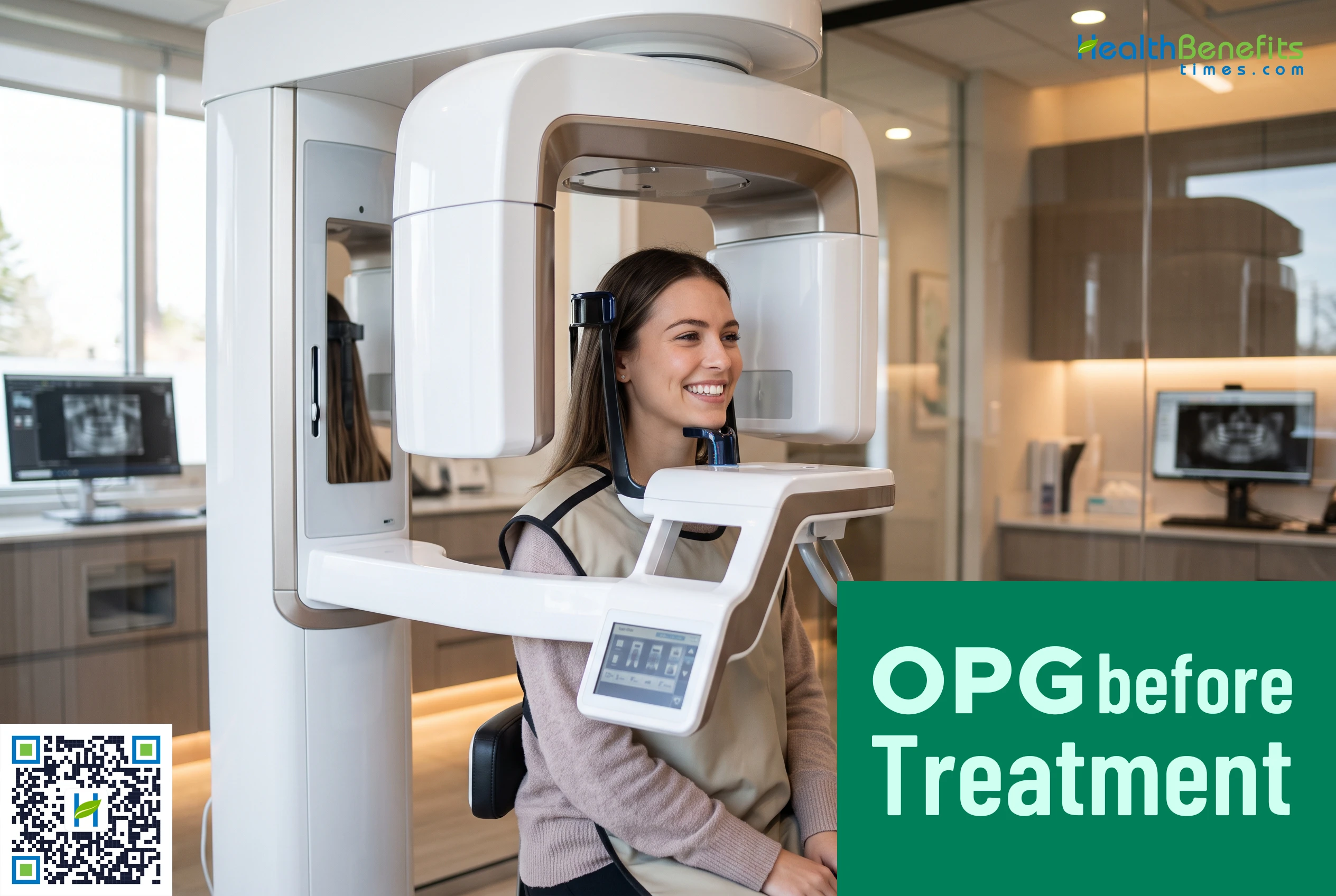
OPG stands for orthopantomogram, and it’s a single panoramic x-ray that captures your entire mouth in one image, both your upper and lower jaw, all your teeth, and the surrounding bone. Rather than the small, close-up images taken for cavities, an OPG steps back and shows the whole picture: how your teeth sit in the jaw, where your wisdom teeth are pointing, and the shape of the jawbone itself. The scan itself only takes about 10 minutes, with the machine rotating around your head while you stay still with your chin resting in place.
A related scan called a lateral cephalogram (or “ceph”) is sometimes taken alongside an OPG. Instead of a front-on view, it’s a side-on image of your head, used mainly by orthodontists to measure your jaw and bite before working out a treatment plan for braces or aligners.
Why Your Dentist Might Order One
There are a handful of common situations where an OPG becomes an important step before treatment goes ahead:
- Wisdom teeth – Before removing wisdom teeth, dentists need to see exactly how they’re angled, how close they sit to nerves, and whether they’re impacted, none of which is visible on a small bitewing x-ray.
- Dental implants – Placing an implant means understanding the shape, height, and density of the jawbone underneath the gum, which an OPG maps out clearly.
- Orthodontics – Braces and aligners work by moving teeth through bone, so orthodontists use an OPG (often paired with a ceph) to check how teeth are developing and whether any are missing, unerupted, or growing at odd angles.
- Root canals and extractions – Seeing the full root structure and surrounding bone helps a dentist plan more complicated extractions or root canal treatment with fewer surprises.
- New patient check-ups – Many dental practices use an OPG as a baseline record, especially for new patients, so future changes can be compared against a starting point.
What an OPG Can Reveal
Beyond the specific reason it was ordered, an OPG often picks up things a dentist wouldn’t otherwise see, including impacted or unerupted teeth, cysts or other growths in the jaw, bone loss around existing teeth, jaw joint (TMJ) irregularities, and occasionally issues in the sinuses sitting just above the upper back teeth. This is part of why dentists lean on OPGs so often: one scan gives a broad, reliable overview that turns guesswork into an actual plan.
What to Expect at Your Appointment
There’s very little to prepare for. You’ll be asked to remove any metal items that could interfere with the image, things like earrings, necklaces, piercings, and hair clips, and you may be given a lead apron to wear for extra protection. You’ll then stand or sit with your chin resting on a support while the machine slowly rotates around your head, capturing the panoramic image. There’s no injection and nothing invasive involved, and most people find it’s over before they’ve had time to get uncomfortable. Your dentist usually receives the images within a day, so the results feed straight into your next appointment rather than causing a long delay to treatment.
It’s worth noting that an OPG is a broad overview rather than a close-up. Dentists often pair it with smaller bitewing or periapical x-rays when they need finer detail on a specific tooth, such as checking for decay between teeth or right at the root tip. Each type of x-ray answers a slightly different question, which is why you might be asked for more than one type of image depending on what’s being investigated.
Is an OPG Safe?
An OPG uses a very low dose of radiation, lower than a standard chest x-ray, so dentists don’t hesitate to order one when there’s a clear clinical reason. As with any x-ray, it’s still worth letting the clinic know if you’re pregnant, since they’ll want to take extra precautions.
Getting an OPG Done Locally
Patients in the Riverina area don’t need to travel far for this kind of imaging. An OPG Leeton scan is available at Xplore Radiology’s Leeton clinic on Kurrajong Avenue, which has been serving the local community since 2005. Patients with eligible dental imaging referrals can ask the clinic about Medicare bulk billing options. The clinic also offers cephalometric imaging for patients starting orthodontic treatment, alongside its broader range of x-ray, ultrasound, and CT services, with results typically sent back to your dentist within 24 hours. Being able to get an OPG and ceph done at the same local appointment, without a long drive to a bigger centre, makes it easier to keep your treatment on schedule.
Talk to Your Dentist
An OPG isn’t ordered for no reason, it’s usually the step that lets your dentist or orthodontist plan your treatment properly instead of working with limited information. If you’ve been asked to get one done, it’s worth asking your dentist exactly what they’re checking for, so you understand how it fits into your overall treatment plan.
Comments
comments