

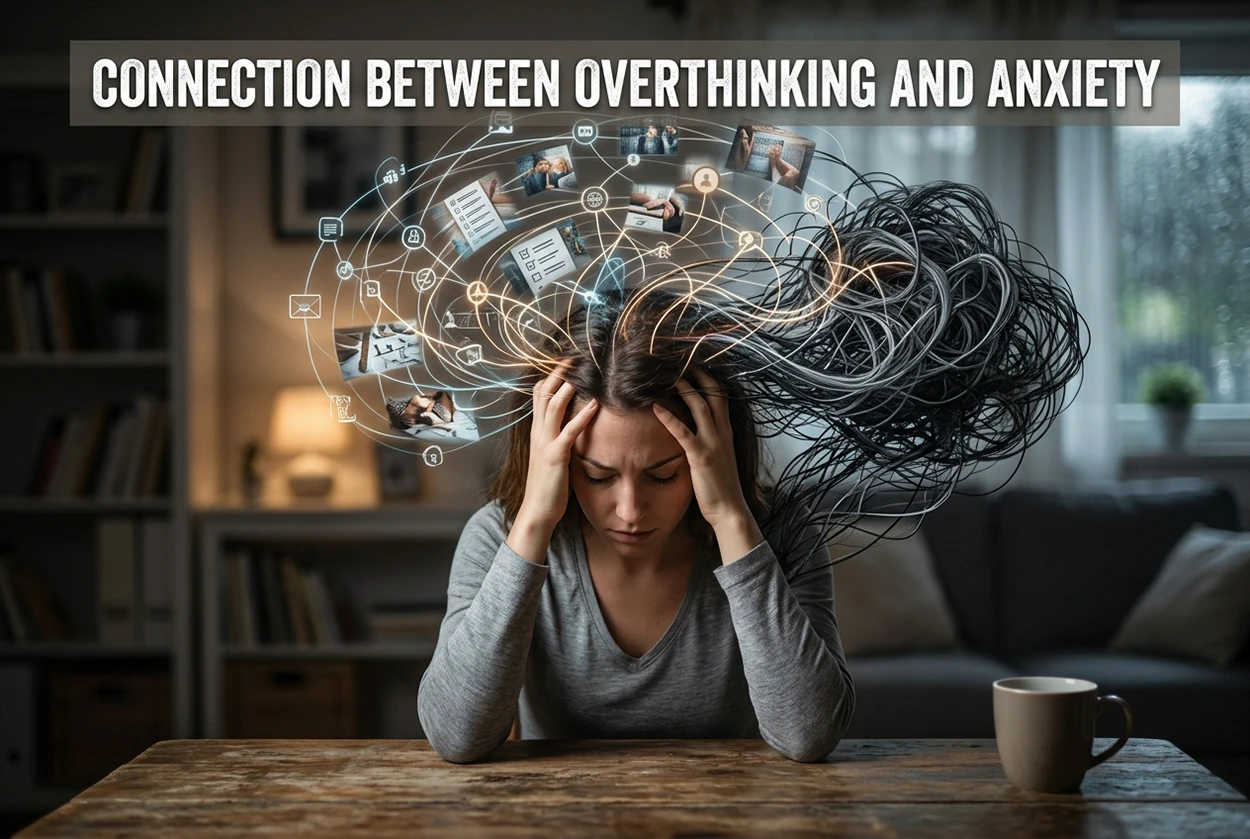
Did I say the wrong thing? What if they misunderstood me? What if something goes wrong? What should I have done differently?
One thought leads to another, and before you know it, your mind has spent hours trying to solve something that may not have an answer yet.
This is where anxiety and overthinking can become closely connected.
Overthinking is not a mental health condition on its own. All of us think deeply, revisit decisions, and worry about things from time to time. But when thinking becomes repetitive, difficult to switch off, and focused largely on possible problems or threats, it can feed anxiety and make it harder to feel at ease.
Why does anxiety make us overthink?
At its simplest, anxiety is the mind and body’s response to perceived threat or uncertainty. A certain amount of worry can help us prepare for challenges. But when worry becomes excessive or difficult to control, it can start interfering with everyday life.
Overthinking can feel like an attempt to regain control.
If I think about every possible outcome, maybe I can prevent something from going wrong.
If I replay the conversation enough times, maybe I can figure out exactly what the other person meant.
If I prepare for every possible problem, maybe I will not be caught off guard.
The problem is that the mind can keep searching for certainty long after useful thinking has ended.
You may find yourself asking the same question in slightly different ways without actually feeling any more reassured.
When thinking turns into a loop
There is a difference between reflection and rumination.
Reflection can help you understand what happened and decide what to do next.
Overthinking often keeps you inside the same question.
Something happens.
You think about it.
You imagine what could happen next.
You worry about it.
You look for reassurance.
You feel better briefly.
Then another “What if?” appears.
And the cycle starts again.
This can be exhausting because the mind feels busy without necessarily moving forward.
Over time, this kind of persistent worry can affect concentration, sleep, decision-making, and your ability to relax. These are also common experiences associated with anxiety disorders.
What does overthinking feel like?
Overthinking does not always look like obvious worry.
Sometimes it sounds like:
“I should have said something different.”
“What if they are upset with me?”
“What if I make the wrong decision?”
“Maybe I am not doing enough.”
“What if something goes wrong?”
Sometimes, it looks like avoiding a decision altogether because every option feels risky.
Sometimes, it looks like constantly seeking reassurance from other people, searching online for answers, or repeatedly checking that something is okay.
And sometimes, it simply feels like being unable to switch your mind off.
Recognising these patterns can be an important part of depression awareness and broader mental health awareness too. Anxiety and depression can overlap, and persistent anxiety can increase the risk of depression.
The relationship between stress, anxiety and depression
Stress, anxiety and depression are often spoken about together, but they are not the same thing.
Stress is a natural response to challenging situations. Anxiety can involve persistent fear or worry that feels excessive or difficult to control. Depression involves experiences such as persistent low mood or loss of interest and pleasure, along with other symptoms that can affect everyday functioning.
Yet they can influence one another.
Ongoing stress can leave you feeling overwhelmed. That can contribute to anxiety. Persistent anxiety can become exhausting, and for some people, prolonged distress can coexist with or contribute to depressive symptoms.
This is why stress anxiety depression should not be treated as interchangeable terms. Understanding the differences can make it easier to recognise when something may need more attention and support.
It is also important to remember that getting better does not always happen in a straight line. Healing from depression or managing anxiety can involve understanding the patterns that keep us stuck, building new ways of coping and having the right support around us.
How can you step out of the overthinking cycle?
The goal is not to stop thinking.
Your mind is supposed to think, anticipate and make sense of experiences. The goal is to notice when thinking has stopped being useful and has become a loop.
Separate facts from possibilities
Ask yourself:
What do I know, and what am I imagining might happen?
An anxious mind can treat a possibility as though it were already a fact. Creating that distinction can help you step back from the thought.
Ask whether the thought needs action
Some thoughts point towards something you can do.
If you are worried about an upcoming presentation, preparing for it may help.
But if you have already prepared and are repeatedly imagining everything that could go wrong, more thinking may not make you more prepared.
Sometimes, the most helpful response to a thought is not another thought. It is to return to what you can actually do.
Come back to the present
Overthinking often pulls you into the past or the future.
You replay what happened or predict what might happen.
Grounding yourself in what is happening right now—through your surroundings, your breathing, movement or a simple everyday activity—can help create some distance from the mental loop.
Give uncertainty some room
One of the hardest parts of anxiety is accepting that you cannot know everything in advance.
You may never know exactly what someone thought about your message.
You may not know whether a decision will work out perfectly.
You may not be able to predict what happens next.
Learning to live with some uncertainty can be uncomfortable, but it can also reduce the pressure to think your way into certainty.
When should you seek help?
Occasional overthinking is part of being human. But if worry feels persistent, difficult to control or begins affecting your sleep, relationships, work, studies or everyday life, it may be worth speaking to a mental health professional. Anxiety disorders are treatable, and psychological therapies can help people develop new ways of thinking, coping and responding to situations that trigger anxiety.
Therapy can provide a space to understand why certain thought patterns keep returning and learn ways to respond to them differently. You do not need to wait until your anxiety becomes overwhelming before seeking support.
If you experience a panic attack, immediate anxiety attack help can begin with moving somewhere safe and focusing on slow, steady breathing while reminding yourself that the intense feelings will pass. If panic attacks or intense anxiety keep occurring, consider speaking with a mental health professional to understand what may be contributing to them.
Looking for anxiety attack help is not an overreaction. Panic can feel frightening and overwhelming, and having support can help you understand what is happening and develop strategies for managing future episodes.
And if anxiety is occurring alongside persistent low mood, loss of interest, hopelessness or other depressive symptoms, seeking professional support is especially important. You do not have to figure out whether it is stress anxiety depression on your own. A professional can help you understand what you are experiencing and what kind of support may be appropriate.
You don’t have to believe every thought
Perhaps the most important thing to remember about overthinking is this:
A thought is not necessarily a fact.
Your mind may produce a hundred possible outcomes. That does not mean they will happen.
It may replay something you said. That does not mean you said something wrong.
It may tell you that you need to solve everything right now. You probably do not.
Learning to notice these thoughts without automatically following them can be a meaningful step towards better mental well-being.
And if you are also navigating depression, remember that healing from depression does not require you to have everything figured out at once. Progress can begin with understanding what you are experiencing, taking one manageable step and reaching out for support when you need it.
Sometimes, the goal is not to find the perfect answer.
It is to recognise that you have been asking the same question for too long – and give yourself permission to stop.
Comments
comments