

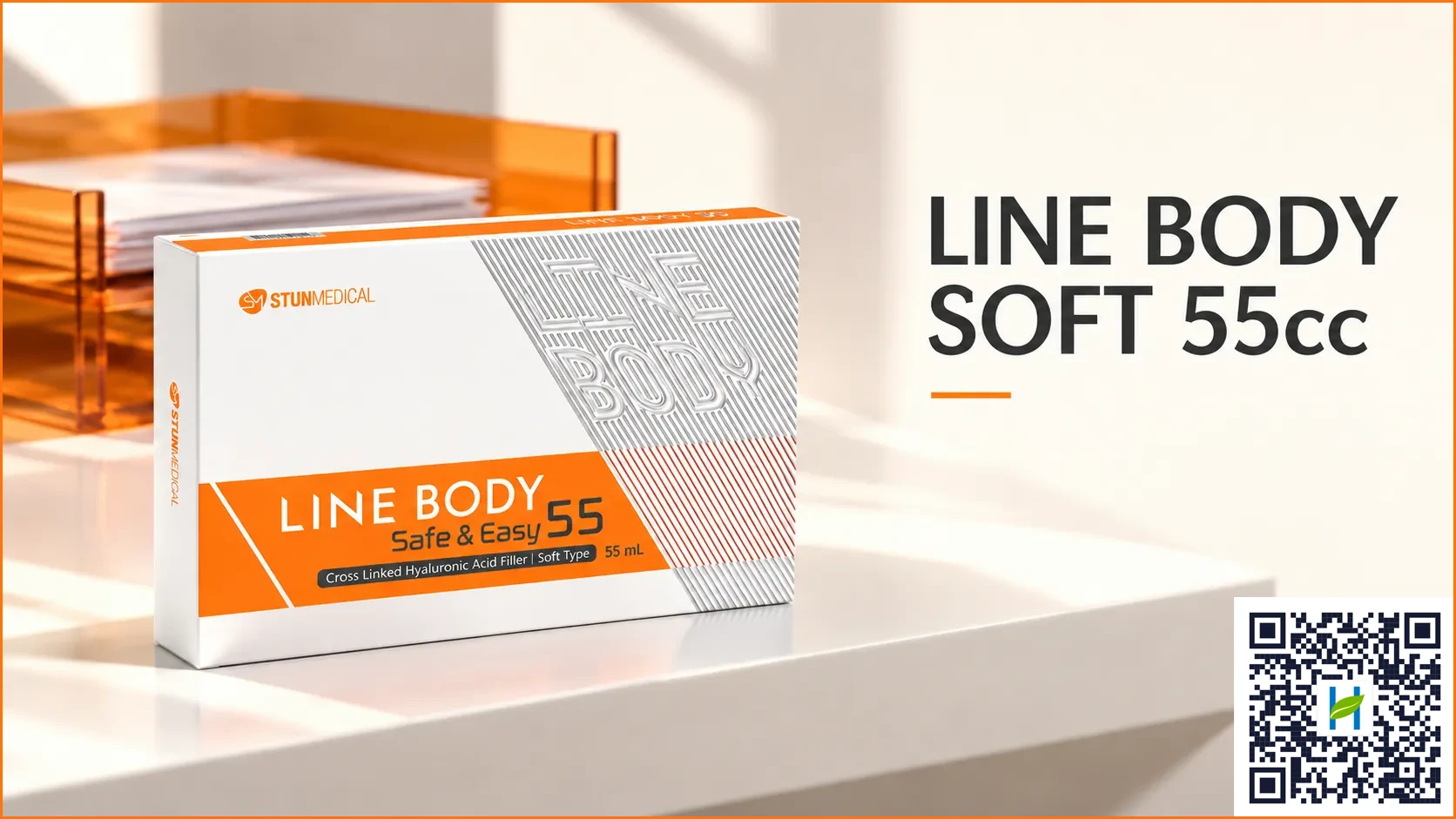
Line Body Soft 55cc belongs to STUN Medical’s Line Body range. The manufacturer describes the range as crosslinked, non-animal hyaluronic acid at 20 mg/mL and identifies Soft and Hard versions.[1] That establishes its basic material identity. The more interesting question is what a soft HA gel is intended to mean, and how that differs from the loose language often used to sell aesthetic products.
This is a discussion of the product’s material concept. In the United States, the FDA has not approved injectable fillers for body contouring or enhancement and warns that large-scale body injection can cause serious harm.[5] Understanding the chemistry is useful; it does not establish that a marketed application is authorized or appropriate.
Hyaluronic acid becomes a different material when it forms a gel
Hyaluronic acid is familiar from moisturizers, so it is easy to assume that every HA product is essentially a stronger hydration serum. Line Body sits in a different category: a crosslinked hydrogel. Its identity depends on how HA chains form a network, not simply on the presence of a water-binding ingredient.
Crosslinking connects polymer chains into a structure that influences the material’s resistance to deformation and breakdown. The resulting gel has both elastic and viscous behavior. Elastic behavior describes the tendency to recover after deformation; viscous behavior relates to flow and dissipation of energy. Research comparing HA fillers shows that these characteristics vary between formulations, even when products share the same broad ingredient category.[2]
For a reader, a useful comparison is between a list of building materials and the completed building. Knowing that two structures contain steel does not describe how they respond to a load. Likewise, “contains HA” tells us what a formulation is built around, but not its complete mechanical behavior. The network is part of the product.
This is why Line Body Soft should be discussed as a formulated gel rather than as a large container of skincare HA. The distinction explains the vocabulary around softness and shape retention. It also prevents a familiar cosmetic ingredient from making an entirely different product category seem automatically simple.
How softness elasticity and cohesion differ
“Soft” is immediately understandable as a feeling, but it is not a complete scientific description. A professional explanation should separate several properties rather than treating them as synonyms. A gel can deform readily yet remain cohesive; a material can also resist a small movement but behave differently when the force becomes larger.
Elastic modulus, often written as G-prime, is one measurement used to describe resistance to deformation in a rheometer. A higher value under comparable conditions generally indicates greater elastic resistance in that particular test. It is not an all-purpose score for product quality, comfort, or natural appearance. Fagien and colleagues examined multiple physical characteristics precisely because one number does not fully describe a filler.[2]
Cohesion asks whether a gel holds together under the conditions of a test. Flexibility asks how it deforms. These can contribute different pieces of information. Research by Faivre and colleagues introduced additional ways to examine gel strength and stretch, finding that conventional elastic modulus alone did not capture all of the larger-scale mechanical behavior they studied.[3]
For Line Body, the manufacturer publicly distinguishes Soft and Hard, but that naming does not provide a numerical comparison of their properties. It would be premature to turn the names into a claim that one version is more natural, longer lasting, or more comfortable. Those are separate conclusions requiring their own evidence.
The useful question is therefore more specific: what does softness describe here? If the answer refers to a material property, the explanation should stay at that level. If it refers to a patient experience or clinical result, the supporting evidence needs to address that experience or result directly.
Why volume and shape are different
A product’s volume tells us how much material it contains. Shape is a spatial result involving how a material behaves within a particular environment. Confusing the two creates some of the least helpful promises in aesthetic marketing: more product becomes more correction, and more correction becomes a better result, without explaining the steps between them.
Laboratory work by La Gatta and colleagues illustrates why the distinction matters. Their study of four other HA fillers examined hydration capacity, rigidity, cohesion, and degradation. The gels differed across these characteristics despite belonging to the same broad volumetric category.[4] This was not a Line Body study, so its measured values cannot be assigned to Line Body Soft.
HA gels also contain water and may take up additional water under experimental conditions. That behavior is not equivalent to a guaranteed visible increase in a person. A swelling measurement obtained in a laboratory solution should not be converted into a promised enhancement, a treatment quantity, or a forecast of final appearance.
For customers, it helps to ask what the word “volume” refers to in a particular sentence. Is it the amount inside the package, the physical behavior of a gel in a test, or an observed clinical outcome? Those meanings should remain separate. A clear explanation of the product does not require pretending they are identical.
| Term | What it describes | What it does not establish |
| Package volume | Quantity of supplied material | The amount appropriate for a person or a predictable visible result |
| HA concentration | HA mass per unit volume | Complete gel texture, durability, or clinical superiority |
| Elastic modulus | Resistance to deformation under stated test conditions | A universal ranking of natural appearance or comfort |
| Cohesion | How the gel stays together during a defined test | Absence of complications or unrestricted suitability |
| Hydration capacity | Water uptake under specified conditions | A fixed increase in visible volume after use |
What happens when a gel is moved and released
Picture a hypothetical gel sample between two laboratory plates. When the upper plate makes a very small back-and-forth movement, the network may deform while largely retaining its organization. G-prime describes the elastic part of that response: energy stored during the movement that can be returned as the load is released. The viscous part dissipates energy instead. Both can be present in the same sample, which is why HA gels are described as viscoelastic.[2]
Now imagine gradually increasing the movement. The gel may eventually leave the range in which its response stays proportional to the applied deformation. Its apparent resistance can change, and structures within the material may rearrange. A measurement made during the original small movement cannot fully describe this larger deformation. Faivre’s work explores additional measures of strength and stretch to characterize these differences.[3]
Finally, remove the load. Observe how far the sample returns toward its earlier shape, how much deformation remains, and whether it has stayed as a connected mass. Recovery concerns the elastic response and time-dependent behavior; remaining connected concerns cohesion. A gel could be readily deformable while still holding together, so softness and loss of cohesion should not be confused.
This example describes general material behavior, not a published test of Line Body. It explains why a Soft designation can be meaningful as a formulation category while still leaving several distinct properties to characterize. A complete texture profile includes response to small movement, response to greater deformation, and behavior after release.
What the Line Body Soft presentation tells you
The name 55cc refers to the marketed presentation; one cubic centimeter equals one milliliter. That number should be kept separate from the manufacturer’s 20 mg/mL HA concentration for the Line Body range. The Soft designation also needs to remain attached to the name, since STUN Medical identifies a Hard version as well.[1] These details establish which product is being discussed. They do not establish a treatment quantity, an anatomical recommendation, or an expected duration. The exact current label remains the reference when presentations differ between listings.
Line Body Soft’s core identity is therefore a crosslinked HA network in a named texture variant. The network explains why it is a gel; the Soft name distinguishes it within the manufacturer’s range; and the presentation describes the quantity supplied. Each piece answers a different question. None needs to be made into a substitute for the others.
Frequently asked questions
Is Line Body Soft just a highly concentrated HA serum
No. It is described by its manufacturer as a crosslinked HA gel within the Line Body range. That is a different material concept from a topical moisturizing serum. The network structure and mechanical behavior matter to its identity. Familiarity with HA in skincare does not make the products interchangeable or establish the same purpose.
Is Soft better than Hard
The names alone cannot establish a winner. They identify different versions, but superiority would require a defined outcome and a suitable comparison. A claim about lower stiffness is different from a claim about greater comfort or better appearance. Without product-specific comparative evidence, Soft and Hard should not be ranked as universally better or worse.
Does more HA mean a firmer or longer lasting gel
Not automatically. Concentration is only one part of a formulation. Network structure and manufacturing influence the finished material as well. Comparing products only by the HA number misses those differences. A concentration figure cannot provide a reliable estimate of duration, and it should not be treated as a general strength score.
Does 55cc tell me the result I could expect
No. It identifies a marketed quantity of material, not a personal outcome. A package size cannot establish a suitable amount, the appearance of a change, or how a gel will behave in an individual. It is a product identifier and commercial unit. Turning it into an outcome forecast goes beyond what that number means.
Does soft mean it will feel completely natural
That cannot be promised from the name. A natural feel is a personal and clinical outcome, whereas softness may refer to a material characteristic. Appearance, movement, and touch are different aspects of that outcome. Product-specific clinical evidence would be needed to support a defined claim, rather than relying on a reassuring descriptor.
Is HA automatically safe because it occurs in the body
No. A substance’s natural presence does not establish the safety of a manufactured product or a particular use. The FDA’s warning against body contouring with injectable fillers applies to the procedure category, including HA products.[5] Appropriate authorization and qualified clinical judgment remain separate from whether an ingredient is familiar or naturally occurring.
Discuss the exact gel formulation
When discussing Line Body Soft with a dermal filler supplier, keep the enquiry centered on the exact formulation and the evidence available for its material properties. Ask what supports any statement about softness, durability, or feel. A worthwhile product conversation should help a professional distinguish the gel’s verified identity from assumptions about performance, while keeping applicable authorization and patient suitability with qualified clinical decision-makers.
References
[1] STUN Medical. LINEBODY: Soft and Hard. Product Information. Undated; accessed 2026.
[2] Fagien S, Bertucci V, von Grote E, Mashburn JH. Rheologic and Physicochemical Properties Used to Differentiate Injectable Hyaluronic Acid Filler Products. Plastic and Reconstructive Surgery. 2019.
[3] Faivre J, Gallet M, Tremblais E, Trevidic P, Bourdon F. Advanced Concepts in Rheology for the Evaluation of Hyaluronic Acid-Based Soft Tissue Fillers. Dermatologic Surgery. 2021.
[4] La Gatta A, Salzillo R, Catalano C, et al. Hyaluronan-Based Hydrogels as Dermal Fillers: The Biophysical Properties That Translate into a Volumetric Effect. PLOS ONE. 2019.
[5] U.S. Food and Drug Administration. Dermal Filler Do’s and Don’ts for Wrinkles, Lips and More. 2023.
Comments
comments