

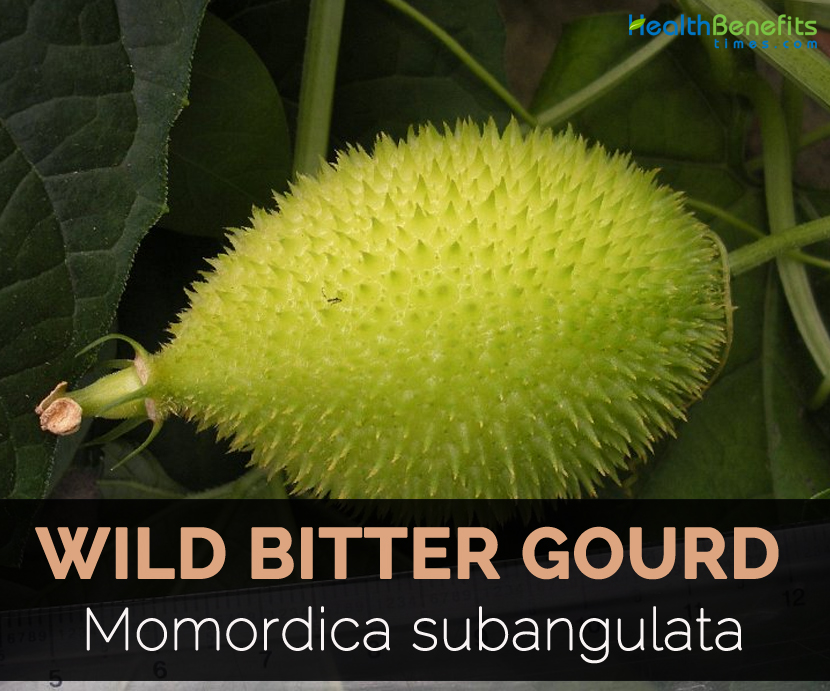
| Wild Bitter Gourd Quick Facts | |
|---|---|
| Name: | Wild Bitter Gourd |
| Scientific Name: | Momordica subangulata |
| Origin | The old World tropics – India, southeast Asia to south China |
| Shapes | Ovoid or ovateoblong, 3–7 cm, 2.5–4 cm in diameter |
| Name | Wild Bitter Gourd |
|---|---|
| Scientific Name | Momordica subangulata |
| Native | The old World tropics – India, southeast Asia to south China |
| Common/English Name | Teasel Gourd, Frog Gourd, Wild Bitter Gourd |
| Name in Other Languages | Chinese: Ao E Mu Bie, Yun Nan Mu Bie; India: Bhat Karela; Indonesia: Pare Hutan (Malay, Sumatra), Repiye Imbo (Rejang, Sumatra); Malaysia: Kambas, Peria Katak; Thai: Phak Hai, Phakmae; Vietnam: Gấc Cạnh |
| Plant Growth Habit | Dioecious, perennial scandent herb |
| Stem | Glabrous or puberulent, angular |
| Leaf | Simple, 3-5-palmately lobed, thin |
| Flower | Solitary, yellow, up to 5 cm across |
| Fruit shape & size | Ovoid or ovateoblong, 3–7 cm, 2.5–4 cm in diameter |
| Seed | Gray or yellow-brown, oblong, ovoid or globose, 7–14 mm by 5–8 mm |
Culinary uses
Young fruits and shoots are cooked in curries, boiled or steamed and eaten with chilli sauce.
References:
http://www.efloras.org/florataxon.aspx?flora_id=2&taxon_id=200022701
https://www.jircas.affrc.go.jp/project/value_addition/Vegetables/073.html
Awesome
Comments
comments